Television
The Sins of the Mother: Some Thoughts on MAD MEN’s Betty Draper
In the most recent issue of Entertainment Weekly, Mark Harris’ column, “TV’s Great Bad Mommies” was devoted to the “bad mommies” featured on Showtime’s Weeds, Nurse Jackie, and United States of Tara. These women “invite you to be appalled — because, as we all know, few guilty pleasures are as nastily satisfying as secretly ragging on somebody else’s parenting skills.” His column concludes with a nod to Mad Men‘s Betty Draper (January Jones), who “performs motherhood like a scripted role — and experiences parenting less as a fulfillment than as the steep price she agreed to pay for the life of privilege she once wanted.”
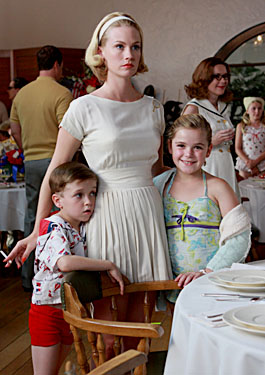
I both agree and disagree with Harris’ assessment of Betty’s approach to motherhood. While it is tempting to see her as an ice queen, as a woman who merely endures her children in order to gain access to club lunches, furs and a maid, I think this view also discounts the richness of Betty’s character. Because Don Draper’s (Jon Hamm) childhood is such a compelling mystery, it is easy to forget that Betty also experienced a traumatic childhood. Her story, like Don’s, is only revealed to the viewer in pieces.
We have learned, for example, that the late Mrs. Hofstadt was a beautiful, regal woman, but that she was also a real bitch; Betty discusses her with a mixture of reverence, fear, and resentment. Furthermore, as we discovered in last night’s episode, “The Arrangements,” Ruth Hofstadt took rather Draconian measures to ensure that her “fat” daughter lost weight (and kept it off). While sharing a tub of chocolate ice cream (with salt?) Gene (Ryan Cutrona) tells Sally (Kiernan Shipka) about how her Grandma Ruth would take her mother shopping and then make Betty walk all the way home. This parenting left an indelible mark on the adult Betty, who rarely puts anything other than vodka or cigarettes in her mouth. Oddly, Gene finds the story to be amusing, colorful even, rather than disturbing. He also urges Sally to become something other than a housewife, explaining that her grandmother did drafting work for an engineer in the 1920s. Smart women, it seems, should do things.

While this exchange exists, in part, to show some of the disdain Gene harbors for his daughter’s shallow existence, it also illustrates that he is surprisingly progressive for a man of his age and time. He sees that Betty is living a life of unrealized potential (I can’t wait for the episode in which Betty receives a copy of The Feminine Mystique [1963]) and worries that Sally, an intelligent and curious child, will grow up to do the same. “You can really do something,” he tells Sally with sudden gravitas, “don’t let your mother tell you otherwise” (I originally had a link to this scene below but it has been removed by AMC. Phooey).
After purchasing a bag of peaches for his beloved granddaughter, Gene collapses in the A & P. Sally is naturally devastated by her grandfather’s death–the only adult to take a genuine interest in her has died. Therefore, when the news is delivered to Betty by a solemn police officer, it is fitting that neither of these two adults acknowledge Sally or her grief. Instead they leave her outside to sob alone in her ballet outfit. Later, when Sally rebukes her parents and aunt and uncle for laughing over a joke (she is too young to understand that laughter is often a part of grief), Betty chastises for her for being “hysterical.” “Go watch TV, Sally,” she commands. During this exchange the mother in me longed to reach my arms through the television screen and embrace Sally. And I wondered how I was supposed to feel about Betty and Don since they did not.
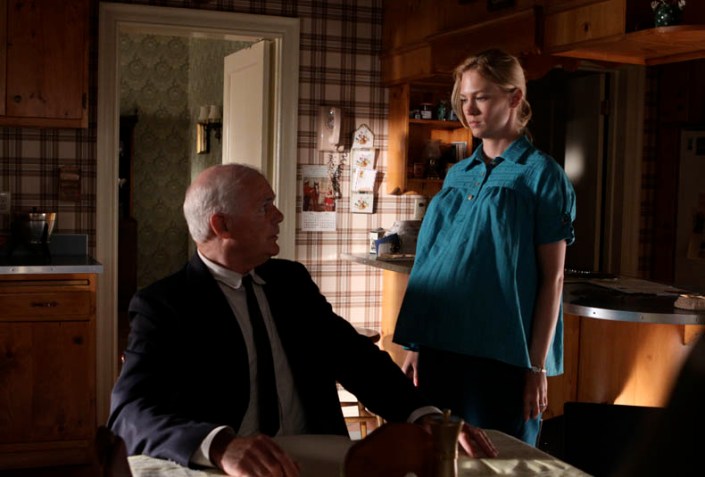
Indeed, at these moments it is difficult not to hate Betty Draper. But we must remember the lonely childhood Betty must have endured walking home from the grocery store, wiping the tears from her chubby cheeks, wondering all the while how she might gain the approval of the cold woman waiting for her at home. Betty was raised to shut herself away from food and emotion–she can’t even bring herself to discuss her father’s will with him. “Can’t you keep it to yourself?” she pleads, “I’m your little girl.”
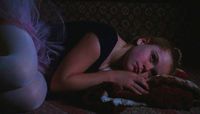
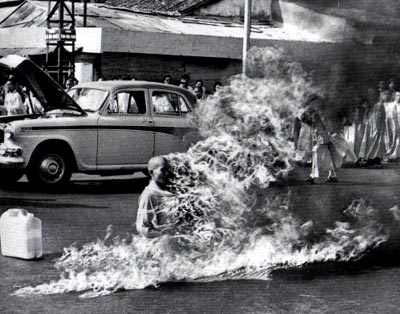
This is not an excuse for Betty’s approach to mothering, but it is an explanation. Meanwhile, Sally is left to mourn her grandfather alone in front of the television, while images of self-immolating monks dance before her eyes.
So what do you think? Is Betty meant to be a sympathetic character, or do the writers want us to hate her?
Evan Rachel Wood Ain’t MY Vampire Queen
Like many True Blood fans I was anxiously awaiting the arrival of Sophie-Anne (Evan Rachel Wood), vampire queen of Louisiana, whose existence had been leaked through various entertainment news sources weeks ago. Last week I was tantalized by the sight of her lavish home and the image of a pale female foot, bathed in a stream of blood. And as a fan of Wood, whose portrayal of a teenage terror in Thirteen (2003, Catherine Hardwicke) blew me away, I was sure that the young actress was well-equipped to handle the role of an 1100-year-old vampire queen.
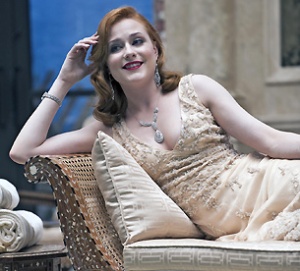
But last night I found myself underwhelmed. I don’t blame Queen Sophie-Anne’s failure on the writers–who gave her choice lines like “I haven’t been interested in men since Eisenhower was President”–or the costume designers–who gave her beautiful white gowns and bathing suits to luxuriate in (plus a vintage copy of Vogue to read!). No, this character fell flat due to Wood’s lackluster performance (though EW’s Ken Tucker disagrees with me).
Queen Sophie-Anne is supposed to be more than 1,000 years old, but Wood plays her like a precocious child playing dress up. Such a role is certainly challenging–Wood needs to convey the sense that she is an old soul even as she lives in a teenager’s body, a state of endless arrested development. But it has been done before and done well. Here I can’t help but think of Kirsten Dunst’s turn as Claudia, a mature, blood-thristy vampire trapped in the body of a sweet, prepubescent girl for all of eternity, in Interview with a Vampire (1994, Neil Jordan).
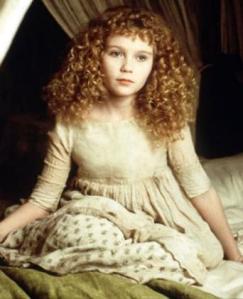
I believed Dunst’s performance–indeed, I found it to be highly disturbing. Dunst expressed her frustration with her small, child’s body and its incompatibility with her adult hungers. You could see her age in her eyes and in the way she carried her body. Queen Sophie-Anne is supposed to be elegant, regal and a commanding presence (she is the QUEEN after all) but as Wood plays her she is more like an annoying celebutante in the vein of a Paris Hilton or a Lydia Hearst. Blech.

I am not giving up on Evan Rachel Wood (girlfriend did look hot), but for now I remain unimpressed.
P.S. Not enough Eric (Alexander Skarsgard) in last night’s episode. Just sayin’.
I’m Thinking More MEAT!: Some Thoughts on True Blood, Episode 10
True Blood seems to get better with every episode that airs. When it premiered last fall I was unimpressed and was close to giving it up. My new Southern friends here in North Carolina assured me that Sookie Stackhouse’s (Anna Paquin) accent was laughable (what did I know?) and the series’ vampire plot seemed like Buffy-lite. But slowly the show found its footing. And now I’m obsessed.
I attribute much of the show’s allure to its mastery of the slow burn. What I mean is this: while many programs with rich, soapy plots (The O.C., Desperate Housewives, Gossip Girl)) rush through their storylines, anxious to bring them to a climax before audience interest wanes, True Blood is a true tease. Mysteries remain mysterious and flirtations go on and on and on (I am particulary taken by the brewing attraction between Sookie and Eric [Alexander Skarsgard]). Furthermore, we are always finding out something new about the show’s characters–they evolve and become more complex with each episode.
Maryann Forrester’s (Michelle Forbes) story arc is another great example of True Blood‘s deft storytelling technique and character development. Maryann first appeared at the scene of Tara’s car accident at the end of Season 1, cradling a pig and looking devious. The writers made us suspicious of her character then, but buried her secrets behind Maryann’s sweet, disarming demeanor. In this way we were much like Tara (Rutina Wesley); we know something isn’t right about Maryann, but what is it? That she smokes too much weed, buys too much delicious fruit, and parties too hard for a woman in her 40s?

It is not until almost halfway through Season 2 that we find out that Maryann is an immortal supernatural being and somehow tied to the god, Bacchus. She thrives on unfettered human drives like hunger, lust and violence. The scene in last night’s episode (“New World in My View”), where Maryann crafts a pyre of meat and flowers while the sounds of buzzing flies fill the air was the apotheosis of the excess she had been slowly and cannily directing all season long. It was a satisfying moment.
The best scene of the evening, however, had to be when Jason Stackhouse (Ryan Kwanten) (who really deserves an Emmy for his work this season) and Andy Bellefleur (Chris Bauer) (who will always be Frank Sobotka to me) outwit Maryann’s angry mob by outfitting Jason as the “God who comes.” These two characters are consistently portrayed as the biggest morons in the town of Bon Temps, but they are able to (momentarily) save Sam Merlotte’s (Sam Trammell) life by using their wits. So there’s something else rattling around in Jason’s brain besides the drive to drink beer, screw and kick ass? Good to know.

An honorable mention goes to Lafayette Reynolds (Nelson Ellis) (any scene with Lafayette is a great scene as far as I’m concerned), who banded together with his estranged aunt (Adina Porter) to yank Tara free from Maryann’s spell. At one point Lettie Mae prays for her daughter’s salvation but trails off in despair and, without missing a beat, Lafayette finishes her prayer. Lettie Mae turns, looking surprised. “Jesus and I agree to see other people. That doesn’t mean we don’t talk from time to time” he responds in his usual deadpan manner. So Lafayette has religion? Yet another nuance we can add to his already rich character.

And of course I would be remiss if I didn’t mention “the Queen” (Evan Rachel Wood), who Bill (Stephen Moyer) visits just before the episode ends. We see only her white leg, covered in a stream of blood, before the screen fades to black. As always, True Blood, like any good tease, leaves me wanting more.
- ← Previous
- 1
- …
- 6
- 7
 judgmental observer