Teaching this Old Horse some New Teaching Tricks

(from fanpop.com)
This semester I have experimented a lot with my teaching and classroom policies. While implementing new policies certainly adds more work (and frustration) to an already busy semester, my hope is to find the right mix of assignments and policies so that ultimately, running my class is less work and less frustration. One policy I tried out was changing my approach to student absences. In the past my absence policy has been that students could miss 3 classes over the course of the semester with no penalty. After 3 absences, I deduct 10 points (aka, a full letter grade) from their final grades for each additional missed class. Though I think this policy is quite generous, it created a lot of headaches for me. Students would be cavalier about missing classes early in the semester (missing 3 within the first 6 weeks of the semester) and then, when cold/flu season hit the campus (and it always does), they would miss even more classes and then beg forgiveness. I once had a student show up in my class looking like the Crypt Keeper. When I asked her why she came to class when she was clearly very ill and contagious she said that she had used up all of her absences and didn’t want to fail my class. Another student showed up to class drunk (very drunk) for the same reason. This led me to become the “absence judge, jury and executioner”: I would have to determine how the student would make up the additional absences in a way that was fair to the students who did the work and showed up every day . I also had to determine which truant students would have an opportunity to make up their absences. Does a sick aunt warrant missing 3 additional classes? What about a really bad break up? A court date?

from liketotally80s.com
This process is exhausting to describe and, I assure you, even more exhausting when experienced in real life. I have so much to do with my job and policing absences made me cuckoo-bananas. So this semester, after consulting with many other professors, I came up with a new plan. Students were still allowed to miss 3 classes without penalty. But then, I added this paragraph to my syllabus:
Students may “make up” missed classes by turning in a 4 page paper that describes, in detail, what was discussed in class during the missed day. This requires obtaining the notes of at least 2 classmates and piecing together the missed lecture/class discussion from these notes and from discussions with classmates (i.e., NOT me). If the missed class is a Tuesday, the paper should also discuss the reading assignment. If the missed class is a Thursday, the paper must discuss the week’s assigned film. This paper MUST be turned in within 2 weeks of the missed class. This is the ONLY way to “make up” a missed class. You must take care of obtaining notes from classmates on your own. After 2 weeks, the absence will be counted. THERE ARE NO EXCEPTIONS TO THIS POLICY.
This semester I had approximately 30 students and in that entire group, only 2 students missed more than 3 classes. One of the students missed many classes early on and took it upon himself to withdraw from my class. He actually apologized for his truancy and then said he hoped to try to take my class again in the future. There was no whining or pleading (and there usually is in these situations). He took responsibility for absences and removed himself from my classroom. I was actually shocked by how maturely my student handled the situation — it was kind of like interacting with a real adult! The 2nd student, who missed 4 classes, just turned in his make up paper. Again, this student did not attempt to make excuses for the classes he missed. He just turned in his paper and that was that. I say this because I have never had a semester at East Carolina University where students have attended classes so regularly. I could attribute this to the fact that I taught 2 upper-level seminars filled almost entirely with film minors who were invested in the class and its material — that probably helped. But I also think that having an absence policy that removed the weight of policing student attendance from my shoulders to their shoulders may have also helped. I also think that I have been making the mistake of coddling my students a bit too much. If I start treating them more like independent adults, they will act that way. Or at least, that is how it went down this semester.
The other change I made this semester was to the way I managed the students’ reading assignments. I had been finding that even in classes filled with my best students, there was a reading problem. That is, students weren’t doing the weekly reading assignments.
It got so bad last semester that I finally just asked my students point-blank “Why aren’t you reading?” And they told me. They felt the reading assignments were either too long or they didn’t see the need or value in reading them on the days when I didn’t go over the reading in detail in class ( in my day we did 50 pages of reading for a class, the professor didn’t discuss it with us and WE LIKED IT! but I digress….). So I listened to this feedback and changed things up. This semester I taught shorter essays (10-20 pages tops) and I also required the students to compose 3 tweets about the week’s reading and post them to Twitter every Monday, using the course hashtag. Here is an excerpt from the assignment I handed out at the beginning of the semester:
Guidelines for Twitter Use in ENGL3901
General Requirements
-You must post at least 3 tweets each week by 5pm every Monday (the earliest you may post is AFTER 5pm on the previous Monday)
For example:
-you must read the following short pieces by Jan 22 [Geoffrey Nowell-Smith “After the War,” pp. 436-443; Geoffrey Nowell-Smith “Transformation of the Hollywood System,” pp. 443-451]
so the tweets about that reading are due anytime BETWEEN 5pm on Jan 15th and 5pm on Jan 22
-You may do all 3 tweets in one sitting or spread them out over the course of a week
-All tweets MUST include the hashtag #E3901 so that the class (and your professor) will be able to see them
-All tweets must contain at least one substantial piece of information on or about the week’s reading assignment
As with the adoption of any new technology, there was a learning curve involved in using Twitter for classroom credit. Over half the students had never used Twitter before and therefore were not accustomed to its 140 character limit. I also had to send out weekly reminders for the first few weeks of class. But by the end of the semester I was surprised to see that the students kept up with this assignment and that they were actually processing the reading in useful ways. Being forced to take a complex idea and express it in 140 characters forces the student to engage with the material more deeply than if s/he had simply read the assignment and then put it down (or not read it at all!). I also think that having to account for their reading labor (and it IS labor) publicly — to the professor and to classroom peers — made the students realize the value and importance of the weekly reading assignments.

I actually wrote about this experience — as well as my experiences using blogs in the classroom — in a new short piece over at MediaCommons. If you’d like to learn more about the value of social media in the media studies classroom, you can click the link below. Please comment!
Click here to read “Mind Expanders and Multimodal Students”
So while instituting new policies has been time-consuming — both in planning, executing and documenting — overall, I am really happy with the results. I have a tendency to “mother hen” my students. I check in and remind them of deadlines, I poke and prod, and ultimately I wear myself out. I think I must wear them out too. Both the new absence policy and the incorporation of Twitter to encourage reading in the classroom has shifted some of those burdens from my shoulders to my students’ shoulders (where it belongs). This was most apparent when I realized that no one had emailed me this semester to explain why s/he had missed class and why I should count a particular absence as “excused” (in my class there is no such thing as an “excused” absence, unless the university tells me so). I feel like students took more ownership of attendance and engagement with their reading assignments. When I teach a 100-person Introduction to Film course this fall (a course with a notoriously high absence rate and low reading engagement rate), I will be interested to see how these new policies work. Til then though, I am going to go ahead and give myself a soul clap:

“To Dance Again!”: Affect, Genre, and the HARRY POTTER Franchise

This week I attended the annual Society for Cinema and Media Studies conference in Chicago. I decided to share the paper I presented there as part of the panel, “Affect in the Age of Transmedia Storytelling” on this blog in an effort to make research that was presented to just 20-25 people (not a bad turn out for one of the first panels of the 5 day conference!), available for a wider audience. My paper was originally titled “‘Falling in Love with Hermione Granger’: Affect, Genre, and the Harry Potter Franchise” but I ultimately did not have time to discuss the song, “Granger Danger” in this brief paper (a note that drew at at least one “Booooo!” from the audience when announced), so I changed the title for this post to reflect that omission.
To watch “Granger Danger” start at the 2 minute mark
Other than the title change and some added clips (yay internet!), the paper below is what I presented last Wednesday. I welcome any feedback.
********
“To Dance Again!”: Affect, Genre, and the Harry Potter Franchise
I want to begin this discussion of affect in the transmedia franchise by discussing a scene from A Very Potter Musical, a full length stage musical written, directed and performed by a group of University of Michigan performing arts students and recorded and broadcast online via YouTube in 2009. The show has 14 original numbers and over 9 million page views. The scene you are about to watch is a recreation of a significant moment from JK Rowling’s Harry Potter and the Goblet of Fire –when Lord Voldemort finally reclaims a human body after more than 11 years of painful disembodiment. What is the first item on Voldemort’s evil agenda? Why, to dance of course!
Begin watching “To Dance Again!” at the 3 minute mark:
In this number Voldemort usefully describes how music can compel the body to dance, even when the brain rejects the idea:
“The other boys would laugh and jeer
But I’d catch em tappin their toes.
‘Cause when Id start to sway
they’d get carried away.
And oh, how the feeling grows…”
These lines—and the whole number for that matter, highlight the relationship between affect and music—how the compulsion to sing or dance is frequently pre-cognitive.

In “Serial Bodies,” Shane Denson defines affect as “the privileged but fleeting moments, when narrative continuity breaks down and the images on the screen resonate materially, unthinkingly, or pre-reflectively with the viewer’s autoaffective sensations.” Denson then goes on to cite Linda Williams’ famous essay on body genres, “Film Bodies: Gender, Genre, and Excess,” in which she argues that when watching horror films, pornography or melodramas, “the body of the spectator is caught up in an almost involuntary mimicry of the emotion or sensation of the body onscreen” (144). Though Williams makes a passing reference to musicals in her list of potential body genres, the musical is rarely discussed in terms of its relationship to affect. However, the instinct to sing or dance to a catchy tune is frequently takes place just before our conscious mind reminds us that such an impulse could lead to public humiliation.

http://www.guardian.co.uk/film/2012/oct/29/horror-movies-help-burn-calories
I am also using affect in this talk to reference the very real emotional connections between fans and the texts they love. In fact, the syntax of the musical favors emotion in that the genre’s most valued characters are those who sing and dance because they love it so much–because the pure bliss of performance cannot be resisted. Those characters who sing and dance purely for money or who overthink their art are usually proven to be villains, or at the very least, in need of reformation.
For example, in The Bandwagon (1953), Jeffrey Cordova (Jack Buchanan) is only able to create a successful show when he stops aiming for “high brow” status and just makes a show filled with music and dance:
So what does a singing and dancing Lord Voldemort have to do with transmedia franchises and affect, the subject of today’s panel? By translating key plot events from the Harry Potter franchise into musical numbers, I am arguing that A Very Potter Musical transforms the fantasy franchise’s key opposition between good and evil to the musical’s own preoccupation with joie de vivre over monetary gain. In her study of Roswell fandom and genre in fan discourse, Louisa Stein argues that fans “use generic codes as points of identification with story and character, making fictional narratives and characters personally meaningful or resonant through processes of genre personalization” (2.4). Likewise for fans of the musical, A Very Potter Musical offers an affective entry point into the vast narratological universe of Harry Potter, making the franchise more personally meaningful. This is not to say that Potter films and books don’t generate affect in their audiences, but rather that the structures of the musical create new opportunities for affect among Potter fans (and of course, for Potter fans who dislike musicals, AVPM will not provide any form of engagement because they won’t seek it out).
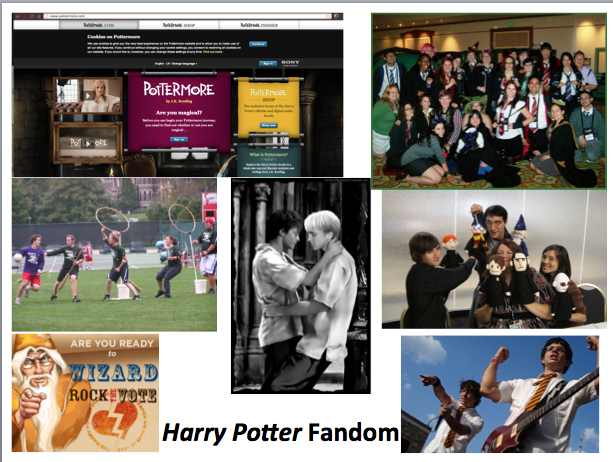
As a transmedia franchise that includes 7 novels, 8 blockbuster films, a Disney theme park, toys, videogames and countless other product tie-ins, Harry Potter fandom is necessarily broad, heterogeneous, and expressed through a range of media platforms: thousands of fan-created websites, newsletters, slash, conventions, a thriving genre of Harry Potter-themed rock music known as “wrock,” and even an activist group known as the Harry Potter Alliance. A Very Potter Musical, which seems to straddle the spaces between fan fiction, wrock, and possibly even filk, disguises its budget limitations with winking musical performances, self reflexivity, and the unabashed passion of its actors. Fan love fills in production gaps and adorns the visible seams of this otherwise amateur production. The lengths that fans will go to express their adoration for a beloved text have been well-documented by fan studies scholars like Henry Jenkins, who describes fan fiction as “a celebration of intense emotional commitments and the religious fervor that links fandom to its roots in fanaticism” (251). Thus for scholars of fan studies, AVPM is nothing new. However, for a scholar of film genres like myself, the show is quite useful for understanding the role that genre—specifically the musical–plays in the relationship between fandom, transmedia franchises and affect.
Watch Darren Criss (Harry Potter) and Joey Richter (Ron Weasley) perform “Goin Back to Hogwarts” with some fans. Note the moment when the fans chime in at the 55 second mark and Darren Criss’ reaction:
One way that AVPM creates an intimate relationship between fan and text is by transforming the multibillion dollar Harry Potter transmedia franchise—the ultimate form of mass culture–back into folk culture. Whereas folk art is an expression of the community who is also its audience, mass art is disseminated to its audience already made, articulating its values for them. However, as so many fan studies scholars have noted, fan fiction allows fans to convert mass culture back into folk culture. I would add that by explicitly relying on the syntax and semantics of the musical, AVPM is even more adept at creating the sense that mass art is folk art. Jane Feuer argues that: “In basing its value system on community, the producing and consuming functions served by the passage of musical entertainment from folk to popular to mass status are rejoined through the genre’s rhetoric” (3).

For example, film musicals often offer up images of the diegetic audience to compensate for the “lost liveness” of the stage, serving as a serving as a stand in for the film audience’s subjectivity (27). Many Hollywood musicals include a diegetic audience that cues the non-digetic audience in about how to feel about a performance—if they clap and cheer, the performance was successful. If they sit silently in their seats, the performance was a bust. A similar effect is created when watching the streaming video of the live stage performance of AVPM. As you heard in the “To Dance Again!” number, the laughter, applause, and hoots of appreciation stemming from the live, diegetic audience solidifies the non-diegetic audience’s understanding that these low budget performances are, in fact, successful — even when it is difficult to hear some of the actors’ lines and jokes are lost. This is especially important for something broadcast over the internet, since most viewers of AVPM are likely watching on their computer screens, alone. The diegetic audience thus serves as a viewing companion, reassuring us about when to laugh or applaud.

Likewise, Feuer argues that many musicals include characters who are not supposed to be professional singers and dancers but who instead sing and dance for the love of it. This use of “amateurs” gives us the feeling that stars are singing and dancing on screen because they love to, not because they are being paid to do so. By masking this professionalism, the musical’s performers are closer to us, the amateurs in the audience. AVPM offers a similar experience, only the performers we are watching really are amateurs in that the show itself is a labor of love rather than a profit-generating venture.

This feeling is bolstered by the show’s shoddy production values. For example, in Harry Potter and the Sorcerer’s Stone, the evil Lord Voldemort attempts to revive his body by attaching what little remains of his soul to the simpering Professor Quirrell. In the book, and even more so in the film adaptation, this melding of two men—skull to skull–is a horrifying spectacle. However, in AVPM the inability to create a CGI monster and the need to improvise becomes one of the show’s best gags.

We marvel, not at Rowling’s fantastical prose nor at the wonders of CGI, but at the cleverness of the students who have put on this show.
Watch the big reveal here:
When watching AVPM the amateurish costumes and sets, the imperfect sound and image quality, and the occasional mistakes, lets us know we know we are watching Harry Potter fans who are just like us—rather than seasoned professionals. Such moments work, to quote Feuer again, to “pierce through the barrier of the screen” (1). So while AVPM is not spontaneous (clearly it was rehearsed and well though-out), its imperfections create the feeling of spontaneity, which is so central to the task of making mass art appear as folk art. Furthermore, Glen Creeber argues that the rawness of online video and the solitary viewing conditions it generates creates a sense of intimacy and authenticity not found in cinema or television. He argues that the “homemade” aesthetic of webcam images creates the “profound intimacy of the image” (598).
Watch Harry Potter face off with a Hungarian Horntail at the 1 minute mark:
In addition to creating intimacy between fan and text, A Very Potter Musical—due to the genre’s focus on the joys of song–creates an affective relationship between viewer and text. For example, in Harry Potter and the Goblet of Fire, Harry Potter’s participation in the Triwizard Tournament leads him to engage in battle with a Hungarian Horntail, a fierce breed of dragon. Harry ultimately defeats the Horntail with his exceptional broom-flying skills. And in the film adaptation, we get to see this fantastical scene come to life through the magic of CGI. However, in AVPM, Harry defeats the dragon by summoning his guitar, not his broom, and then by performing an emo ballad about the futility of hand-to-hand combat entitled “Hey Dragon”.
Watch the number here:
The song concludes with the lyrics:
“I can’t defeat thee
So please don’t eat me
All I can do
Is sing a song for you.”
The dragon is eventually lulled to sleep by Harry’s song. Harry thus relies on the power of music—rather than magic—to win a seemingly insurmountable challenge. So while this musical number is a practical way to disguise the absence of state of the art special effects, it also highlights the way that music can impact the body, turning a fierce dragon into a purring kitten. The consumption of spectacle is a pleasure central to the Potter franchise but in AVPM these are replaced with the pleasures of musical performance.
Like most examples of fan fiction, AVPM also highlights aspects of the Potterverse that may not be apparent in the novels, films and officially licensed paratexts, but which fans desire. For example, in the books, secondary character Ginny Weasley is defined almost entirely in relation to her older brother, Ron, and her love interest, Harry. Likewise, Ginny’s romantic relationship with Harry is primarily understood through Harry’s point of view. For example, in Harry Potter and the Half Blood Prince, Rowling describes Harry’s budding feelings for Ginny in this way:

Likewise, the films cue us in to Harry’s desires via longing close ups or by frequently putting Ginny in a position to be rescued by Harry. This is such a prevalent plot twist, in fact, that wrock band Harry and the Potters wrote a song about it:
The fan knows little of Ginny’s interiority, other than through bits of dialogue or the occasional longing glance at Harry:

In AVPM, however, Ginny performs the torch song “Harry,” which puts a literal and metaphoric spotlight on what it feels like to be in love with the Boy Who Lived.
Watch “Harry” here, performed by Ginny Weasley (Jaime Lyn Beatty)
Ginny’s moving performance, in which she dances awkwardly with Harry’s guitar—a proxy for her absent love object—provides a renewed emotional connection with this secondary character. And Ginny’s performance—which is passionate but imperfect as she struggles to hit her big notes—creates an affective relationship with this character that may not have been possible when watching the Potter films. The goosebumps that appear on my arms as Ginny sings, are a testament to the way that music generates an affective viewing experience.

Here again we can see how the choice of genre—the musical—allows Potter fans an entry point into the transmedia franchise that is personal and intimate. Indeed, there are numerous covers of “Harry” on YouTube, a testament to the way that AVPM allows Potter fans a different, more embodied way, to express their fandom.
Watch my favorite fan covers of “Harry” here:
One thing all of these performances share is a nervous, almost giddy, sense of joy—we can trace the joy expressed in the original AVPM performance as it is then translated and transmuted through each fan video—a domino effect of pure love. Likewise, the comments on each video are generally supportive, with the Potter fan community coming together to support each new iteration of the original fan text.

In this way, AVPM fandom appears to mimic that of the wrock community. Suzanne Scott argues that wrock, unlike filk, “mimics a conventional performer/audience dialectic rather than a collective creative enterprise when performed.”

Although there is a separation between performer and audience here, I believe that the significance of AVPM lies in the affective relationships it facilitates between fan and text, even if the text’s various performers are performing online with one another, as opposed to face to face in a filk song circle.

In conclusion, A Very Potter Musical translates the fan’s love of the Harry Potter storyworld and its characters into a series of musical numbers that fans can then sing themselves. By depicting bodies that must express themselves through song and dance, A Very Potter Musical is an ideal venue for understanding the importance of affect in fan fiction. AVPM demonstrates the way that mass culture can be transmuted back into folk culture, thereby offering fans of the transmedia franchise a personalized, emotional engagement.

Works Consulted
Creeber, Glen. “It’s Not TV, it’s Online Drama: The Return of the Intimate Screen.” International Journal of Cultural Studies 14.6: (2011): 591-606
Denson, Shane. “Serial Bodies: Corporeal Engagement in Long-Form Serial Television.” Media Initiative 22 Feb 2013 http://medieninitiative.wordpress.com/2013/02/22/serial-bodies/
Feuer, Jane. The Hollywood Musical, 2nd Ed. Bloomington: University of Indiana Press, 1993.
Jenkins, Henry. 2012. “‘Cultural Acupuncture’: Fan Activism and the Harry Potter Alliance.” In “Transformative Works and Fan Activism,” edited by Henry Jenkins and Sangita Shresthova, special issue, Transformative Works and Cultures, no. 10. doi:10.3983/twc.2012.0305.
——-. Convergence Culture: Where Old and New Media Collide. New York: New York University Press, 2006.
———. Textual Poachers: Television Fans and Participatory Culture. New York: Routledge, 1992.
Rowling, JK. Harry Potter and the Half Blood Prince. New York: Scholastic Inc., 2005.
Scott, Suzanne. “Revenge of the Fan Boy: Convergence Culture and the Politics of Incorporation.” Diss. University of Southern California, 2011. Online.
Stein, Louisa Ellen. 2008. “Emotions-Only” versus “Special People”: Genre in fan discourse. Transformative Works and Cultures, no. 1. http://journal.transformativeworks.org/index.php/twc/article/view/43.
Tatum, Melissa L. 2009. “Identity and authenticity in the filk community.” Transformative Works and Cultures, no. 3. http://dx.doi.org/10.3983/twc.2009.0139.
Williams, Linda. “Film Bodies: Gender, Genre and Excess.” The Film Genre Reader III. Ed. Barry Keith Grant. Austin: University of Texas Press, 2003. 141-159.
Smash Talkin: A Roundtable on the SMASH Season 2 Premiere

http://www.justjared.com/2012/11/20/katharine-mcphee-jennifer-hudson-smash-season-2-trailer/
This roundtable, focusing on the season 2 premiere of NBC’s Smash (which aired on February 5th), arose in response to a recent article “How “Smash” Became TV’s Biggest Train Wreck” by Kate Arthur. Though the article accurately addresses many of the problems in Smash’s first season (Emory Cohen’s dead performance as marijuana addict, Leo, Ellis’ unexplained and over-the-top villainy, Debra Messing’s scarves), it also pins most of the series’ failures onto the Season 1 showrunner, Theresa Rebeck (who apparently also likes scarves). So one goal of this roundtable was to identify what changes, if any, have been made to season 2 with its new showrunner, Josh Safran (of Gossip Girl fame).
Another question that was raised by those of us who read this article was: was Smash’s first season really “TV’s Biggest Trainwreck” or are the people who watch (or rather who “hate watch”) Smash simply unaccustomed to rhythms of the musical? The six academics participating in this roundtable are all fans of the musical genre and therefore, never saw Smash’s narrative as a failure since we were never watching the show for its narrative in the first place. But are great numbers enough to keep viewers around for season 2? Let’s find out…
***
The roundtable started off discussing what was great about the season 2 premiere:
Overall Narrative Structure

Image source:
http://classicmoviechat.com/?tag=mickey-rooney
Alfred Martin: I do like that they’ve seemed to cut out all the extraneous plot and really focused in on the show and aren’t dinking around with Julia’s (Debra Messing) marriage. And thank GOD they seem to have gotten rid of her HORRIBLE son (Emery Cohen).
Kyra Hunting: I understand that many people feel that the show didn’t work because of the narrative or that the show worked despite the narrative on the strength of the musical numbers, cast, etc. But here is the thing: I LOVE the narrative – and so do many of my colleagues who are big fans of classical Hollywood musical. I feel like the disconnect for many is that a musical narrative logic is being imposed on a television environment. At its core I feel like Smash is a sexed up, knives out version of a Judy Garland/Mickey Rooney musical – New York is a pretty big barn – but hey lets put on a show!
No More Scarves
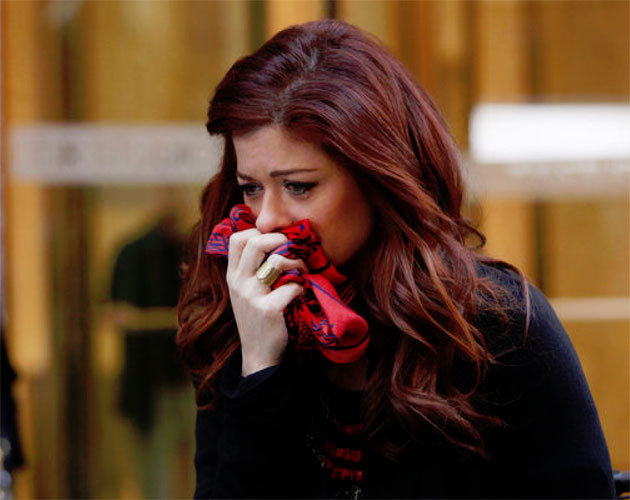
Image source:
http://ca.omg.yahoo.com/blogs/omg-tv/smash-overhaul-continues-rid-scarves-182623707.html
Amanda Ann Klein: I wasn’t all that bothered by Julia’s (Debra Messing) scarf-wearing in season 1 but now that her scarves are gone I like Julia more. Coincidence? I think not.
Jennifer Lynn Jones: I honestly never noticed the scarves either, although I feel that I subconsciously registered that the costume designers were signifying that Julia was approaching “a certain age.” Thinking back on it now, that and some other Julia plot points are bugging me, like too many offstage domestic dramas being heaped on her plate. And why can’t Julia be reaching “a certain age” and still be fabulous? Maybe scarfless Julia will be. Maybe that’s something to look forward to.
Alfred: I never noticed the scarves either. I find it interesting that (and I can’t remember from last season if) Debra Messing got top billing last season.
Amanda: Her scarves got top billing.
Jennifer Hudson

“Then maybe you better hit the road?”
Image source:
http://www.salon.com/2013/02/05/hate_watching_smash_is_one_of_lifes_great_pleasures/
Amanda: The best number of the night was definitely Jennifer Hudson’s first number, “Mama Makes Three,” in the musical within a musical, Beautiful (though I thought it was hilarious that Karen [Katherine McPhee] described Hudson’s character in the show as “this sweet 1950s Aretha/Etta James type but she has this really overbearing mother.”). I personally love musical numbers that are set on an actual stage and this one was really fun: costumes, dancers, etc. This is what I want from my musicals! All I wrote in my notebook during this number was “WOMAN CAN SING.” On a related note, Katherine McPhee must never ever, ever sing another duet with Jennifer Hudson (“On Broadway”). Never.
Jennifer: I agree! Just hearing J.Hud in the previews for the next episode gave me chills.
Alfred: Why does the black lady have to be connected to Aretha Franklin and Etta James? But Jennifer Hudson looks and sounds AMAZING (I’ve loved her since her days on American Idol). The first scene shown seems to suggest that she is starring in a “black” musical, which I think is really interesting given this show. Really? She’s getting ready to star in a revival of The Wiz? This role seems to be trading on clichés big time, particularly with this character. The song “On Broadway” should just simply be barred from anyone singing it ever. It’s a horrible song that is locked in its specific temporal moment (and I always see the opening of All That Jazz in my head whenever I hear it). Also, her character doesn’t seem to be integral to the story. I’ll be really interested to see how (and if) they integrate her more deeply into the story.
Sad Julia & Sad Derek

Image source:
http://www.salon.com/2013/02/05/hate_watching_smash_is_one_of_lifes_great_pleasures/
Amanda: I’m glad Julia is getting a divorce and I’m glad that Derek (Jack Davenport) is realizing that maybe women only sleep with him because their jobs depend on it.
Alfred: For me, it’s less about getting rid of the scarves and more about them having gotten rid of her husband, Frank (Brian D’arcy James). As much as I liked Brian D’arcy James in Next to Normal on Broadway, he was underutilized and annoying as hell in Smash. I’m not sure about them going down this Will & Grace retread with Julia and Tom (Christian Borle) planning to live together.
Kelli Marshall: I kinda like that Derek is realizing this too, but that “Robert Palmer” number was just…too much.
Jennifer: No, the Palmer-style Eurythmics song did not work for me either, but can we really imagine a kinder, gentler Derek? And would we really want one? Dickishness is half his charm, the rest obviously being accent and scruffy hair. I think he does a good job with that bad boy charmer role. As director, he rides the line between leader and villain well.
Kyra: Derek without Dickishness and arrogance hardly seems like Derek at all. It seem odd to me that this never occurred to him before and while I really like him having to deal with the consequences of his actions, I don’t want him to become a saint.
Amanda: I agree the “Would I Lie to You?” number was odd. But I believe it was the only “fantasy” number in the first two episodes of season 2 and so for that reason, I was glad to see it. I read somewhere that the show is trying to get away from these numbers, as they are the ones most likely to turn off audiences who don’t like musicals. I think that if you view a spontaneous Bollywood number ( “A Thousand and One Nights”) as odd simply because it was inspired by the eating of Indian food (to name one example of a fantasy number that was skewered by fans last season), then you probably don’t like musicals all that much. So why are you watching this show then, haters? Musicals need the flimsiest of excuses to launch into a number. This is the point of a musical, no? I really enjoyed Karen’s Bollywood fantasy number from Season 1. If you can get past the ethnocentrism of the piece, it had all the elements of a great number: beautiful costumes and make up, fun choreography, and loads and loads of performers. I thought it was aware of its own campiness and embraced it. I loved it. Click here to watch.
Kelli: I like the way you think, Klein! I’ve repressed my love for and enjoyment of the Bollywood number on The Twitter Machine (and the like) so I would not be reamed in public. I did, however, show it to my Cinema History course last spring when we discussed America’s appropriation of Bollywood. Also showed a Zumba workout video, if you’re interested. 😉
Megan Hilty

Image source:
http://www.salon.com/2013/02/05/hate_watching_smash_is_one_of_lifes_great_pleasures/
Amanda: Hilty’s last number, “They Just Keep Moving the Line,” performed at the Generic Theater Association Event (you know, the one filled with “Broadway Bigwigs”) was amazing. I will sit through 90 minutes of bullshit narrative to hear this woman sing.
Kelli: Indeed, girl. Indeed. Hilty ain’t messin’ around.
Jennifer: Yep. I wasn’t always on Ivy’s team, but this and all the sorrow they’re heaping on her now are definitely getting me there.
Kyra: I never disliked Karen the way many did, but I do think the best possible thing about the stupid Hipster musical is Karen could move on to that, the sort of Songs For A New World thing her voice might work for, and Ivy could finally go back to being Marilyn. Derek splitting these two projects might be interesting to and would take Karen/Ivy’s rivalry in a novel direction.
Alfred: I really disliked Ivy until two things happened: One, it was revealed that her TV mother is Bernadette Peters; Two, she became one of the more complexly-written characters on the show. And she is really acting the crap out of that character. And indeed, this episode started when she SLAYED that song. That voice?!?!?!?
The Bad
Katharine McPhee
Amanda: I loved McPhee during her season of American Idol, maybe because she performed mostly pop music? But on Smash, which is mostly focused on broadway music, her voice just never sounds as strong as it needs to be. It’s almost impossible to believe that she would be cast in the lead role of Bombshell, over Megan Hilty. I don’t buy the excuse that she is Derek’s “muse.” Or does “muse” just mean “someone I want to screw”? If so, she is totally Derek’s “muse.” That plot, which was so central to season 1, was always the most problematic one for me. But it seems like that will be less of an issue for this season, which is a plus.
Jennifer: I’ve had several conversations with different people about McPhee’s character Karen, though, especially comparing her to Ivy. Most people I’ve spoken to about the contrast between Karen and Ivy don’t seem to get why Karen would even be in the running against Ivy, something that Rachel Shukert brought up during Julie Klausne’s special Smash-themed podcast episode “How Was Your Smash.” Ivy seems to look so much more like Marilyn Monroe, and has those great Broadway pipes to boot. However, there’s a certain vulnerability in Karen that I think really resonates with Monroe and often gets overlooked, so for that reason, I’ve pretty much been pulling for Karen all along. However, I found her whinier and more cloying in these first two episodes, so we’ll see how it goes for the second season.
Kyra: Jennifer, I really really share some of your feelings about Karen and her vulnerability. I saw below that she is Norma Jean, and Norma Jean after all was the core that made Marilyn so appealing. I also think the assumption that her voice couldn’t be a broadway one depends on a pretty narrow understanding of a broadway voice. Ivy definitely has the more traditional belt but I’ve certainly seen modern musicals with the quieter/poppier sound that Karen has. Nonetheless, I think this has been such a flashpoint for people, and so often used to deny realism, that breaking the Ivy/Karen Marilyn competition might be necessary.
Amanda: Well said, Jennifer and Kyra. I understand this reasoning but for me, broadway numbers are about being BIG! BIG! BIG! I want big emotion, big drama and big pipes. This is why I was so disappointed with Anne Hathaway’s performance of “I Dreamed a Dream” in Les Miserables ( 2012, Tom Hooper). [http://vimeo.com/57307781] Her voice sounded pretty and her acting was moving but I don’t care about all of those things when I’m listening to that song. When Fantine sings “I Dreamed a Dream” I want it to bore into my soul: I want her pain and rage over her lover’s betrayal and consequences of that betrayal to crescendo into a big, full throated burst of song. I don’t want quiet in my musicals. One exception: Once (2006, John Carney)
Alfred: I’m just happy that the other characters have stopped calling McPhee “Iowa.” I kind of think she makes sense as Marilyn because she has a kind of lightweight, breathy voice that I think is more suited for what the role is in my head and seems to be more “realistically” (as if that word even makes sense in the world of Smash) rooted in the person she is supposed to be portraying. All that having been said, I just don’t think McPhee is ready for the role she’s been thrust into. For me, she just doesn’t have the chops to carry a show (or the show within the show).
Karen’s Hipster Love Interest

Image source:
http://www.broadway.com/buzz/163179/get-a-first-look-at-newsies-jeremy-jordan-and-katharine-mcphee-on-the-steamy-set-of-smash/
Amanda: What singer/songwriter living in New York City and working on composing a musical doesn’t want people to hear his work, especially when those people are in a position to help him? Jimmy (Jeremy Jordan) tells Karen “I write for myself” and “I don’t need other people to tell me I’m good.” Ridiculous. I declare shenanigans on this hipster character.
Jennifer: This guy? Too much. The fact that they namecheck The Strokes, even just to mock Karen, gives the tell that these writers don’t know from hipsters. And how many hipsters are writing musical theater anyway? Nonetheless, I do like the idea of having more than one musical being staged for the show, and I love the idea of these shows competing against each other. That seems fitting for Broadway in a sense: competing for space, competing for talent, competing for attention and audiences. And if the new musical brings in more songs, ALL THE BETTER.
Alfred: More importantly, what an awkward way to let the viewer know that he is “fair game” for Karen as a love interest than to have his gay pal declare his heterosexuality. Is it too soon to ask for this dude to be written out? His whole “too cool for school” act is old already and we’re only two hours in. It would seem, as y’all have said before, that someone writing a musical would really be a lot more open to people who could drum up opportunities for him rather than being an asshole hipster.
Amanda: [raises fist in anger] HIPSTERS!!!
Too Much Talky, Not Enough Singy

Image source:
http://www.nydailynews.com/entertainment/tv-movies/new-reality-show-cast-real-life-grace-article-1.197100
Amanda: In an effort to mend the narrative and character issues from season 1, I think Josh Safran decided to frontload all the narrative changes and focus less on the musical performances (and just giving a few solo/duet performances at that, very few group numbers with dancing). At least I’m hoping this was the case. Because if it’s not, I am not sure I’ll continue to watch. The narrative in this show isn’t strong enough to keep me around–there are better melodramas out there.
Jennifer: I’m a little worried that the remaining staff have taken too many of the criticisms to heart and gone to what might seem like safer zones. That might mean fewer numbers, or numbers more motivated by the musical. That might also mean going in a more familiar direction with Debra Messing’s character, Julia. I got antsy when I noticed how many “Grace” (of Will and Grace) moments there seemed to be in the second episode: moving in with her gay best friend after the end of a failed relationship, taking to the bed with her misery and not bathing enough, even doing Grace’s little “d’oh” sound at one point. Having looked back over the first season a bit and re-read a lot of the recent commentaries, I will agree that Julia was probably given too many of the plot points and paring some back may have been a wise choice, but I don’t think taking Debra Messing back to Grace will make the show any better.
Alfred: One of the things that made Smash so great in the first season is that it did not rely so heavly on covers (a la Glee) and instead produced some really top notch Broadway songs (“History is Made at Night” is an AMAZING song). It seems like the notes (from these first two episodes) have been to try to make it more like Glee because the theory (I think) might be that by doing cover songs, it gives viewers a point of entry. Instead, it’s just sucked all the air out of the room and as we saw from the overnights, the ratings were no bueno. And someone breaking into song at a party wouldn’t be told to shut the hell up?
Kelli: I’ll admit it: the premiere was not good. I’m not sure if this shift is a result of all the backlash from Season 1, i.e., setting up new storylines to compensate for those we’re losing (Ellis, Frank and Leo), introducing new characters such as the douchebag bartender/lyricist and his amiable friend/co-worker, generally fixing what the creators assumed (or TV critics and social media kept telling them?) was “broken.” Whatever the reason, the episode didn’t work for me overall.
On the Shift from Season 1 to Season 2:

http://tv.yahoo.com/news/smash-season-2-premiere-frosty-feuds-scandalous-setbacks-234650261.html
Karen Petruska: I’m not sure how helpful I’ll be–I didn’t watch all of last season, and I had a strongly negative reaction to the first hour of the new season premiere. So, I used to work in theatre. And I hate these people on Smash. I hate their petty problems, I hate their fakeness, I hate their sham stakes. I hate them all. I would never hate watch this show because I don’t enjoy hating.
How is it that they completely miss the allure of theatre? The work in the rehearsal room? Best part. Television seems to have transformed the theatre into these big production numbers–all flash, no substance. It is the work, the sweat, the tears, the failed attempts, the successful guesses–that’s what is interesting. Oh, and all those chorus people in the background? They matter. They make up the heart of the show. Focusing on the stars in theatre is dumb–it makes zero sense. Sure, in film it makes sense. Even in television, it may make sense. But in theatre? Nope. You are only as good as the person across from you. If their energy saps, your energy saps. If they can’t look at you with a genuine reaction, you can’t be in the moment.
Amanda: Karen, I think it’s really interesting having you in this conversation since you didn’t watch the first season. I will say that we did see a bit more of the “work, the sweat, the tears, the failed attempts, the successful guesses” of putting on a show in season 1. We see Tom (Christian Borle) and Julia composing songs and trying them out. We watch Karen learning how to become a better dancer. We see the cast workshopping the numbers and trying out different routines. One thing we do not see much of though, is what life is like for the members of the chorus. Sam (Leslie Odom, Jr.) gets a bit of a spotlight at the end of season 1, but only because he is dating Tom (and once he started to get more screen time we knew he was going to be Tom’s next love interest). All of this is to say that I think the season 2 premiere was highly focused on critics’ problems with the show and, consequently, not very interested in pulling in new viewers like yourself.
Kelli: Yes, one of my favorite things about season 1 is the repetition of the numbers during rehearsals, workshopping, etc. The viewer gets to learn the numbers alongside the cast members–and the duplication of them from episode to episode makes it feel as though the toil, practice, etc. is legit.
Amanda: Yes! By the end of season 1 I felt like I was getting to know the numbers and starting to fall in love with them (like listening to an album a few times before you really start to love it), and I got excited when I started to recognize the numbers. That’s quite a feat for original music. I’ve said this a few times on Twitter: I would pay to see Bombshell. Even without Megan Hilty and the others in it.
Kyra: Agreed, and the struggles the show is having would be the perfect opportunity to go back to that. Workshopping scenes that didn’t work, changing numbers, trying to sell themselves to new investors…it would have fit this new narrative so easily, but no sign in sight. The best moment in the two new episodes was the one moment Ivy did a number from the show.
Karen: And I will never, ever, ever buy Katherine McPhee. Her character (based on the few episodes I have seen) is timid, weak, and way too “aw, shucks.” She’s like the person on reality TV who kills it every week yet still pretends to be surprised by their praise–and that has been blown up to be her entire character trait. I’m from the midwest. Have these writers ever met anyone from the midwest? So I hate this show because nothing in it seems real. Or sincere.
On Switching Showrunners

Image source:
http://offstageleft.com/?paged=3
Karen: In terms of journalism, it is more of a gossip piece than anything else, but I think there are interesting things to read between the lines. This is a clash of culture, in some ways. But I am intrigued that everyone resisted Rebeck’s seeming authority as a writer. As if a writer should not want to protect their work–that seems an awfully cruel treatment of a writer. But in television we praise showrunners and ignore all other writers in the room. So showrunners get blamed, too. Why the show sucked in the ratings could be a lot of things, but who wants to watch a show that has the stink of an old, smelly sock? They needed a radical shift–like, for example, firing McPhee. It wouldn’t have been her fault, necessarily, but it would have been news. And it could have prompted curiosity–more than firing a relatively unknown showrunner.
Jennifer: Smash had everything going for it: It had the famous director. It had the best producers for adapting stage to screen. It had the Tony-award winning songwriting team. It had great–even some legendary–Broadway performers. It had the network’s full backing. And at the beginning it had the critics’ love. And then over the course of the first season, it failed to deliver because of one megalomaniacal old crone who couldn’t see that all her ideas were shit.
That may be the legend, but I’m not buying it. Not that there weren’t problems in the first season. However, laying the blame for all those misses at the feet of one person, the only woman in a team of nine executive producers, is fallacious, even if her name is the one under the marquee in the opening credits. From the initial promos alone, we know that her name wasn’t the one being used to sell the program anyway; her name wasn’t being dragged out until there needed to be a scapegoat. The plight of the female showrunner has been an ongoing story over the past few years, as there are so few in the industry but of late so many of those have been raked over the coals and thrown under the bus.
Last thoughts?

Kyra: The two biggest potential pitfalls of the show that I see for many viewers is the pacing and the stakes and both work for me if you accept some musical logics. I feel like the stakes and therefore the narrative are high enough for me because in my world who gets the part, or what number makes it into the show really does feel like life or death stakes.
The season two reboot, however, worried me. Certainly I’m not sad to see Ellis (Jaime Cepero) go, and I can only hope that ditching the romantic partners means ditching some of the excess narrative that distracts from the shows larger focus. But I totally agree with Karen that we need much more time in the studio, at the piano, rehearsal, etc. It is, when its at its best, a backstage show and these two episodes pretty much took away our backstage. I can see the eventual value of the Hipster guy’s musical in bringing in a different musical theater style, one better suited to Katherine McPhee’s voice, but right now it seems a weird detour. Most worrying to me, as Amanda points out, there is a lack of well-integrated musical numbers. There aren’t enough numbers and very very few pull their narrative and emotional weight. Josh Safran seems to want to stick with largely diegetic realistic musical moments (with limited exceptions) and they often feel small (not in the good intimate way). Ivy at the end of the second episode gives a hint of the possibility of the magic. But I fear Safran is going to make this a show about a musical and not a musical television show, clearly a risky proposition for the critical mass but one that I had come to love.
Kelli: “It is, when its at its best, a backstage show and these two episodes pretty much took away our backstage.” I like this point very much, Kyra. It’s not necessarily narrative coherence or complex characterization I’m seeking when I watch Smash (or Glee, Top Hat, Grease, or *gasp* Singin’ in the Rain for that matter). Rather, I need spectacle. And I’d appreciate it if a few of said numbers were integrated (not sung onstage or in a dream state). See, for example, the pilot’s “Let Me Be Your Star,” which--in spite of its (and the show’s) clichéd contrasting of blonde girl/brunette girl–is just about as perfect a closing number as one could hope for. Through montage, crosscutting, and the pairing of McPhee and Hilty (at home, on the street, onstage), it so nicely sets up the stories and, more importantly, the caliber of numbers to come.
Last night’s episode, however, didn’t leave me feeling this hopeful…or impressed. Thus, if 2.1 is what we’re going to get after the infamous showrunner-swap and “the most involved reboot of the TV season” to quote EW (Jan. 11), I think I’d rather stick with Season 1, Julia’s scarves included.
Kyra: Kelli, I completely agree with the above. “Let Me Be Your Star” was exactly the number I was thinking of missing in the first two episodes. It was just the right amount of diegetic and fantasy, did tons of narrative and emotional work, and was just a great number. There was nothing like that last night.
Jennifer:
In Denise Martin’s “How Smash Learned to Stop Worrying and Love the Hate-Watchers” she writes:
“Numbers will either be grounded in reality… or entirely in the clouds. Safran likes fantasy sequences so long as they make sense in the context of the characters…. But no more sudden singing and dancing in the bowling alley. ‘I am against bursting out into song,’ Safran said.”
I cite Safran’s “rules” because I just don’t think that he gets it, and I’m not sure that any of these kinds of changes are going to make much of a difference in the critical reception of the show. Like Kelli wrote above, musicals aren’t about narrative coherence, and they’re not about rules either. Even when music and dancing are “motivated” by a performance storyline, so much of the pleasure is in the opportunities for the extraordinary in the everyday from the unexpected performance Did that guy not even see Fame? Musicals aren’t about fantasy that makes “sense.” They’re about the fantastic and the impossible, the hoping against hope that all will work out, that you’ll get the part, that you’ll be the star, even when all the odds are stacked against you. Putting parameters on the performances sounds a bit like taking the musical out of the musical. I’m not yet willing to claim that that’s the intent or the result, but it does put a damper on the proceedings, and I think we’ve seen some of that in these first two episodes.
***
So, what did you think of the second season premiere of Smash? We’d love to hear your thoughts below.
About the Roundtable:

Image source:
http://bobbyriverstv.blogspot.com/2012/03/on-band-wagon-with-nanette-fabray.html
Kyra Hunting is a doctoral candidate at the University of Wisconsin, Madison where she is completing a dissertation entitled: “Genre Trouble: Cultural Difference and Contemporary Genre TV.” Her work has appeared in The Journal of Popular Culture, Transformative Works and Culture and Communication Review she blogs at and co-edits the media blog Antenna: Responses to Media and Culture. You can find me at: http://wisc.academia.edu/KHunting.
Jennifer Lynn Jones is a doctoral candidate in Film and Media Studies at Indiana University’s Communication and Culture program, writing a dissertation on celebrity, convergence, and corpulence (in short, “fat stars”).
Amanda Ann Klein is an Assistant Professor of film studies at East Carolina University. She recently published her first book, American Film Cycles: Reframing Genres, Screening Social Problems, and Defining Subcultures (University of Texas Press, 2011). You can follow her on Twitter: @AmandaAnnKlein or read her blog: Judgmental Observer.
Kelli Marshall is a lecturer of Media and Cinema Studies at DePaul University. When she’s not teaching or live-tweeting Smash, Kelli researches two rather disparate fields: Shakespeare in film and popular culture, and the film musical, specifically the star image and work of Hollywood song-and-dance man Gene Kelly. Follow Kelli on Twitter at @kellimarshall and/or read more about her take on TV/film (and her adventures in higher ed) on her blog, MediAcademia.
Alfred L. Martin. Jr. is a PhD Candidate in Media Studies at the University of Texas -Austin where he studies race and sexuality on television. He currently serves as Co-Managing Editor for Flow, the Department of Radio-Television-Film’s online media journal.
Karen Petruska received her PhD in moving image studies from Georgia State University in 2012. She is currently a Postdoctoral Teaching Associate at Northeastern University. Her scholarly interests include television studies, media industry studies, new media, and feminist studies.
MTV Reality Programming & the Labor of Identity Construction

http://www.salon.com/2013/01/07/whats_so_funny_about_being_poor/
Note to the reader: Below is a work in progress. I am sharing it here in the hopes of generating discussion and recommendations for further reading and research.
American children born after 1980 are the largest, most racially and ethnically diverse generation in U.S. history. They have seen an African American be reelected as the President of the United States of America. Many high schools now have Gay-Straight Alliance clubs (even as the bullying of gay students continues). Thus, Millennials are often labeled as “post racial,” “post gender,” or “pomosexual,” as if they have solved the eternal problem of human difference that none of us, stretching back for centuries, have been able to solve. However, according to studies conducted by the Applied Research Center, today’s youth still see race (and identity in general):
“The majority of people in our focus groups continue to see racism at work in multiple areas of American life, particularly in criminal justice and employment. When asked in the abstract if race is still a significant factor, a minority of our focus group participants initially said that they don’t believe it is—and some young people clearly believe that class matters more. But when asked to discuss the impact, or lack thereof, that race and racism have within specific systems and institutions, a large majority asserted that race continues to matter deeply.”
Indeed, in my experiences working with Millennials in the classroom, I have found that they are quite eager to self identify by race, ethnicity, nationality, religion, and sexuality. In fact, the more invisible the identity, the more eager they are to make it visible. There seems to be a heightened interest in identity, defining its parameters and its meanings. Here I am defining “identity” in very simple terms: it is a vision of yourself that is based on actual traits (your race, gender, sexual preference, nationality, etc.) but which you might also inflate or redefine to suit your vision of yourself (or how you hope to envision yourself). It is rooted in the material conditions of lived experience and also highly constructed. It is thrust upon the individual but also, quite often, carefully selected by the individual.

http://www.logoinn.org/uncategorized/music-television-out-of-new-mtv-logo
As someone who studies media images for a living, I see similar evidence of the Millennial struggle with identity happening in a very specific location: MTV reality programming. MTV describes itself as “the world’s premier youth entertainment brand” and “the cultural home of the millennial generation, music fans and artists, and a pioneer in creating innovative programming for young people.” When it first premiered in 1981 it was a 24 hour music video jukebox (and my favorite thing ever). MTV began producing original non-music programming as early as 1987 with its TV-centered game show Remote Control. Other programming, including Singled Out, Just Say Julie, and The State followed, thus aligning MTV’s content with something other than music. The success of the reality television series, The Real World, in 1991 cemented MTV’s move towards non-music based programming. Between 1995 and 2000, the number of music videos aired on the channel dropped by 36% (Hay). Now MTV is primarily known for creating original, non-musical content. Specifically, MTV likes to produces reality shows about segments of the contemporary youth demographic–the very demographic that is watching MTV.

http://www.screened.com/just-say-julie/17-31277/
And what I have learned from watching a lot of MTV’s reality programming is that the youth featured on these shows continue to grapple with racial /gender/sexual/class difference. Cast members on MTV’s most highly rated reality shows (Jersey Shore, Teen Mom, The Hills, The Real World, and now Buckwild) willingly serve as synecdoches for their ethnic group, their subculture, their class, their gender, their sexuality, their religion, or their region of the U.S. I agree with Michael Hirschcorn, who offers a lengthy defense of reality programming in The Atlantic:
“Reality shows steal the story structure and pacing of scripted television, but leave behind the canned plots and characters. They have the visceral impact of documentary reportage without the self-importance and general lugubriousness. Where documentaries must construct their narratives from found matter, reality TV can place real people in artificial surroundings designed for maximum emotional impact.”
When, for example, a cast member on The Real World defends a racist/sexist/homophobic comment in an “on the fly” (OTF) interview with the standard “Hey I’m just being real!” excuse, he is, in fact, being real. In other words, he is performing the identity he was cast to perform and which, he feels, he has the duty to perform since he was in fact cast on the show to perform that very identity.

http://www.nypost.com/p/news/national/abercrombie_fitch_offers_to_pay_sW8qVXy2ejHhqmjlC2EEXM
Jersey Shore’s Mike “The Situation” Sorrentino is perhaps the best example of MTV’s labor of identity construction (a runner up would be the Shannon family from Here Comes Honey Boo Boo, certainly an integral part of the poetics of TLC). Mike understands that he needs a single identity—that of the guido—in order to thrive on the series. Mike is defined by his abdominal muscles or rather Mike’s abdominal muscles tell us what kind of man he is—a man who is capable of performing the obsessive compulsive grooming ritual known as “Gym. Tan. Laundry” (aka, “GTL”):
I doubt that Mike GTLs as much as he claims to. But it only matters that he claims to GTL. In Jersey Shore and other MTV reality shows, the subject is in charge of defining himself before the camera. Mike tells us that GTLing makes him a guido and so the ritual becomes a clear marker of his identity. As a white American of European ancestry, Mike has the ability to choose his ethnic identity. He can take up a “symbolic ethnicity,” which Herbert Gans defines as “a nostalgic allegiance to the culture of the immigrant generation, or that of the old country; a love for and a pride in a tradition that can be felt without having to be incorporated in everyday behavior” (9). Mike’s identity functions as an “ethnic pull” rather than as a “racial push.” He chooses to be a guido and constructs the parameters of this identity. Nancy Franklin explains the necessity of the utterance in the creation of the reality TV persona “Like all reality-show participants, Pauly D, The Situation, and the others speak in categorical certainties. They know things for sure, then those things blow up in their faces, then they hate those things and take about three seconds to find new things to believe in.” And Mike believes in GTL. Without it, he is unemployed. That’s because clear identity construction is central to the appeal of MTV’s current programming.
Imagine the following scene: a group of roommates have just come home from a night of drinking. An argument soon erupts between two of the female roommates over who gets to have guests in the house; there is only room for seven guests and the house is at capacity. When an urban, African American character named Brianna becomes irate that her friends cannot come inside, her white, Christian, Southern roommate, Kim, replies, “Let’s not get ghetto. Be…normal.” The women then exchange expletives and threaten each other with physical harm. In the next scene, Kim explains the fight to her roommate, Sarah, who is also white: “I don’t care where you’re from, if you’re from the most inner city…” and here she pauses to grimace, “blackville. You don’t act like that.” Sarah, who has, thus far, been a sympathetic listener, giggles nervously and advises, “Maybe you should watch what you say…just a little?”
Had this scene been in a film or a scripted television show about a group of strangers who move in together, we would likely find these conversations unbelievable. We would roll our eyes at Kim’s over-the-top, racially-inflected villainy and cry foul: “Come on, who would say that? A real person wouldn’t say that!” But when we hear Kim say this exact line to Brianna (in an episode of The Real World XX: Hollywood), we know it is real (or realish) and therefore we must engage with this very real racism:
[You can watch the entire scene here: http://www.mtv.com/videos/misc/225650/lets-not-get-ghetto.jhtml]
Kim’s statements implicitly align Brianna’s behavior in this situation—her anger, her willingness to swear and make physical threats—as rooted in her class and her race (i.e., she acts this way because she comes from “the ghetto”) rather than the more plausible explanation: that Brianna is simply a hothead (like so many other young people who have been cast in the series. In fact, being a hothead is one of the primary criteria for snagging a spot in the show’s cast). Kim makes the racial and class bias of her comments explicit when she labels the nation’s “inner cities,” a location where people apparently behave in the most distasteful of fashions, “Blackville.” Yes, Blackville. LaToya Peterson over at Racialicous calls this scene (and others like it) “hit and run racial commentary” because it dredges up problematic racial prejudices without truly engaging with them. She is nostalgic for earlier incarnations of The Real World and Road Rules (ah Road Rules!) when characters who got into heated arguments would have “an actual conversation where they were both screaming and both making very good points, and both walking away determined to do their own thing. Growth. Development. An actual exchange of ideas.”

Image source:
http://www.avclub.com/articles/julie-thinks-kevin-is-psycho,60707/
Though Peterson sees such scenes as indicative of a new kind of reality programming on MTV, where cast members (who were cast precisely so that they would say something like this) make a racist statement and then are chastised and asked to repent (rather than engaging in a productive dialogue about how and why they came to acquire such a racist/sexist/homophobic vision of the world), this kind of dialogue has been MTV’s bread and butter since it first started airing The Real World over 20 years ago. As Jon Kraszewski argues, “The Real World does not simply locate the reality of a racist statement and neutrally deliver it to an audience. Although not scripted, the show actively constructs what reality and racism are for its audience through a variety of production practices” (179). In The Real World (and other MTV programs), intolerance stems from identity. One is racist because one is from the South. One is sexist because one is a male jock. And over the course of a show these individuals are informed that their identities have led them astray–that they are in fact racist or sexist–but now they will know better! Yes, as outrageous as Kim’s comments are, they are nothing new for The Real World.

http://www.avclub.com/articles/julie-thinks-kevin-is-psycho,60707/
Currently, I am embarking on a new research project that seeks to understand the contours of MTV’s new cultural terrain, the images it creates for youth audiences, and the way Millennials consume and interact with its programming. Though I have written quite a lot about MTV programs like The Hills, Teen Mom, and Jersey Shore over the last few years, I am only now starting to think about these programs in relation to each other and how MTV understands youth selfhood. I imagine (I hope!) that this project will grow richer and more complicated as I move through it, but for now I’d like to outline how MTV has fostered what I see as a new poetics of being-in-the-world. While MTV initially catered to Generation X, a generation of passive spectators, Millennials are a generation of active spectators. For them, MTV is an “identity workbook”: cast members speak their differences openly, try on different identities, and pick fights in order to see how these identities play out and to what effect. The Jersey Shore cast members actively and self-consciously constructs “guido” identities for themselves while those on Buckwild tell MTV’s cameras what it means to be “country.” Thus, the difference between the MTV of 1981 and the MTV of today is not simply the difference between music videos and reality TV—the difference is in the way MTV conceives of youth selfhood. Instead of watching and observing, MTV’s contemporary youth audience is generating the identities they consume on screen, and marking out what they believe it means to be an African American, a Southerner, a Christian, a homosexual, or a transgender youth in America today.
This is not to say that Generation X (and I am speaking here not of actual people, but the image of this generation that exists in popular culture) was not also interested in identity, but we rarely took an active role in its construction. Exhausted or embarrassed by our parent’s endless spouts of energy and their marches for equality, we preferred (prefer) to toss our hands in the air and declare things to be “racist” or “sexist,” complain about it, maybe even blog about it (ahem!), but ultimately we don’t do anything. The image of this generation appearing in popular culture is one of apathy and spectatorship. As Jonathan I. Oake writes “Thus, the deviance of Xer subcultural subjectivity lies in its perverse privileging of ‘watching’ over ‘doing.’ While baby boomers are mythologized as those who made history, Xer identity is presided over by the trope of the ‘slacker’: the indolent, apathetic, couch-dwelling TV addict” (86-87).
But Millennials, like the Baby Boomers, are a generation of doers. Or rather, they “do” by “being.” They project themselves into the world—through social media, blogs and yes, through reality television. For this reason, Adam Wilson calls them the “Laptop Generation”: “If the 1980s was the Me generation — marked by consumerism and an obsession with personal needs (Give me hair gel! Give me cocaine!) — then we are living in the iGeneration, in which the self is projected back toward the world via social media.” This generation wrangles with our divisions, even if they lack the language and the critical distance to do so in a way that pleases us.
Take for example, Buckwild, MTV’s new series about West Virginia youth that premiered this week to respectable ratings. MTV is turning its cameras to this region of the country to capitalize, no doubt, on the recent cycle of hillbilly-sploitation (Hillbilly Handfishing, Swamp People, Bayou Billionaires, Rocket City Rednecks, Here Comes Honey Boo Boo, etc). The difference, of course, is that MTV presents this subculture from the point of view of Millennials. And, as in all of MTV’s recent reality shows, it centers on a clear definition of identity. To see what I mean, let’s pause and take a look at the trailer for MTV’s new identity series, Buckwild:
It is fitting that the Buckwild trailer opens with a sign that reads “Welcome to West Virginia: Wild and Wonderful” since for so many of MTV’s programs (Laguna Beach, The Hills, The City, Jersey Shore) location breeds identity. It is also crucial that the trailer is narrated by one of the show’s cast members since all of these programs are about self-construction. As we hear the narration, “West Virginia is a place founded on freedom. For me and my friends, that means the freedom to do whatever the fuck we want!” we see a montage of youthful hi-jinx: bridge diving, tubing, “mudding,” drinking and shooting firearms. In some ways these activities are region-specific—driving off-road vehicles through the mud and skinny-dipping in the local swimming hole are not activities in which Lauren Conrad (The Hills) or Snooki (Jersey Shore) are likely to participate. And yet, for all its specificity, this Buckwild trailer is also highly generic: we have a group of unemployed or underemployed young people in their late teens and early twenties drinking, having sex, and passing the time, believing that their way of life, their identities, are unique enough to warrant the presence of constant camera surveillance. “We’re young, free and Buckwild,” our narrator concludes. But she could have just as easily said “We’re young, free and Jersey Shore!” or “We’re young, free and living in The Hills!” In this way, MTV’s identity project works to both highlight and eradicate differences in contemporary youth cultures.
MTV is not shy about its identity project. Every series has a distinctive look marked by its cinematography, editing, lighting, and/or soundtrack choices. For example, as I have argued elsewhere, The Hills, Laguna Beach, and The City employ a seamless cinematic style—including the use of widescreen, shot/reverse shot sequences, high key lighting, and telephoto lenses—mirrors its cast members’ positions as wealthy white consumers living in a fantasy world. By contrast, Jersey Shore, with its out-of-focus shots, visible leaders, and 70s brothel-chic house, all give the impression that the text (and the people contained within that text) are sleaze. Programs like Making the Band employ “bling” style editing, a surface layer of glitz that mimics the ambitions of the gamedoc’s participants. And Buckwild aims for a naturalist aesthetic, with cast members filmed primarily against the backdrop of leafless trees, mud holes or open green spaces. Buckwild defines West Virginians as naturalists: individuals with little money who must rely on nature for their amusements.
Even MTV programs like The Real World, which maintain the aesthetics we typically associate with documentary realism (long takes, mobile framing, imperfect sound and lighting quality), cast members speak their difference openly so that by the end of each new season premiere most of the cast has aligned themselves with a particular identity: the homosexual, the homophobe, the African American, the racist, the Christian, the foreigner, the Midwestern one, the city child, the girl with a history of abuse, the boy who is borderline abusive, etc. These cast members are not simply participants in a reality show—they are also its progeny. MTV cast members were suckled at the teats of reality television and they understand how identity works within its confines. Identity must be visible if it is to mean anything. And so Jersey Shore’s The Situation must “GTL” in order to be a guido (and to keep his job performing guido-ness) and Buckwild’s Shaine tells what it means to live in the “holler” and go “muddin” (in order to keep his job performing West Virginia-ness). Identity is lucrative today.
So a poetics of MTV is, simply, an engagement with American identities as they constructed, deconstructed and reconstructed. We film ourselves, we watch ourselves, we hate ourselves, we write about ourselves, and then we film ourselves again. It is our challenge to watch these programs and parse through the identity politics they present. I am not trying to argue that MTV is taking premeditated strides towards mending our broken social bonds. Rather, MTV is doing what it has always done—it is filling a gap, in this case, our desire to figure out what identity means in a society that really wants to believe it is post-identity.
Works Cited
Gans, Herbert. “Symbolic Ethnicity: The Future of Ethnic Groups and Cultures in America.” Ethnic and Racial Studies 2:1 (1979): 1-20.
Hay, Carla. “Proper Role of Music TV Debated in U.S.” Billboard. 17 Feb 2o01. Web. 10 Jan 2013.
Kraszewski, Jon. “Country Hicks and Urban Cliques: Mediating Race, Reality, and Liberalism on MTV’s The Real World.” Reality TV: Remaking Television Culture. Eds. Susan Murray and Laurie Ouellette. New York: NYU Press, 2004. 179-196.
Oake, Jonathan I. “Reality Bites and Generation X as Spectator.” The Velvet Light Trap 53 (2004): 83-97.
The Most Objective “Best of 2012″ List Ever, Part III: Social Media

http://www.forbes.com/sites/benkerschberg/2011/09/28/managing-information-risk-and-archiving-social-media/
Earlier this week I posted “Part I: Television” and “Part II: Memes” of “The Most Objective ‘Best of 2012’ List Ever.” There doesn’t seem to be much enthusiasm for these highly idiosyncratic “Best Of” lists that I’ve been producing BUT I’m the kind of gal who likes to finish what she starts, so today I present Part III of my list:
Best of Social Media
You thought this post was going to be about Pinterest, didn’t you? Wasn’t 2012 the year of Pinterest? And really, I should be the target consumer for Pinterest since, according to MediaBistro, 97% of Pinterest users are female. And I’m a female. But after just a few weeks of heavy use back in March, I stopped using my Pinterest account all together. Simply put, I found it overwhelming. So many crafts to make, so many recipes to try, so many quick and easy ways to “do it yourself!” and “make your own.” I want someone else to “do it” and I want to “buy my own.” Pinterest just made me feel bad about myself — which is, apparently, a common complaint about Pinterest. So, no, this post is not about Pinterest. All of you crafty go-getters and DIY-ers need to pick up your homemade Christmas ornaments and old timey cold remedies and go elsewhere.

http://www.lostinidaho.me/2012/02/pinterest-devolving-of-social-media.html
My favorite social media this year is Facebook Groups. Now, I know, I know, Facebook introduced its “Groups” feature way back in October of 2010. But remember folks, this is my list. I do what I want. Facebook Groups qualifies for my “Best of 2012” list because it was not until 2012 that I began to use Groups in earnest and realized the potential of this excellent social media feature. If you have not used this function, it’s very simple: Facebook Groups allows you to start a group (on say, “bird watching” or “rabble-rousing”) and then invite select individuals to join you there. You can make the group private or public and can give those you invite the option to invite others to join as well. Prior to 2012 I was not involved in any Facebook groups. Now I belong to nine:
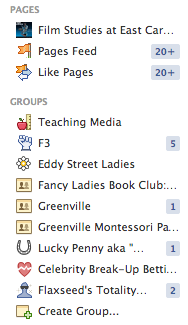
All of these Groups address different needs in my life and contain different users. For example “Greenville” is a venue for members to post questions and announcements pertaining to the city of Greenville (aka, the town where I live). Here people ask for recommendations for house painters, doctors, and babysitters, or post about Greenville-related events. Sadly, this is the least active group to which I belong — mostly because it is small and many of the users are not active social media users (so they don’t see posts or think to respond to them) and because Greenville is the place where fun goes to die (so why should its FB Group be any different?). I also belong to a Group for my children’s school and for a dear friend who was recently diagnosed with breast cancer and wanted a private space in which to update her friends and family about her treatments and prognoses. There are so many uses for this feature.

source:
http://jones.house.gov/office/greenville-office
The most active Groups to which I belong were started by my fellow social media addicts — those who keep tabs on when fellow Group members make posts and engage them in conversation. For example, my all-time favorite FB Group experience from the past year was Skirthathon 2012. For those who do not reside in my small corner of the internet, Skirtathon is the brain child of Dr. Kristen Warner and its premise is simple: wear a skirt or dress every weekday for the entire month of April. For Skirtathon to work, the participants must announce what they are wearing each day to the group. That way, we can keep tabs on each other and shame one another for failures “to skirt” (sample excuses include: “Too tired” and “It’s raining.”). When I participated in Skirtathon 2011, we relied primarily on a Twitter hashtag (#Skirtathon2011) to track each other’s outfits. But I will admit that I often felt a little sheepish posting photos or outfit descriptions to my entire Twitter feed. Though it shouldn’t, it made me feel (like others would feel) that I was frivolous or shallow, a “silly girl.” That’s why this year’s Skirtathon was so much better — this time we had our own private FB Group where participants could not only post photos of their outfits, but the rest of us could comment on these outfits and even provide links to the stores where they were purchased. There was much ooo-ing and ahh-ing and skirt-envy in these comment threads.

As the month went on, the women participating in Skirthaton became increasingly creative and bold, not just in their outfit choices but also in the backdrops and poses used in photos. Suddenly, we were all living in our own personal Anthropologie editorial photo spreads. We also posed with our dogs, cats, babies and even our very large (and very beautiful) pregnant bellies. Even though many of the women using the Group had never met each other in real life (some had not even met via social media prior to joining the Group), everyone gamely commented on each other’s outfits, accessories, and artful use of lighting. I loved seeing a woman I know only because she is the friend of a woman I know through Twitter telling one of my childhood best friends how adorable her son is. It sounds forced but it wasn’t. This is going to sound incredibly cheesy but I’m going to go ahead and say it: this group made me feel beautiful and empowered. Go on and laugh, cynics. But I hold fast to this truth: Skirtathon reminded me that I can love a good sale, a well-placed belt, and a patterned stocking and still be an excellent and serious scholar. I’m every woman, it’s all in meeeeeee. Below are some of my favorite images from this past spring’s Skirtathon (used here with each lady’s permission):

(For more on Skirtathon, check out Kelli Marshall’s post here)
Another FB Group I joined and loved this year was an online book club entitled “Fancy Ladies Book Club.” There was a little bit of secrecy surrounding this book club (for example, this In Media Res post discussing one woman’s participation in the book club was written anonymously for fear of tenure-related repercussions) since the club was formed in order to read E.L. James’ 50 Shades of Grey. But let me be perfectly clear: I was and still am a member of the Fancy Ladies Book Club. In fact, I gave the Fancy Ladies Book Club its “fancy” name as a subterfuge so folks wouldn’t know we were really reading mommy porn. Wasn’t that clever of me? A private group was perfect for such an endeavor since we all wanted to be able to speak as freely (and crassly) as the material warranted. Since completing 50 Shades of Grey (which culminated in a live, somewhat drunken reading at a bar this summer when a few of the Fancy Ladies found themselves at a conference together), we have also read Gillian Flynn’s Gone Girl and Junot Diaz’s This is How You Lose Her. In all cases our conversations were alternately funny, smutty, smart, and enlightening. I am hoping we read Louise Erdich’s The Round House in January and that I can continue to read and learn from this community of brilliant women.

Finally, the most recent addition to my FB Groups list is also the most useful (not that dishing about erotic fiction and skirts isn’t useful too. But those Groups don’t impact my job). Approximately 2 months ago, Erin Copple Smith, an Assistant Professor of Media Studies at Austin College, started a FB Group called “Teaching Media.” Unlike the previous groups I just mentioned, “Teaching Media” is an “open group.” This means that posts to this group will appear in the poster’s FB feed and that members can invite others to join. The group now boasts 251 members and has, at least for me, been an invaluable resource for answers to questions I have had about the ins and outs of teaching a media studies-based curriculum.

While Twitter has also been a great resource for me in terms of crowdsourcing information on syllabus building as well as my own personal research (I have detailed why here), the 140 character limit can be, well, limiting when trying to get an answer to a question that is nuanced and requires a more than a single sentence to explain. Furthermore, the “Teaching Media” page serves as an archive of sorts that Group members can return to a few days, weeks, or months after the original discussion took place (this is much more difficult to do with Twitter). In the two months since the Group has been online I have asked about: how fellow instructors use Twitter in the classroom, what kinds of absence policies have worked (and not worked), and about how to handle the possibility of inappropriate audience commentary at a student-hosted screening of The Room. I have also snapped up innumerable tips for future assignments (yes, Tony Bleach, I will be playing the “genres game” you described on the first day of my spring class, “American Film Genres: Then & Now”). What is great about this Group is that people really do respond — and quickly at that — to queries. Furthermore, they respond in detail (i.e., more than 140 characters), often offering links and examples. As someone who works at a university where there is only one other film studies-trained faculty member (Hi Anna!), I often feel like I have only one person (albeit a great person) to turn to when I have pedagogical questions specific to my field. But the “Teaching Media” group has gifted me an entire 250-person (and counting) department of smart, creative, highly engaged teachers. At any hour of the day, any day of the week (except, I guess, for the day after tomorrow, which is “THE DAY AFTER TOMORROW” when the world ends), I can get an answer to my teaching-related questions. Even flesh and blood colleagues can’t offer that kind of support. When I read about the innovative assignments, in-class exercises, and curricula being used by professors all over the world, I am motivated to be a better teacher. I am, in fact, becoming a better teacher.
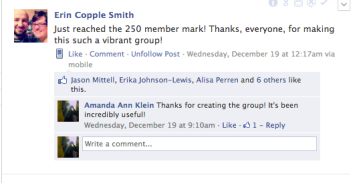
By now you may have noticed that 2 out of my 3 favorite Facebook Groups are populated exclusively by women and primarily by women who work in academia. I don’t think this is accidental. Although the demographics of the Ivory Tower have changed a lot in recent years, it is still, in many ways, an “old boys’ club.” By that I mean: female academics are less comfortable with traditional modes of networking and often have trouble with promoting themselves aggressively as someone worth knowing. As Zdenka Šadl explains:
The academic institutions of higher education, where men dominate (both in terms of number and hierarchy) and act to prevent women from fully participating in and integrating into formal and informal networks, are prime examples of homosocial institution [Etzkowitz, Kemelgor and Uzzi 2000; Fogelberg et al. 1999; Gupta et al. 2004; Hearn 2004; Husu 2004]. Academics generally establish informal connections on the basis of the principle of gender homophily. However, it is predominantly men who form social networks – male academics give support to their male colleagues. Husu [2001] reports that many senior women interviewed in her study observed that their male colleagues supported each other through ‘old boy’s networks’. These networks, also referred to as the ‘invisible college’, [O‘Leary and Mitchell 1990] involve informal power groups whose members are in a position to make (implicit) decisions about the academic rank, status, and position of an academic. Academic women are often excluded from academic networks, and this often puts them at a disadvantage [Kaufman 1978; O‘Leary and Mitchell 1990; Toren 1991; Vazquez-Cupeiro and Elston 2006].
(you can read the full article here)
These Facebook Groups have provided me with a welcoming intellectual community in which I feel free to discuss my love of clothing as easily as I discuss the weird blend of feminism and misogyny found in Junot Diaz’s novels. I feel like I have joined my own “invisible college” and it has improved my enjoyment of academic conferences and academic life immensely. I feel supported by these women in my field — I feel like they have my back. I know I have theirs.
On a side note, if you found this post interesting or would like to discuss it further in a [gasp!] face to face format, I am happy to say that a group of smart young female scholars will be discussing these various issues in a workshop entitled “Gender, Networking, Social Media, and Collegiality” at next year’s Society for Cinema and Media Studies conference in Chicago. I think it’s going to be fabulous.
In the meantime, though, I’d love to hear about your favorite social media site or tool that made your 2012 better. Please share below.
The Most Objective “Best of 2012″ List Ever, Part II: Memes

Over the weekend I posted Part I of “The Most Objective ‘Best of 2012’ List Ever,” focusing on why I think Wilfred is the best, or at least the most unusual and innovative, television show of 2012. I then promised threatened to continue to devote posts to “Best Film,” “Best Meme,” “Best Single,” and “Best of Social Media” of 2012. That list was ambitious, particularly since I am going on a long vacation in a few days. I’ve realized I may not get to cover everything promised in my first post before 2013 hits (when you will promptly stop caring about “Best of 2012” lists). But as the kids say, YOLO! Let’s move forward as best we can:
I present Part II of my “Best of 2012″ list:
Best Internet Meme
It’s hard to select the best meme of 2012. There are so many and, like all trends, when they hit big they are all-consuming. Then the next meme comes along and we forget. Meme enthusiasts are fickle lovers. For example, all summer long I was enamored with “Mikayla is Not Impressed,” a meme that originated in a photograph taken of gymnast Mikayla Maroney just after she won a silver medal in the Women’s Vault Final at the 2012 summer Olympics. Maroney was the favorite to win this particular event, so when the following photograph was taken, many assumed the gymnast was “not impressed” with her silver medal:

Source:
Reuters
As much as I love “Mikayla is Not Impressed,” the principal behind it is one-dimensional. Take something that should be impressive — like the Mars Rover or the assassination of Osama Bin Laden — and then photoshop Maroney’s unsmiling face into the image to denote that this event isn’t all that impressive after all. Maroney’s recognizability, combined with the ease of the iteration (take photograph, add Maroney, no caption necessary), made this meme very easy to create, disseminate, and understand. Even my children (who are 3 and 6 years-old) understood the humor of “Mikayla is not Impressed” and frequently asked to scroll through the meme’s Tumblr. In fact, the meme has so permeated my home that when one of my children does something that displeases me, all I need to do is scrunch up my mouth and cross my arms and my daughter will say “Why are you ‘not impressed’?” (true story). However, the moment that Mikayla Maroney and President Obama posed together while making the “not impressed” face, the meme effectively came to an end. It was fabulous to see our Commander-in-Chief embracing contemporary internet culture but where could a meme about being “not impressed” go after such an impressive photo op?

Source:
http://newsfeed.time.com/2012/11/18/barack-obama-and-gymnast-mckayla-maroney-strike-the-not-impressed-pose/
Another meme I have greatly enjoyed this year is “One Tiny Hand.” Like “Mikayla is Not Impressed,” “One Tiny Hand” does not require any text to make meaning. Its humor — or rather its horror — is based on seeing a famous person with “one tiny hand.” I enjoy this meme because it performs like a game of “Where’s Waldo.” You know a tiny hand is lurking somewhere in the photo. Sometimes it is foregrounded, as it is in the image of Kim Jong Il below. But sometimes, when there are multiple people in the image, it takes some time to locate the tiny appendage. The jouissance of this meme lies in the sudden discovery of the tiny hand.

Source: http://knowyourmeme.com/memes/one-tiny-hand

Source: http://knowyourmeme.com/memes/one-tiny-hand
Other 2012 favorites:

source:
http://www.tumblr.com/tagged/drunk-baby-meme

source:
http://imgur.com/pD1KV

source:
http://forum.woodenboat.com/showthread.php?155818-Bilge-Philosophy

source:
http://www.buzzfeed.com/daves4/the-very-best-of-the-bad-luck-brian-meme
While I love all of the above memes, they are fairly straight forward image macros: take a stock image and add some text to make comedy gold. Likewise, the joke behind each of these popular 2012 memes is always the same: Grumpy Cat and Mikayla hate/are not impressed by everything they should love/be impressed by; Drunk Baby says things a drunk old man would say if he were actually a little baby; Bad Luck Brian can’t seem to do anything right; and Inappropriate Timing Bill Clinton just wants to have sex.

http://blogs.phoenixnewtimes.com/jackalope/2012/11/grumpy_cat_tardar_sauce_arizona_appearance_scooter_fiesta_gilbert.php
My pick for Best Meme of 2012 is based on the fact that it has been able to grow and evolve into different iterations, possibly because it has been around since 2007: the “Yo Dawg” or “Sup Dawg” meme. Now wait a minute, you might be thinking, that meme has been around since 2007? Then how can it be on your “Best of 2012” list? Great question, my intrepid reader. But, I prefer to think of memes the same way we think of television series. 30 Rock may have premiered in 2006, but the show’s writers have produced new seasons every year (some better than others). Similarly, the “Yo Dawg” meme came into existence in 2007, but it has continued to grow and change over the years, existing in several different iterations. Its dual structure — based on recursivity and the smiling face of a man — has proved fertile ground for innovation. In its most basic form (pictured below), the meme features an image macro of rapper/actor/ TV host, Xzibit (née, Alvin Nathaniel Joiner), smiling and claiming to know what the addressee (aka, “yo dawg”) “likes” (a car, a kitchen, a rocket ship) and then promising to give that person an even better version of the coveted object.

source: http://knowyourmeme.com/memes/xzibit-yo-dawg
In order to get the humor of this meme in its original form, you need to remember that Xzibit hosted the MTV reality series, Pimp My Ride from 2004-2007. In the series, car owners in the Los Angeles area were given the opportunity to have their old, broken down cars completely rebuilt (inside and out) and outfitted with luxury features ranging from leather seats and LED lights to TV screens and (yes) fish tanks. These extravagant touches were usually an homage to the car’s owner, like the surfer whose VW bus was outfitted with a clothes dryer (http://en.wikipedia.org/wiki/Pimp_My_Ride). When presenting the lucky car owner with his new, personally customized ride, Xzibit would point out each of the added features. showcased by MTV’s frenetic cinematography and editing. The original meme plays on Xzibit’s signature voice overs (“Yo Dawg, I heard you like X, so I put X in your X so you can Y while you Y”).
Note: Couldn’t find a clip of Xzibit presenting a newly pimped car, but this episode (hosted by fat Joe) offers the template. Go to the 9.25 mark
This version of the meme always features the same image of Xzibit, taken from a “set of studio portraits that were originally used to promote the 2006 sports drama film Gridiron Gang, in which the rapper plays the role of a minor character named Malcolm Moore” (www.knowyourmeme.com). One of the three images pictured below always serve as part of the image macro.

http://knowyourmeme.com/memes/xzibit-yo-dawg
This image, much like Xzibit’s persona on Pimp My Ride, presents the celebrity as a figure of altruism. His smile, which is just on the verge of a hearty laugh, is inviting and generous. Therefore, when Xzibit claims to know what you, dawg, really likes, it feels loving. In this way, the “Yo Dawg” meme mirrors the popular Ryan Gosling-centered “Hey Girl” meme. Particularly in its feminist iteration, the “Hey Girl” meme is all about turning the Goz into the meme-makers’ own movable Ken doll. Talk about the male gaze, Ryan! Say “interpellate,” Ryan! Mmmm. Yes, Ryan, yessssss. Instead of making sweet, sweet love to Rachel McAdams, the Goz is speaking my language, which is almost as good as making sweet, sweet love to him. Almost.

http://feministryangosling.tumblr.com/page/9
Likewise, the appeal of the Xzibit meme, at least initially, is that after pimping so many rides for so many years, Xzibit is now going to pimp something for you. As I discussed in a post about memes last year, so many memes are based on a certain amount of cruelty (something or someone is being laughed at). But the “Yo Dawg” meme is based on affection: I heard you like this, so I am going to give that thing that you like, along with a smaller version of that thing inside of the bigger version of that thing. For example:

http://thechive.com/2009/04/29/the-best-of-xzibits-yo-dawg-yo-meme/

According to KnowYourMeme.com, the “Yo Dawg” meme is “recursive.” That is, the standard version of the meme relies on nested images — one image contains a smaller version of itself, which contains a smaller version of itself, which contains a smaller version of itself, etc. While the “yo yo” example featured above does rely on an invented image, generally this meme is funniest when the image is a found object:

http://www.thechive.com
As the meme evolved, the text of the original is no longer necessary. Just the presence of Xzibit lets us know that the object we are looking at is recursive:

http://knowyourmeme.com/photos/143289-xzibit-yo-dawg
http://cheezburger.com/6103145984
By 2009 the meme was so widespread that Xzibit himself was frustrated with it. He tweeted the following on February 27th of that year:

http://www.urlesque.com/2009/03/02/xzibit-learns-to-embrace-his-meme/
My guess is that Xzibit wanted to distance himself from his Pimp My Ride days, and resume his rapping career. I would also imagine that, at least in 2009, Xzibit might not have realized the power of social media — if he had, he would have known not to tell his followers/meme-makers to commit suicide via a public Twitter account. It’s futile to try to control the internet, Mr. Xzibit; one can only throw oneself at its feet in supplication. Indeed, that is exactly what Xzibit did:
http://www.urlesque.com/2009/03/02/xzibit-learns-to-embrace-his-meme/
The most recent examples of “Yo Dawg,” appearing in 2012, are premised, not on recursivity, but on Xzibit’s infectious smile. In this iteration of the meme, Xzibit is depicted in a series of vertical, multi-panel image macros, a structure meant to be read like a comic book (only from top to bottom rather than left to right), in which his solemn expression is proven to be unsustainable:

The version of the meme below combines sad-to-happy Xzibit with “Happy Motorcycle Dog,” a meme that first appeared in December 2011, further proving the adaptability of the Yo Dawg meme:

http://www.thechive.com
Thus, the contemporary iteration of “Yo Dawg” is almost completely different from its standard, recursive version. The semantics of the meme (smiling Xzibit) are divorced from their original syntax (Xzibit likes recursive imagery!) and instead become a meme in their own right (Xzibit can’t stop smiling!). Here we see memes functioning in a manner similar to that of film genres and cycles, which are able to take familiar imagery and use them for different purposes. It is this complexity and adaptability that makes this particular meme my favorite of 2012.
So now I must ask: what are your favorite memes of 2012 and why?
The Most Objective “Best of 2012” List Ever, Part I: Television

Around this time of year, every newspaper, magazine, and blog offers up some form of the “Best Of” list, chronicling the best films, television series (or episodes), music, books, Broadway shows, trends, etc. of the previous year. Obviously, ranking the year’s best of anything is subjective and also impossible (after all, only an individual who was watched every television episode that aired in 2012 could state, definitively, which were in the top 5). And yet, such lists are so alluring. As a working mom, who reads, watches and listens to only a fraction of what I would like to read, watch and listen to, these “Best Of” lists take an unwieldy set of pop culture possibilities and whittles it down to a manageable chunk. These lists tell me “These are the only films from 2012 that you need to watch.” Then I take a deep breath and load up my Netflix queue.
You might thinking to yourself “Why would I read a ‘Best Of’ list compiled by a woman who has just admitted that she relies on other people’s ‘Best Of’ lists to tell her what pop culture was worthwhile from the previous year?” Excellent question. Why are you reading this? Don’t you have something better to do? No? Well then settle in, friend. I have some completely subjective selections for you based on an unrepresentative sampling of the year’s popular culture. I think you’ve made the right choice.
So without further ado, I present Part I of my “Best of 2012” list:
Best Television Series

2012 was an excellent year for television. I loved watching Walter White (Bryan Cranston) lose the final pieces of his soul on Breaking Bad. The last shot of the Girls season finale, in which Hannah (Lena Dunham) finds herself on Coney Island (after passing out in the subway and getting her purse stolen) and slowly stuffs her face with cake, was the perfect end to a first season filled with uncomfortable, body-focused stories and imagery. The look on Don Draper’s (John Hamm) face when he sees his daughter wearing fishnets and go-go boots or the scene in which Henry (Christopher Stanley) feeds his newly-plump wife (aka, “Fat Betty”) some steak at the kitchen table in the middle of the night were two highlights of the Mad Men season. I also loved watching all or most of the 2012 seasons of Louie, Boardwalk Empire, Happy Endings, 30 Rock, Parks and Recreation, Don’t Trust the B in Apt 23, Parenthood, Teen Mom, and Game of Thrones. No, I don’t watch Homeland, The Good Wife, or Justified. I’m sure I would like all three, but right now I don’t have room for them in my TV diet. Like I said, “best of” lists are subjective. Let’s move on.
Dog smoking cigarette = win
While I loved all of the aforementioned programs and could make a “Best” case for many of them, my choice for “best” television series of 2012 goes to the FX series, Wilfred, because it is, simply put, the most bizarre show I have ever watched, with the exception of (of course) Twin Peaks.
“Can you hear it?” “No, ma’am, I cannot.”
The pilot episode of Wilfred opens with Ryan (Elijah Woods) trying and failing to commit suicide. We eventually find out that Ryan used to be a successful lawyer, working in his father’s firm, but when we meet him he is unemployed and estranged from his father (the reasons for this are only explained in the second season). Ryan’s attempts to end his life are finally interrupted by his neighbor, Jenna (Fiona Gubelmann), who wants him to watch her dog, Wilfred. Ryan is surprised to discover that Wilfred appears to him as a large, vulgar, Australian pothead (Jason Gann) wearing a very unconvincing dog costume. And the kicker is: Ryan is the only one who sees Wilfred in this way. This may seem like a gimmicky basis for a show, but it is also the source of some of the show’s greatest gags: one minute Wilfred is lecturing Ryan on ethics and the next he is chasing and maiming pelicans on the beach (“It’s a pelican !!! IT’S A PELICAN!!!..It was a pelican!!!”):
In a lukewarm review of pilot, Todd VanDerWerff explains “the show gets a surprising amount of mileage out of having Gann running around in a dog costume and saying things a dog might say if it could speak.” But Wilfred isn’t just shots of Jason Gann humping or chatting up his life partner, Bear, who is a large stuffed bear. The reason I love the show is because it so deftly shifts from bleakness to laugh-out-loud comedy. I often read about how shows like Louie and Girls are changing the rules of the sitcom by offering up tragic moments (like when Louie’s love interest dies in front of him on Christmas Day) in between low-brow body humor and Seinnfeld-ian levels of navel-gazing. But Wilfred takes those devices to another level. In Wilfred, despair and laughter are produced by the same cue — what is light quickly becomes dark, and vice versa.This is because the series is structured around the tension between two realities: either Ryan is a lonely, depressed, schizophrenic who uses an imaginary friend to work through his life’s problems or he is a lonely, depressed but otherwise sane man who happens to see his neighbor’s dog in human form because that is something that happens in this world. Therefore almost every scene on the series can be read in two ways.
Each episode is named after a particular lesson or virtue that Ryan needs to learn, such as “Letting Go,” “Avoidance,” and “Honesty.” Wilfred teaches these lessons to an unwilling Ryan , usually embroiling him in interpersonal conflicts that force the passive man to say or do things he normally wouldn’t. Although Ryan’s suicide attempt from the pilot is barely acknowledged, the series is clearly about teaching Ryan how to “live” (and live) in the world again. Of course, every “lesson” Wilfred teaches Ryan serves Wilfred’s interests in some way. We feel good when Ryan learns to stand up for himself or to reconnect with his institutionalized mother (played by an excellently loopy Mary Steenburgen), but we are always left wondering: is Wilfred helping Ryan to live or is he destroying Ryan’s life, piece by piece? And if Ryan is simply imagining Wilfred, then is Ryan using this dog-shaped delusion as an excuse to destroy his own life? Is he committing suicide, just at an incredibly slow rate?
Wilfred dances in between these many possibilities. Its genius lies in convincing the viewer to believe one scenario and then upending that belief with a single line or image. For example, after Ryan finally gives up on the possibility of romance with Jenna, he begins dating a co-worker named Amanda (Allison Mack). Amanda seems perfect — she’s funny, quirky, and clearly besotted with Ryan. It seems that perhaps Ryan will finally be able to have a loving intimate relationship after past traumas had made this kind of human connection difficult for him. But in “Truth,” Wilfred tries to convince Ryan that he should not move in with Amanda because he is still too mentally unstable. Ryan believes that Wilfred, as usual, is just looking out for his own self interests — if Amanda moves in, Wilfred will lose his best friend. Who will take him for walks or smoke pot with him? As they have this argument, an earthquake traps Ryan and Wilfred in the basement (of course). Bruce (Dwight Yoakam), the only other human who can see Wilfred (and thus the only plot point in the series that lends credence to the theory that Ryan might not crazy), appears to rescue the duo, promising to reveal the “truth” about Amanda that is concealed in a suitcase. This truth will prove why Wilfred is right.

But first, Ryan and Bruce must engage in a game of “Calvinball,” which involves pillow fights and “truth or dare.” The game is deliriously surreal, like so much in the series. When Ryan finally “wins ” the game and is granted access to the magical suitcase, he doesn’t discover anything about Amanda. Instead he finds a timer that tells him that he has spent 12 hours in his basement playing a bizarre game orchestrated by his neighbor’s dog. In other words, Wilfred was right — Ryan should not move in with Amanda.
Ryan is such a likable character (he is kind, empathetic and selfless to a fault) and we want him to be happy. But when we see the timer, the audience realizes — at the same moment that Ryan does — that he is crazy … but wait, is he? Or is this just what Wilfred wants Ryan to think in order to maintain the status quo? Isn’t it suspicious that everything that ends up “being for the best” also happens to serve Wilfred’s interests? These uncertainties are what drive the series and which make this show more than a collection of pooping on the lawn jokes (though I am 100% for a show that is nothing more than pooping on the lawn jokes).
And if that doesn’t interest you, Wilfred is worth watching for its “couch scenes” alone. Incidentally, as I was writing this post I found out that these short scenes, appearing at the end of show (after the main story has been resolved), are called “tags,” or “codas” (thank you Twitter):
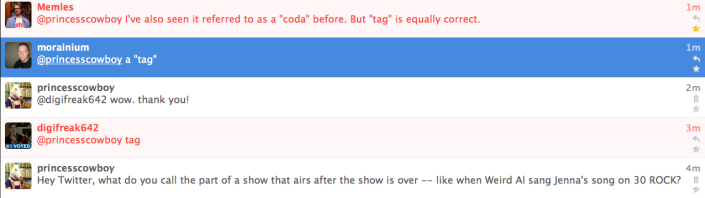
Learning is fun!
The tags in Wilfred almost always take place on the couch in Ryan’s basement and feature Ryan and Wilfred engaged in a banal task, like playing a board game or having an inane conversation. They’re always fabulous:
And if that doesn’t interest you? Well, there are loads of other shows to watch. I hear The Good Wife is awesome, so maybe you should watch that instead?
I will be posting my “Best Meme,” “Best Film,” “Best Single,” and “Best of Social Media” picks over the course of the next few weeks. Stay tuned! If you dare!
My Year of Reading for Pleasure

The first chapter book I ever read without adult intervention was E.B. White’s Charlotte’s Web. I was 6 years old and it took me months to finish it. Or maybe it only took a few weeks. Never trust a 6-year-old’s concept of time. Regardless, by the time I finished Charlotte’s Web the corners of the book were smushed and the cover was missing. I read that book. I don’t remember too much about the experience except this: I couldn’t believe that I was reading a chapter book all by myself. It seemed impossibly mature. My next literary milestone occurred a few years later when I read Katherine Paterson’s Bridge to Terabithia, a lovely tale of friendship between two 5th graders. Then (SPOILER ALERT) one of the friends falls into a river and drowns. This was the first book I read in which a human character — a kid no less! — dies. I knew the death was coming — my classmates spread the news like a dark secret (“Did you read the book where the girl dies?”) — but the sadness I experienced as I read about little Leslie’s tragic drowning still surprised me. How sweet and liberating it was to cry over something that had no consequences in the real world.

Naturally this led me, at the tender age of 11, to Wilson Rawls’ Where the Red Fern Grows, the big papa of children’s literature death porn. If you’re not familiar with this tearjerker, it’s about a little boy who, after much hard work and much saving of money in an old K.C. Baking Powder can, finally purchases two coonhounds, Little Ann and Old Dan. Why did he want these dogs? To hunt raccoons of course! Old Dan and Little Ann were topnotch coonhounds. Then they die. And let’s be clear: these dogs don’t just die, they perform death in the most melodramatic, Oscar-baiting fashion imaginable. Remember this passage?
“What I saw was more than I could stand. The noise I heard had been made by Little Ann. All her life she had slept by Old Dan’s side. And although he was dead, she had left the doghouse, had come back to the porch, and snuggled up by his side.”
I’m surprised that Little Ann didn’t rise up on her hind legs and recite a soliloquy about love and companionship before collapsing in a heap onto Old Dan’s grave. But those epic death scenes weren’t enough for Wilson Rawls. He continues the torture when he has his narrator reflect on the lives of his faithful pups:
“After the last shovel of dirt was patted in place, I sat down and let my mind drift back through the years. I thought of the old K. C. Baking Powder can, and the first time I saw my pups in the box at the depot. I thought of the fifty dollars, the nickels and dimes, and the fishermen and blackberry patches.
I looked at his grave and, with tears in my eyes, I voiced these words: ‘You were worth it, old friend, and a thousand times over.'”
I defy you to read Where the Red Fern Grows and not have your heart broken. I remember finishing that book, in the summer after 5th grade, and running to my mom’s room, sobbing. All I could do was hold up the book and whine “They both DIED!” My mom nodded and smiled. I think she was relieved. 11-year-olds cry a lot but book crying is much easier to handle than real-life crying.

In those early heady days of book consumption, I found that, in addition to crying, I liked being terrified. I read most of the Stephen King canon, which I would not recommend for young children. Seriously, 11-year-old’s should not be allowed to read It. After that I was terrified of my sink. And gutters. And really, everything. That’s some top notch parenting, Klein family.

Sure, I read some of the children’s lit classics, like Scott O’Dell’s Island of the Blue Dolphins and Frances Hodgson Burnett’s The Secret Garden, and the period/masturbation/wet dreams books by Jude Blume (Are You There God, It’s Me, Margaret, Deenie, Then Again, Maybe I Won’t) but I really loved the trash. There were the Sweet Valley High books, Flowers in the Attic (V.C. Andrews, you dirty, dirty bird), and Archie digests. I loved reading so much that when I went to college, I had no doubts about becoming an English major. While my friends complained about their homework, I lounged in my bed reading A View from the Bridge (Arthur Miller), Geography III (Elizabeth Bishop) and Nightwood (Djuna Barnes) and loving my major. Most of the time it didn’t even feel like work to me. Ironically, it was when I went to graduate school to become a professional reader of books that I stopped reading fiction completely. Part of this had to do with the fact that I decided to study film, rather than literature. But also, having to devote so much time and energy to reading and decoding dense theoretical texts put me off the idea of reading for pleasure. For 10 years the only books I read “for pleasure” were the Harry Potter series and US Weekly.
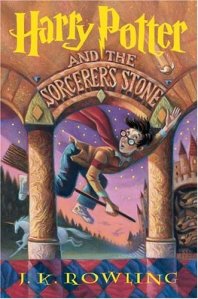
This changed when my husband brought home a Kindle Fire last winter. It was a holiday gift from his boss. I wasn’t too interested –you know, since “I don’t read.” But I had been hearing a lot about Suzanne Collins’ The Hunger Games series from, well, everyone, and I was tempted to read it myself. I had been tempted by sensational kid-murdering novels before, of course, but usually I would tell myself that I didn’t have time to read. I’m a working mother and I don’t get to recline on a couch somewhere and read a young adult novel about a dystopian world in which teenagers are forced to kill each other. Of course, I could watch a film or TV show about a dystopian world in which teenagers are forced to kill each other (because that’s not pleasure, it’s “work”). When I finally decided to download a copy of The Hunger Games on New Year’s Eve 2011, I did so because I thought it might be therapeutic. My father had died a few days before year’s end and reading seemed like a good way to work through my emotions. So I read.

A few days later I finished The Hunger Games and decided, on a whim, to buy the sequel, Mockingjay. I bought Catching Fire one week later. And that’s how it went for several months. I found myself reading several books each month. I still had two kids and a full-time job and dishes to wash, but I found a way to fit reading in to my daily schedule. If I ever thought that maybe I shouldn’t be spending so much time reading — that I could be finishing up an article or folding some laundry or letting the children out of their cages for their daily 10 minutes of sun exposure — I reminded myself: this is therapeutic. So I kept reading.

Now it’s approximately 11 months after I first picked up the Kindle and I have read a total of 23 books. Here they are, categorized by my own personalized genres:
Fun stuff I never would have let myself read in grad school:
The Hunger Games, Mockingjay, Catching Fire (Suzanne Collins)
50 Shades of Grey (E.L. James)
Twilight (Stephenie Meyer)
Gone Girl (Gillian Flynn)
Books written by funny people I like:
Is Everyone Hanging Out without Me? (Mindy Kaling)
Bossypants (Tina Fey)
Half Empty (David Rackoff)
Sad books where people die or are already dead:
Swamplandia! (Karen Russell)
The Descendants (Kaui Hart Hemmings)
The Fault in Our Stars (John Green)
The Brief and Wondrous Life of Oscar Wao (Junot Diaz)
Dysfunctional family stories
Little Children, The Leftovers (Tom Perrotta)
Motherland (Amy Sohn)
The Marriage Plot (Jeffrey Eugenides)
Room (Emma Donoghue)
Dystopian and/or fantasy
The Night Circus (Erin Morgenstern)
A Visit from the Goon Squad (Jennifer Egan)
Ready Player One (Ernest Cline)
Misc.
Pulphead (John Jeremiah Sullivan)
The Perks of Being a Wallflower (Stephen Chbosky)
That’s three times as many books as I read in the preceding decade. Why did I read so much? I think the e-book format definitely compelled me to read more. The convenience of being able to purchase a book whenever I wanted to coupled with the portability of the device — try propping a real novel on a gym elliptical machine — has definitely made me more inclined to read and to read often. In fact, according to a recent Pew Research Center survey “The average reader of e-books says she has read 24 books (the mean number) in the past 12 months, compared with an average of 15 books by a non-e-book consumer.” I also found that social media really encouraged my reading habits. Every time I finished a book I could go on Twitter and ask people what my next book should be — one thing people are always happy to share are book recommendations. I also got involved with an online book club on Facebook. The group, composed primarily of other female academics, led me to read two books I never would have picked up otherwise: 50 Shades of Grey and Gone Girl. This culminated with a drunken live reading of 50 Shades of Grey at a conference, which was as delightful as it sounds (at least it was for us, less so for our bewildered bartender). More recently I decided to read Twilight. After tweeting about this decision, several other Twitter-friends decided to join me in the endeavor, forming an impromptu book club (here is a link to a Storify of our conversations). I have not enjoyed Twilight, but participating in Twilight-related tweeting has motivated me to finish. This sense of community, whether it’s an organized book club or simply sharing my thoughts about a recent read with online friends, has greatly added to my reading enjoyment this year.

I’ve also read a lot this year because I finally remembered that I like to read. It seems like a silly thing to forget but as I get further along in my career it has become easier to marginalize the activities that give me pleasure simply because they serve no purpose other than the giving of pleasure. As if pleasure is purposeless or wasteful. Perhaps this is just a symptom of being a working parent but I suspect it has more to do with the larger culture of academia, which stresses a lifestyle in which everything — including leisure time –must be quantified, accounted for, and somehow contribute to one’s research or pedagogy. In an article for the Chronicle of Higher Education that hit just a little too close to home for me, “It’s Your Duty to be Miserable!” ,William Pannapacker describes the typical thought process of the academic:
“If someone asks, ‘How are you?,’ I sigh, shrug, and say, ‘Busy, like everyone else.’ If pressed, I will admit that I spent some time with my family—the way a Mormon might confess to having tried a beer, once. For more than 20 years, I have worn what Ian Bogost has called ‘the turtlenecked hairshirt.’I can’t help it; self-abnegation is the deepest reflex of my profession, and it’s getting stronger all the time.”
In 2012 I have made an attempt to get out of my hairshirt, one e-book at a time. I’m not sure that I will continue my frenetic reading pace in 2013, but I have definitely re-Kindled my love affair with the written word (pun intended). I have found that reading for pleasure is valuable because it is pleasurable, and nothing more.
For those of you out there with e-readers, have you found that you now read more? If so, why do you think that is? What is the best book you read in 2012? And what should I read in 2013?
Screening THE ROOM: 2012

Note: I have been given permission by the students of ENGL4980 to use their images in this post.
Hey there, you. Yes, I’m talking to you, my dear reader. I know it’s been three months since my last post. That doesn’t mean that I forgot about you. In fact, there has been a blog-sized hole in my heart these last few months that I have been aching to fill with my gob-smacking insights into film and television. But now I’m back. And I’ve brought you chocolates and roses. Or rather, I’m bringing you a post about chocolates and roses and rain-slicked windows and “sexy” red dresses and lots and lots ham-fisted performances and green screens and unexplained establishing shots and tiny doggies and alley football. In other words, I’m bringing you a post about screening The Room...[insert dramatic music]…2012!

I came up with the idea of having my student run their own cult film screening when I first taught ENGL4980 “Topics in Film Aesthetics: Trash Cinema” in the Fall of 2009. The course objective was to examine the aesthetics of films which were notorious, not for their excellence, but for their terribleness. In “Esper, the Renunciator: Teaching ‘Bad’ Movies to Good Students,” Jeffrey Sconce argues: “beach blanket films, Elvis pictures, 1950s monster-movies — any film where history and technique remove students from the ‘effects’ of representation and plunge them headlong into the quagmire of signification itself” can be fruitful classroom texts (31). The polished Hollywood stalwarts that populate the syllabi of so many film studies courses — Casablanca (1942, Michael Curtiz), Citizen Kane (1941, Orson Welles), Vertigo (1958, Alfred Hitchcock) — are so seamlessly crafted and carry the weight of so much critical praise that it is often difficult for students to find a way to analyze their “invisible” style. Of course, I do teach these films in other classes (one film I will always teach in Intro to Film is Casablanca –always and forever). But I think it’s useful for film studies students to also look at films with a highly visible style — ideally one in which all of the seams are showing. Further, understanding how and why we classify popular culture as being in “good” or “bad” taste tells us a lot about how unnatural and constructed such categories can be. These are topics that can often be easily ignored when we only watched Ingrid Bergman framed in a beautifully lit close up.

Throughout the semester my students and I have been studying American films that have been marginalized due to a variety of interrelated factors: their small budgets and chintzy set designs (Sins of the Fleshapoids [1965, Mike Kuchar]), their completely inept style (Glen or Glenda? [1953, Ed Wood, Jr]), their offensive subject matter (Pink Flamingos [1972, John Waters] and Superstar: The Karen Carpenter Story [1987, Todd Haynes]), their violent or sexual imagery (2000 Maniacs [1964, Herschell Gordon Lewis] and Bad Girls Go to Hell [1965, Doris Wishman]) and their desire to place marginalized faces at the center of the screen (Freaks [1932, Tod Browning] and Blacula [1972, William Crain]). In addition to understanding why these films have historically been viewed as “trash” (we relied heavily on Pierre Bordieu’s pithy line “Taste classifies and classifies the classifier” to answer this question) we also sought to understand why moviegoers persist in watching these movies. This second question is, admittedly, harder to answer. Why did my students enjoy watching the blurry, overdubbed images of Todd Haynes’ Superstar or delight in the conclusion of Sins of the Fleshapoids when (SPOILER ALERT!) a female “fleshapoid” gives birth to her own baby toy robot?
Watch a fleshapoid give birth to the fruit of her forbidden robot love.
Enter The Room. I will admit now that the idea for this assignment was partially selfish: I had read about The Room and wanted to experience a live screening myself. Right here in my own town! Of course, beyond my desire to scream the holy words “YOU’RE TEARING ME APART, LISA!” with a crowd of rambunctious moviegoers, I also felt that this assignment would be an inventive way of having my students learn by doing. The fancy word for that is “praxis.” You’re impressed now, aren’t you?
I had a few goals with this class project:
1. To teach students about the importance of “ballyhoo”
Eric Schaefer defines ballyhoo as “that noisy, vulgar spiel that drew audiences to circuses and sideshows…a hyperbolic excess of words and images that sparked the imagination” (103). Ballyhoo promises audiences something—an image, an experience or a reaction (“This movie will make you puke!”)—that it does not always fulfill. This unfulfilled promise is a convention of exploitation advertising. I encouraged my students to think of their advertising in this way — as an exaggeration or complete misrepresentation of the experience of attending The Room. Say whatever you need to say to fill the theater seats.

I told the students that their grade for this project would be partially determined by the amount of people in the audience and the level of enthusiasm emanating from the audience during the screening. Just as exploiteers like Kroger Babb and David Friedman endeavored to fill as many theater seats as possible because their livelihoods depended on it, my students had to fill the theater or risk a low grade. The students were given the duration of the semester to design and distribute posters, create a buzz in various forms of media, and prepare the venue for the night of the screening — just as their exploiteer ancestors did.
They made a variety of posters and flyers:

They created a Facebook event page and posted regular reminders extolling the virtues of The Room:

They created a series of “Golden Tickets” which they planted around campus. Students who located the tickets and attended the screening received a “special” prize which I believe was just a ring pop. But you see: that’s exploitation!

The students also convinced the school paper, The East Carolinian, to write an article about our event and called the campus radio station to plug the screening after the Presidential election. Overall, I found their ballyhoo to be creative and persistent, which is key to the successful exploitation of a film. Indeed, about 15 minutes before the start of the screening, when it appeared as if they would not fill the theater, several of my students ran outside the venue to harass students as they walked by: “Don’t you want to come and watch The Room? It’s the greatest movie ever! We’ll give you spoons!” That’s exploitation too! Lesson learned, students. Lesson learned.
2. To teach students about how cult film audiences are created and nurtured
This was the trickiest aspect of the class project because a cult audience is defined by its almost spontaneous nature. A cult is created by the audience, not by a group of students hoping to score an A in the film studies class that they’re taking to fulfill their Writing Intensive requirement for graduation. We watched The Room during our first full week of class and the campus-wide screening did not take place until the 13th week of class, so by the night of the screening I think my students were legitimate enthusiasts. But what of the audience members who had been lured into the theater on a Monday night, through false promises that the event would be the screening event of a lifetime or because their friends in the class had begged them to or because they were promised special prizes?

Could a group of students (the majority of whom had never seen The Room prior to enrolling in my course) create a cult film audience out of sheer force of will? I think they did.

It was the students’ responsibility to prepare the audience for the evening’s events through their promotional efforts and also by presenting a brief introduction to the film. Ostensibly motivated by the desire to educate, exploiteers would often bring in “experts” (or actors dressed as doctors and nurses) to speak to audiences who came to watch their sex hygiene or drug films. But of course, this was titillation in the guise of education, further adding to the experience of watching the film (which started the moment an audience member saw the first advertisement in the local paper). We attempted to replicate this environment by having one of the students serve as an emcee. She provided the audience with insight into the cult of The Room and a demonstration of key rituals. Our emcee cracked jokes and interacted with the audience throughout her introduction, which prepped the audience for the film to come.

The students were also tasked with assembling prop bags for the audience and deciding on what rituals they wanted the audience to perform (again, a seemingly antithetical concept in the world of interactive screenings). They repeated some of the most basic rituals of The Room — the throwing of spoons, the shouting of “Because you’re a woman!” every time Lisa offered up an excuse for her duplicitous behavior, and the calling out of “Hi Denny! Bye Denny!” — but they also added a few new rituals. First, during each of the film’s lengthy and grotesque lovemaking scenes, my students wandered through the audience with bunches of fake red roses (because the film’s protagonist, Johnny, and his fiance, Lisa, make love on a pile of roses). They would tap an audience member on the shoulder and whisper “Welcome to the sex scene. Please accept this rose.” It’s already uncomfortable watching Johnny make love to Lisa’s belly button but to have someone offer you a rose during such an awkward scene heightens those feelings. The second ritual they added was to release several garbage bags worth of balloons during the film’s climactic (and lengthy) party scene. Once the balloons were released, the audience began to bat them around (they would pop after hitting the ceiling), thus bringing the on-screen party into the audience:
On a side note, I should add that the students also purchased a small pack of glowing, LED-filled balloons, which they thought would be a fun addition to this ritual. However, upon reading the instructions the students discovered that these balloons were potentially dangerous when popped and had to be safely “detonated” after use. This added a little, personalized thrill to the screening for me as every time I heard a popping noise I wondered if I might lose my job because a student had just been blinded. That’s exploitation too! Way to go, students!
3. To teach students about the joys (and frustrations) of a class project

In the classes I teach there is rarely a good reason to assign a class project. However, this screening assignment afforded me a truly useful reason to force my students to work together — to create an environment in which it is safe for me to hurl curses at a screen for 100 glorious minutes. As I mentioned, part of the students’ grades for this project was going to be determined by the amount of people they could convince to attend the screening as well as the enthusiasm of the audience (after all, a cult film audience who sits silently is no kind of cult film audience at all). This meant that if the event was a bust, the grades were a bust too. In the weeks leading up to the screening, I witnessed more and more cohesion among my 14 students. They conferred before and after class, collecting in corners of the classroom to share flyers and advertising ideas. Indeed, on the night of the event I noticed a change in the dynamic of the group. I stood back and watched as they arranged prop bags, fiddled with their power point, psyched up the event’s emcee, and of course, fretted over whether or not the evening would be a success. True, I felt a little like the judge, jury and executioner throughout all of this — in the hour leading up to the screening I caught students eyeing me nervously — but I also felt very proud of them. Moments before the event started we gathered for a class huddle and shouted “YOU’RE TEARING ME APART LISA!”

In short, I was delighted with the results of this student project. I think students learned — first hand — what it would be like to be an exploiteer whose livelihood depended on generating enough ballyhoo to fill a theater. I think they also learned about the joys and rewards of cult viewership even if the viewership they created was highly constructed and mediated through the lens of a class project.
Below I would love to hear about any successes (or failures) you’ve had in attempting to implement class projects into the film or media studies classroom. Were these projects simply “busywork” or do you think they helped your students to gain a greater understanding of the course material?
Works Cited
Bourdieu, Pierre. Distinction: A Social Critique of the Judgment of Taste. Trans. Richard Nice. Cambridge: Harvard University Press, 1984.
Schaefer, Eric. “Bold! Daring! Shocking! True!”: A History of Exploitation Films, 1919-1959. Durham: Duke University Press, 1999.
Sconce, Jeffrey. “Esper, the Renunciator: Teaching ‘Bad’ Movies to Good Students.” Defining Cult Films: The Cultural Politics of Oppositional Taste. Eds. Mark Jancovich, Antonio Lazaro Reboll, Julian Stringer, and Andy Willis. Manchester: Machester University Press, 2003. 14-34.
Work, Study and Scholarship as an Academic Parent, Part II: Parenting on the Job
A few weeks ago I published Part 1 of a two-part post entitled “Work, Study and Scholarship as an Academic Parent, Part I: Grad School Babies.” This post covered the presentations and discussions that took place during a workshop that I chaired at this year’s Console-ing Passions: A Conference on Television, Audio, Video, New Media, and Feminism, hosted by Suffolk University, entitled “Work, Study and Scholarship as an Academic Parent.” This post discussed the challenges and rewards of having a child while still in graduate school. I was pleased to see how many people engaged in this conversation — in the comments section of this blog, on Facebook, and on Twitter. I often feel self conscious whenever I link up my roles as parent and professor since acknowledging that one role might impact the other implies a weakness. It makes me a less desirable employee than my child-free counterpart. Thus, the first rule of being an academic parent is don’t talk about being an academic parent. I also worry about alienating ,or at least annoying, my child-free friends and colleagues with posts like these — I don’t want anyone to “un-baby” my blog. Wait, you’re doing it right now, aren’t you? Okay fine. Here’s a picture of a kitten:

In all seriousness, I think these conversations are important for all academics to have, even those who never plan to have children. We all need to work together, after all, and we need to find ways to accomodate each other and create policies that help us all to be the best scholars, teachers, and yes, committee-members, we can be. As my lovely colleague, Anna Froula put it:
“I want the colleagues I work with to be happy at work (so they’ll keep working with me), so it’s a quality of life issue. The reason I defer to [colleagues with children when] scheduling meetings is because, simply put, you have more humans in your family that depend on you to balance work and home life. My time is more flexible because I don’t have kids. If one of us had an ill parent or some other pressing issue to deal with, it would be the same thing. We should want to take care of each other so we can enjoy working together and do so efficiently.”
Like Anna, I want us all to enjoy working together. To that end, this post will replace all cute baby pictures with cute animal pictures. But be warned: my Facebook page remains fully babyfied.
*****
“The ‘Child Friendly’ Department: Definitions and Expectations”
In this post I’ll be summarizing the portions of the workshop that covered parenting after graduate school. In many ways, the life of a college instructor is ideally suited to the rhythms of parenting. We have the option to take our summers “off” (though for me, “taking the summer off” means I don’t teach but I do continue to research, write, and work on my fall syllabi and course plans). Most teaching schedules are confined to a Tuesday/Thursday or Monday/Wednesday/Friday schedule, which allows parents to work from home at least one or two days per week (unless they hold an administrative position). And most college courses are over by 4:00 pm or 5:00 pm, which allows parents to be home when their kids are finished with school for the day. Pretty sweet, right? Well, maybe not. In their article, “Care, Career, and Academe: Heeding the Calls of a New Professoriate,” Nikki C. Townsley and Kristin J. Broadfoot argue that “…short-term flexibility obfuscates the long term inflexibility of academia for faculty committed to both work and family.” Here are some examples:
* women who get TT job before having kids were less likely to become mothers or get married and were more likely to be divorced or separated.
* female academics were found to hold the highest rate of childlessness amongst professional women at 43%.
* the tenure track model supports a progressive, linear and seamless career model in that many TT jobs expect professors to teach full course loads, be on several committees and publish at least one book in the 1st 5 years on the job.
* in fact, TT job expectations are built on presumption that professor has a full-time home-based caregiver and homemaker. The university is not structured to accommodate dual career families.

These statistics beg the question: is being an academic parent harder for women than it is for men? In “Does it Take a Department to Raise a Child?” Bonnie J. Dow writes that lack of support for pre-tenure parenting negatively affects careers of female junior faculty more than male junior faculty. Here are some of her findings:
*12-14 years after obtaining PhD, males on the tenure track in the humanities & social sciences with “early babies” (babies born in the first 5 years after finishing the PhD) receive tenure at rate of 78%.
* 58% of women in same position receive tenure.
*women with “late babies” (babies born more than 5 years after the PhD) received tenure at a rate of 71%.
*47% of women reported great deal of tension and stress over parenting/work conflict versus 27% of men.

Dow’s findings indicate that many female professors are unable to fulfill the requirements of tenure while parenting a young child. The later women wait to have a baby, the better their chances for tenure. But male parents don’t face the same problems. They have an easier time having successful academic careers while having families. Indeed, Dow’s article mirrors many of the points made by Anne-Marie Slaughter in her hotly contested piece in The Atlantic from earlier this summer. In her article, entitled “Why Women Still Can’t Have it All,” Slaughter argues that women have a harder time being mother-workers than men do. I know there was a lot of blowback on this piece but Slaughter makes a lot of great points. For example, she writes:
“If women feel deeply that turning down a promotion that would involve more travel, for instance, is the right thing to do, then they will continue to do that. Ultimately, it is society that must change, coming to value choices to put family ahead of work just as much as those to put work ahead of family. If we really valued those choices, we would value the people who make them; if we valued the people who make them, we would do everything possible to hire and retain them; if we did everything possible to allow them to combine work and family equally over time, then the choices would get a lot easier.”
As I mentioned in my last post, graduate student mothers are told to hide the fact that they are mothers when going on the job market. As if being a parent is a liability. Academia needs to find a way to better bring together work and family.
Before we move on, though, why don’t we all enjoy a puppy picture?

Ahhhhhh.
Now I’d like to discuss some of the feedback I collected through my survey. First, a quick note on this survey. Although I did obtain IRB approval in order to conduct this survey and share the results publicly, I quickly discovered that I had no idea how to design a survey. I had an especially difficult time crafting multi-part questions. For example, I wanted to know how many of my respondents (which included tenure track faculty, fixed term faculty, independent scholars, and graduate students) were offered the option to stop their tenure clock after the birth of a child, who took that option and why. The data that resulted from my questions is confusing since the question was targeted only at those people on the tenure track, followed by those who had the option to stop the clock, followed by those who actually took that option. But I did get some useful data. In partIcular, I was intrigued by the responses to my question “What is your definition of a child friendly department?” I read through all of the responses and was able to sort these responses into 5 broad categories, which I will list below (along with some representative responses).
How Do Your Colleagues Define a “Child Friendly” Department?
1. Openness and Acceptance

“I would define it as a place where children are accepted and discussed as a normal thing, where I don’t have to feel like I might be looked down upon for having children, where I can speak freely about them without reservation. You know, like you’d talk about your dogs. No one is worried that they shouldn’t mention owning dogs because they might be judged or it might affect their academic work. Yet I feel like it’s easier to talk about pets than children.”
“Faculty, staff and graduate students would also not feel uncomfortable even *mentioning* children, which can happen among academics.”
“…parents feel comfortable revealing work/family conflict to chair in an effort to resolve them If possible”
“A department that accepts parenting as an appropriate activity for a professor and makes reasonable accommodations for it.”
“One that understands and accomodates faculty with children such that within reason, parents are allowed to be the kind of parents they would like to be. “
2. Flexibility… for Everyone, not Just Parents

“Rather than child friendly, perhaps family friendly or life friendly–a place which recognizes that humans have obligations to other humans that sometimes interrupt the ordinarily scheduled activities of a career. That said, I do think all department members should be thoughtful and respectful of their colleagues, recognizing that obligations come in lots of shapes and sizes–some of which are easier to talk about than others.”
“A department that recognizes that faculty AND staff are humans with human needs and issues including the care of children [and/or ill family members or elderly parents] with willingness to flexibly schedule committee meetings or to understand the need for occasional help arranging coverage of classes in emergencies (as with conferences and other professional demands) and to offer suggestions for newcomers on how to find effective childcare.”
“A ‘child friendly’ department alternates the times at which meetings and events (readings, workshops, etc.) are scheduled, so that not *everything* happens during a parent’s ‘second shift’ at home.”
“One that understands not to schedule events after 4:30 in the afternoon. One that understands that if you do schedule a lot of nightly events, then you won’t go. And one that makes public statements supporting why parents with young children are less able to participate in extracurricular events.”
3. Where Parents Aren’t Penalized for Being Parents

“A child friendly department is one that …promotes/recognizes employees based on their JOB performance, and doesn’t penalize or overlook employees based on their maternal obligations.”
“…a general respect for my decision to have children, where it is not looked at as a problem, or a road block on my tenure track.”
“A department that doesn’t force people to choose between a career and a family.”
“One that makes it easy for me to be an academic and a parent at the same time. As a grad student, I can’t afford day care, and I live away from my family, which means that since I have the more flexible schedule between me and my non-academic partner, I am the full-time caretake of my kids, as well as a full-time student, part-time teacher, union steward, committee member, etc. I don’t have the luxury of separating these out.”
“Provides parents with the same opportunities as non-parents. Does not give parents or non-parents an advantage over each other.”
4. Clearly Defined (& Fair) Parental Leave Policies, Including the Option to Stop Tenure Clock

“Gives teaching and graduate assistants maternity leave…”
“A department that provides parental leaves for both partners and in the case of a single parent a longer leave or reduced load including the leave. In addition, if a faculty member elects to stop the tenure clock then at the time of assessment one should not look at when s/he received his/her Ph.D.”
In “Why Maternity Leave is Important,” Meredith Melnick cites a study by the National Bureau of Economic Research (NBER) that found: “Women with 3-month-old infants who worked full time reported feeling greater rates of depression, stress, poor health and overall family stress than mothers who were able to stay home (either because they didn’t have a job or because they were on maternity leave).” These results suggest that the transition back into employment immediately after childbirth is difficult for the average family. Mothers in particular get stressed and depressed when they must return to work too soon after the birth or adoption of a child. And a stressed/depressed mother has a negative impact on her children. Melnick quotes NBER researchers, Pinka Chatterji, Sara Markowitz and Jeanne Brooks-Gunn, who found that “Numerous studies show that clinical depression in mothers as well as self-reported depressive symptoms, anxiety, and psychological distress, are important risk factors for adverse emotional and cognitive outcomes in their children, particularly during the first few years of life.” Despite the results of studies that demonstrate the necessity of some kind of paid parental leave for new parents, the U.S. is one of two developed economies in the world that do not provide some form of universal paid maternity leave (the other is Australia). This is the same country that produces senators like Rep. Todd Akin, the Republican nominee for Senate in Missouri, who believes the female body contains “biological defenses” that prevent it from getting pregnant during a “legitimate rape.” In other words, women shouldn’t abort their babies and they can’t take off work to care for them either. But I digress…

In terms of the folks I surveyed, 23% took an unpaid parental leave, 32% took a paid leave and 28% took no kind of leave after the birth/adoption of a child. Of those who did not take any time off, 15% said their departments did not offer paid leave, 9% worried it would affect their ability to keep their jobs, 6% worried it would impact their ability to get tenure, 12% (who were men) said that men do not normally take leave in their departments and 9% said they didn’t take leave because they didn’t want to. In general, it seems that the length of parental leaves (if they are offered at all) vary wildly from school to school. I was lucky to get a paid maternity leave of one full semester after the birth of my son. Since he was born, my university’s policy has been shortened from a full semester (15 weeks) to 12 weeks. I don’t see how this change saves the university much money (do we save money by having a professor teach 4 weeks of a 15 week course?) and since I am currently on my university’s Faculty Welfare Committee, I plan to address this change when we meet again this fall.
5. Your Question is Illogical!
4 of my 180 respondents responded to the question “How do you define a child friendly department” with something along the lines of “Girl, you crazy!”

“Why do we need a definition? An employee’s job is to work. Their outside responsibilities belong outside of the work environment. University employees are employees just like in a business. Business does not allow exceptions for parents with children-schedules or maternity leaves. Only in this environment would the employees be pandered to in this way.”
“I don’t have one. Why would other adults do favors for my children? My colleagues interact with me and I am not a child.”
“One of the problems to be considered when exploring the idea of ‘child friendly’ is a perceived disconnect between faculty expectations and the ‘real-world’ workplace. To put this another way, the public is unlikely to be supportive of expressions of concern about the absence of a child friendly culture when they have to do without it in their lives. Nor is the legislature likely to be supportive.”
These comments are not representative of the vast pool of responses I received, but I found them worth reporting because they address something important that academics need to consider: do we expect too much? After all, a parent working in a top law firm can’t expect meetings to be scheduled around her daycare schedule and an ER doctor can’t refuse to work nights because he wants to be able to put his baby to bed.

Bonnie J. Dow argues that lack of institutional support for colleagues with children ends up hurting the entire department: “…as long as family-friendly departments enable academic parents to rely on their colleagues’ informal support, they simultaneously enable institutions to forestall developing the structural solutions that would make that support less necessary.” She claims that when a faculty member agrees to cover a class after a colleague gives birth “…the unintended consequence of such short-term fixes is that institutions continue to rely upon them as ad hoc and interpersonal solutions to a structural problem.” Likewise, academic parents must be careful not to take advantage of colleagues. Dow offers 5 rules that academic parents should follow in a good faith effort to not take advantage of their child-free colleagues:
1. Don’t bring kids to the office
2. Don’t bring kids to meetings
3. Arrange for child care for meetings (NOT JUST TEACHING)
4. Department couples are not interchangeable—you both need to be present
5. Colleagues are not required to accommodate your parenting philosophy
I’m not sure that I agree with all of Dow’s suggestions. If your child is ill and you must get to campus to meet with a student, you might have to bring your kid with you, and that doesn’t seem like it should be a big deal. But Dow’s overarching point seems to be: remember that you are part of a department. Meetings, job candidate dinners, and the like, are all part of your work obligations and you should therefore have childcare available for those events. When you stop pulling your weight, your weight doesn’t vanish. It just appears in someone else’s “to do” pile. Colleagues should keep my precarious schedule in mind (if you want me to attend a weekly meeting, then try to schedule it during my kid’s day care hours) but my needs do not trump their needs. At some point every member of a given department is going to have a personal situation conflict with duties at work. As colleagues we need to be able to take up each other’s slack when needed and within reason.

How can we do this? Jason Mittell offered some great suggestions during our worksop. As chair of his department he has instituted and/or supported the following policies to make life easier for the humans who work there (and the humans who depend on them) :
* Make kids visible. By acknowledging that we’re parents & not trying to hide it in the workplace, we all can be more sensitive to various demands & conflicts that can emerge. This means both talking about our kids and making a welcome environment for them to be in the office when necessary.
* Fewer meetings. Whenever possible, we try to deal with things via email or ad-hoc rather than have frequent regular meetings, recognizing that the more flexible our schedules are, the better. Not all faculty members feel this is preferable, but to me, at least, it helps ensure that time spent in the office is more focused on what I need it to be, rather than the formalities of meetings.
* Sensitive scheduling of meetings. When we do have meetings, we try to schedule them during regular hours that coincide with school/daycare coverage (i.e. never later than 4:30, ideally on Friday afternoon or other times when nobody teaches).
* Sensitive scheduling of class times. For faculty with kids, we try to let them schedule the timing that works best for them. This includes screenings, which we allow to be scheduled concurrently to allow us to only be out one night each week.
* No “face time” expectations. For some faculty, there is frequently a culture of “face time,” where being around the office is an expectation & you’re judged by your presence. I’ve tried to push back against this, emphasizing that as long as you’re getting your work done & students/colleagues know how to get in touch with you, it doesn’t matter where you’re doing it. For staff, it’s a bit more complicated (and I’d love to hear ways to make things work better in this regard), but in general I hope that people feel our department is one where being away from your desk isn’t seen as a problem.
* Embrace flextime & telecommuting. When kids are sick, have events or appointments, or otherwise draw you away from the office, it’s not a big deal to work from home or shift your normal hours around, as long as students & colleagues who need to know are in the loop.
* Engage the conversation. When I shared this list with my colleagues, half of them expressed their appreciation that I had raised the issue. As one said, “I knew that the department embraced these ideas, but having them spelled out in an email from the chair makes it feel more validated and legitimate.”
Don’t you all wish Jason was your department chair?
*****

In the comments section I would love for readers to share their experiences — both good and bad — with being a post-grad academic parent. What policies have been the most helpful to you and why? What changes were you able to make to your department or university’s policies regarding parental leave, the tenure clock, on-site daycare centers, and/or scheduling needs? What changes were you unable to make? And for those academics without children — how have colleagues with children impacted your work life? How have you tried to accomodate them and, just as important, how have they tried to accomodate you? Keep in mind that if you feel uncomfortable having this conversation in a public forum (these are sensitive issues), you can feel free to use an alias. I won’t out you.
Works Cited
Dow, Bonnie J. “Does it Take a Department to Raise a Child?” Women’s Studies in Communication 31.2 (2008): 158-165.
Melnick, Meredith. “Study: Why Maternity Leave is Important.” Time 21 July 2011. <http://healthland.time.com/2011/07/21/study-why-maternity-leave-is-important/>.
Slaughter, Anne-Marie. “Why Women Still Can’t Have it All.” The Atlantic July/August 2012. <http://www.theatlantic.com/magazine/archive/2012/07/why-women-still-cant-have-it-all/309020/>.
Townsley, Nikki C. & Kristin J. Broadfoot. “Care, Career, and Academe: Heeding the Calls of a New Professoriate.” Women’s Studies in Communication 31.2 (2008): 133-143.
 judgmental observer