Television
Why Aren’t You Watching MEN OF A CERTAIN AGE?

My husband and I tend to get a little antsy over the winter holidays, when most TV shows are on hiatus. We value that precious block of time — between 8pm and 10 pm — when the 3-year-old is in bed, the dishes have been washed, and we can finally put our feet up and watch TV. Romantic? No. Enjoyable? Ahhhh yes. So to prepare for that cold, dark 4-6 week stretch of primetime emptiness, I load up our Netflix queue with new releases or try to burn through a season of TV on DVD (recent favorites include Starz’s hilarious and underrated Party Down and the disappointing 5th season of Showtime’s Weeds).

My husband depends on me to investigate and select our television and film diet (this is all a film/media studies professor is good for, after all) and after reading some glowing reviews (also here, here and here) I suggested that we check out TNT’s new hourlong drama Men of a Certain Age. My husband tends to trust me on these matters, but I still knew it was going to be a hard sell: “So honey I think we should watch this new show. It’s about middle-aged men. It stars Ray Romano. And the guy from Quantum Leap. And some other guy who starred on a show we’ve never watched. It’s on TNT. Ummm…it’s supposed to be good…” Nevertheless, my husband agreed because, well, we had nothing else to watch. And as I mentioned, we’re TV addicts. We’ll take methadone if we can’t have heroine.

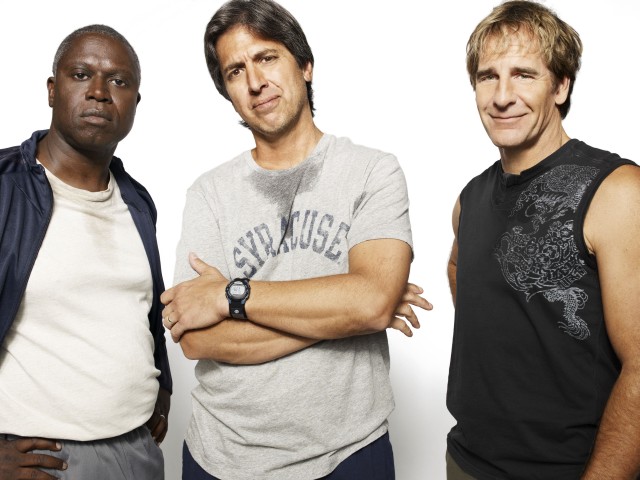
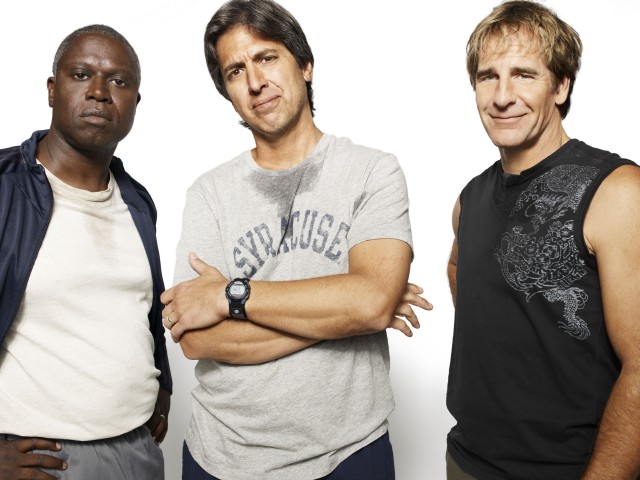
But as it turns out, Men of a Certain Age isn’t TV methadone — it’s the good stuff, people. Men focuses on three friends: Joe (Ray Romano), a recently divorced father of two teenagers, Owen (Andre Braugher), a married father of three who sells cars at his father’s dealership, and Terry (Scott Bakula), a single playboy and struggling actor. Believe me, I am normally not interested in the lives of middle-aged men — especially middling car salesmen and the owner of a party supplies store, but the show manages to make their stories compelling, amusing and touching all at the same time. What I love about Men is that it is realistically treats topics like aging, divorce, and parenthood without cynicism. Joe doesn’t bicker with his ex-wife, Sonia (Penelope Ann Miller, sporting the most unflattering haircut of all time), nor does he concoct elaborate plots to get back her back. Instead, Joe exists in the twilight between acceptance and denial — he lives in a hotel (to avoid moving into an apartment) and offers to fix things up around his (former) home. Indeed, it is often hard to tell if Joe misses his wife or simply his old life (that happened to include his wife). Sound depressing? It is. And yet…it’s not.
Here are some specific reasons to tune into Men:
1. You won’t hate Ray Romano

Okay, that was a little unfair — maybe some of you don’t hate Ray Romano. But anyone who names their sitcom Everybody Loves Raymond is kind of asking for it. Especially since Everybody Loves Raymond was such a colossal pile of shit. I tried — and repeatedly failed — to get through an entire episode of Raymond during it’s long run. But the Ray Romano in Men is both different from and similar to his character on Raymond — there’s the dopey look, the ennui of marriage and children, the humiliations of middle age — but as New York Times critic Alessandra Stanley put it “Joe is what would happen to sitcom Raymond if his wife left him, his parents died, and he started to hate his job.” Romano’s Joe is a chronic gambler (part of the reason behind why his wife left him) with crippling anxiety (part of behind why he failed to become a pro golfer) who misses his old, pre-divorce life. His predicaments, such as a tragicomic attempt at seducing a new date with sexually charged instant messages, are both uncomfortable to watch yet extremely real. Joe needs a hug and Romano plays him just right that the viewer wants to give him one.
2. Andre Braugher’s gut

In one episode of Men Braugher’s Owen is talking to his wife, Melissa (Lisa Gay Hamilton), as he dresses for work. He sits down on the bed, shirtless, his man boobs and formidable middle-aged gut on full display. This moment is not played for laughs, nor is it necessary to the narrative (he could have just as easily performed the scene wearing an undershirt). Rather, Braugher’s gut is simply a detail of the mise en scene, a reality of middle age. The scene is intimate, personal. Marriage — after so many years — is about sleep apnea machines (which Owen must use nightly) and bellies that have gone soft. These realities do not seem to bother Melissa, however. Their relationship is tender and real.
3. It’s a little bit sad, a little bit funny, a little bit disturbing
Not many shows can master this mix of emotions. In fact, off the top of my head I can only think of one other show that mixes these various emotions without plunging any one character into caricature: My So-Called Life (my guess is that Freaks and Geeks strikes a similar tone, but sadly I have not yet watched this series). Men manages to keep its humor, tragedy, realism, and awkwardness in a fine balance throughout each episode. One great example of this occurs in the pilot episode, when the three friends are driving to through the woods and accidentally hit a possum with their SUV. Joe worries that the animal might be suffering ad backs up over it (complete with a sickening thump noise) in an effort to put it out of its misery. But when the men look in the rearview mirror, they see the possum crawl off into the woods. Later that night, Joe and his bookie, Manfro (Jon Manfrellotti), with whom he has established an unlikely friendship, head back to the woods to seek out the possum — Joe simply cannot stomach that the animal might be in pain as a result of his actions. When the two men finally locate the (now dead) animal, we see Joe pick up a large rock and it seems that this will turn into a scene of violence. Is Joe going to vent his frustrations by bashing in the head of this dead animal? The next shot reveals that Joe is actually using that rock (and several more) to build a cairn for the animal. Some might call this storyline overkill (excuse the pun) but it really illuminates Joe’s character. As Manfro observes, “You’re weird, Joe.” I also like that the scene could have gone either way — violent or tender.
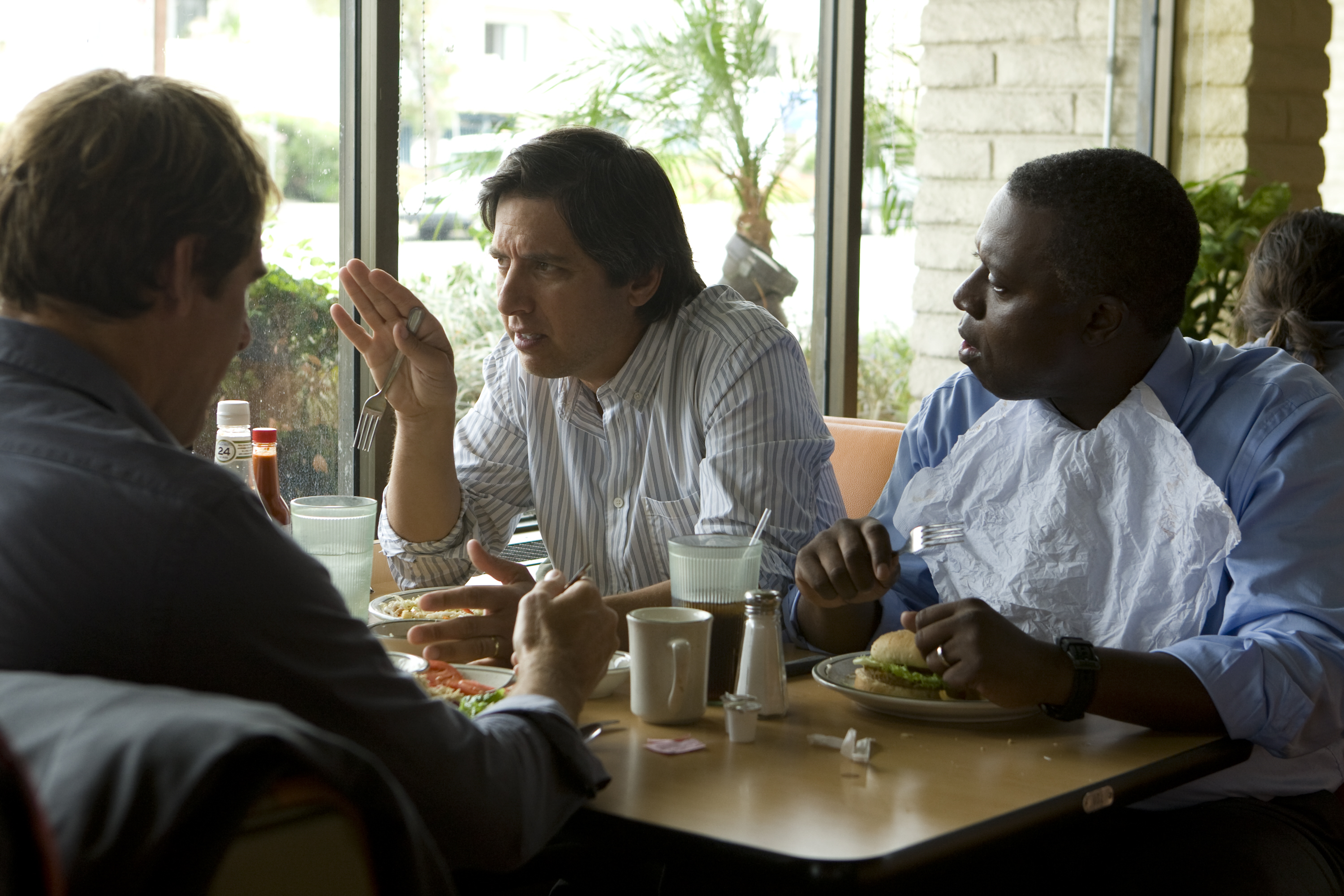
4. The lighting
I‘ve blogged about lighting before in my praise of Mad Men — not because I am a lighting aficionado, but because television shows do not always take their lighting design seriously. The light in Men of a Certain Age is beautiful and always appropriate for its Southern California setting.
Lucky for me, Men of a Certain Age has been renewed for a second season, despite its low ratings. But I’m still going to urge you to watch it because I promise, you will thank me later. Even if you hate Ray Romano. So go on, give it a try. You can watch full episodes at the TNT website. I recommend “Go with the Flow,” a funny but touching episode devoted to Joe’s first date in 20 years.
So what do you think? Are you watching Men of a Certain Age? Did you watch it and hate it? Please share your thoughts below…
Window Dressing: Spectacular Costuming in MTV’s THE CITY

I was just getting back into the blogging habit after my end of the semester/holiday sabbatical when, wouldn’t you know it, I gave birth. Right now my days are consumed with feedings, diaper changes, multiple loads of laundry and assuring the 3-year-old that despite all evidence to the contrary, she is still the center of the universe. Blogging is currently not a possibility.

However, I did finish up an article in early January which has just been published at Flow TV , the online journal of television and media studies. So this makes me feel like I’m still blogging even though all I’m doing is wiping poop off of my pet human’s rear end, which is more delightful than it sounds, I assure you. So until I am able to resume a more regular blogging schedule (i.e., when the pet human agrees to sleep for than 1 to 2 hours at a stretch), all I have to offer you is this article on MTV’s The City, “Window Dressing: Spectacular Costuming in MTV’s The City.“ Please feel free to leave a comment in the comment section and get some dialogue going. Also, big shout out to Devan Goldstein, who came up with the title for this piece. Thanks Devan!

I should add that the current issue of FlowTV is filled with lots of interesting articles — while you’re there, check ’em out!
BIG LOVE Season 4 Premiere: I Want my Beach Boys!

I had big plans to dissect the Big Love season 4 premiere but instead I find myself completely distracted by the fact that, after 3 seasons, the show’s creators decided to change the opening credit sequence. As I sat on the couch, waiting to hear the plaintive strains of French horn and harpsichord that open the Beach Boys’ “God Only Knows,” I was instead assaulted by “Home,”a song by some group called the Engineers.
This should not be that big of a deal, but you see, I’m a big fan of opening credit sequences. Credit sequences are arguably one of the most important segments of the text, both in film and television, because they are the first images the viewer encounters. Traditionally, television credit sequences have served a simple function, namely introducing the show’s cast, creators and guest stars, usually against the backdrop of a few images representative of the series.
The Cosby Show‘s opening credits:
Friends’ opening credits:
This trend has changed somewhat in recent years. Programs like Deadwood (2004-2006), Desperate Housewives (2004-), Six Feet Under (2001-2005), Dexter (2006- ), True Blood (2008- ), and others have replaced this traditional format with a sequence of disconnected, “dreamlike” images that are more “generic,” than specific, more connotative than denotative. These credit sequences clearly borrow their stylistic cues from music videos, which employ chains of disparate images that stress discontinuities in time and space to evoke abstract concepts.
Deadwood‘s opening credits:
Desperate Housewives‘ opening credits:
Of course, in this day of DVRs and TV on DVD, many people fast forward right past the opening credits. But the above sequences serve more than a utilitarian purpose — their imagery begs to be watched over and over. They beg for analysis. And I’m pleased to see that many TV scholars have recently turned their attentions to analyzing opening credits: Angelina Kaprovich on Dexter’s opening credits, Lisa Nakamura on True Blood‘s opening credits, Myles McNutt on Nurse Jackie‘s opening credits, etc.
Big Love‘s original credit sequence:
Although I always watch Big Love via my DVR, I almost always watch the opening credits all the way through. Why? First, there’s the music. I’m not a big Beach Boys fan but “God Only Knows” gets me every time I hear it. As so many music critics have mentioned, it is highly unusual for a love song to begin with the line “I may not always love you…” What I love about the song is precisely this honesty. When Carl Wilson sings, “If you should ever leave me, life would still go on, believe me,” he isn’t making any grand claims — he knows that the world does not begin and end with his beloved. But he still recognizes the beloved’s significance, as well as his own insignificance: “God only knows what I’d be without you.”

This mixture of idealism and realism, devotion and resignation, fits well with the imagery in Big Love‘s original credit sequence. When the sequence opens we see Bill (Bill Paxton), bathed in heavenly light, reach out with confidence to his first wife, Barb (Jeanne Tripplehorn). They ice skate in a circle. When there is a cut to a medium close up of Bill we expect to see Barb again, but instead he is embracing second wife, Nikki (Chloe Sevigny), who studies his face in total absorption. Her gaze is different from Barb’s — less confident, more awestruck. Yet another cut reveals Bill’s third wife, Margene (Ginnifer Goodwin). This may be favorite moment of the sequence — Margene, the youngest and newest bride, seems the most unsteady on her feet. And she embraces Bill like a ballast in a storm.

We then see Bill and the three women form a circle, each hand clasp shot in a close up:
 And then in a series of shot/reverse shot sequences Bill lovingly acknowledges each of his wives. They all seem perfectly calm, perfectly content:
 The bright blue sky, lush greens and soft lighting reflect the idealism of this arrangement, the “Principle” by which these four adults have chosen to live their lives. But in the midst of their bliss, we see a crack forming in the ice, which splits the four adults apart. This split could signify the various struggles the quartet faces over the course of each season. It could also represent the inevitable separation/destruction that will come with death:
 Bill, Barb, Nikki and Margene now find themselves lost, searching for each other amidst a series of white veils:
 Until they all finally reconnect…at a dinner party in space?:
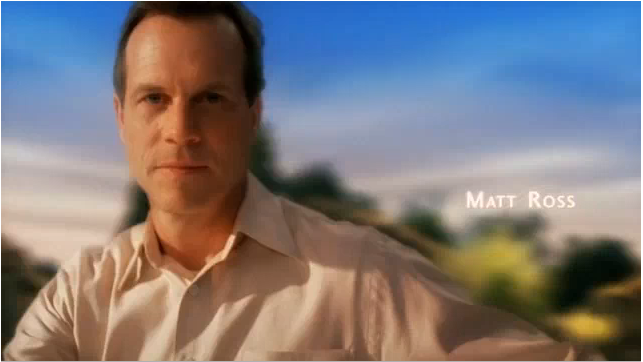
 This final image could be a rendering of the Henricksons’ existence in the afterlife — the family’s reward for faithfully adhering to the Principle. Or, more simply, this image could represent how the Henricksons are continually able to reconnect after each crisis. By opening each episode in this way the viewer is reminded of the characters’ own “big love.” No, I don’t support polygamy, but I find Big Love compelling because the show makes it easy for me to believe that these four people truly love each other and truly believe in the lifestyle they’ve chosen. They believe the sacrifices of polygamy are worth it — not because Bill is power hungry or his wives are brainwashed — but because they really do believe. A show about the devious Alby (Matt Ross) and his drone-like wives would not be nearly as interesting or poignant.
The new opening credits:
So, I suppose you could argue then that this change in the opening credits signals a profound change in the show’s characters and their relationships with one another. Los Angeles Times critic Allyssa Lee writes “…there’s no togetherness in this one. They’re all pretty much alone in their frames, except for the last one, where Bill and someone else are just reaching — only, they never connect. It’s all so … so distant. And so lonely,” while The Wall Street Journal‘s Dawn Fallik opens her recap with “We’re back in Utah and no longer skating on thin ice in ‘Big Love.’ Instead, the new intro has us falling, falling, falling through the air, as the four members of the Henrickson clan try to build a church, open a casino and bury past problems. We’re no longer in Beach Boy territory, folks.”
Sure sure, I get it. But I feel like this new sequence fails to establish what is so important about Big Love — why viewers keep tuning in week after week — the connections between the Henricksons. In this sequence Bill, Barb, Nikki and Margene are unable to touch each other. I think this is the wrong tone to set for this show week after week. And frankly, the final image’s nod to Michelangelo’s The Creation of Adam, is pretty ludicrous.


Finally, so it doesn’t seem as if I stopped watching the Big Love premiere after the credits, here are a few things I loved about last night’s episode:
Alby, dressed in possibly the dorkiest outfit ever, picks up a fine hunk of man (Ben Koldyke) at the park. Must have been those pasty white legs.
They served ice cream sundaes at the opening of the Blackfoot Magic Casino. Mormons are so naughty.
When Lura (Anne Dudek) hears that Roman (Harry Dean Stanton) is dead, she immediately goes to the safe to break out…a can of Coors light! So that’s the drink teetotalers choose when they really want to celebrate?
Lois (Grace Zabriskie) always finds a way to make to money (latest venture: smuggling exotic birds), leading me to wonder what kind of life she might have led had she not gotten mixed up with Juniper Creek. CEO of a Fortune 500 company perhaps?
Also, I don’t care what the critics say, I will never tire of Lois’ and Frank’s (Bruce Dern) attempts to kill each other in new and inventive ways. I love how Frank picked up Lois, outfitted in a girlish dress and head scarf, as if they were two kids on their way to the malt shop, a goofy moment made even more ridiculous by the two goons in the pick up truck who were planning to…tie Lois up in public?
Bill, who possibly had the most reason to hate Roman, is the only person who has the decency to close the dead man’s eyes.
So what did you think of the premiere? And are you happy with the new opening credits? Please share your thoughts below.
“If Hatin’ is Your Occupation, I Got a Full Time Job for You”: MTV’s JERSEY SHORE

“The Italian, whatever, national, whatever their organization is, they don’t understand that ‘guidos’ and ‘guidettes’ are good-looking people that, you know, like to make a scene and be center of attention and just take care of themselves. They are old-fashioned.
They don’t know that; they think it’s offensive, because maybe in their time it was offensive, but now it’s kind of a compliment. So they don’t understand that and that is what we are trying to say. They are way overreacting to the show. We’re 22 to 29 just having fun at the shore. They are just taking it way out of proportion.”
-“Snooki” on The Wendy Williams Show
Back in November I watching an episode of The City when MTV aired an ad for its latest “reality” series, Jersey Shore. The trailer promised to show me the “hottest, tannest, craziest guidos!” As if to make good on that promise, a young man with gelled hair (DJ Pauly D) confesses to the camera “I takes me about 25 minutes to do my hair” while another (Mike, aka, “The Situation”) explains, quite objectively, that he is “ripped up like Rambo.” But when another gentleman (Vinny) appears on-screen, amid a montage of fist pumping ecstasies, it was then that I paused what I watching, went to the DVR recording menu, and selected a season pass for Jersey Shore.
Despite its early low numbers (the premiere averaged just 1.375 million viewers), Jersey Shore‘s ratings have risen steadily since its December 3rd premiere. Bloggers and entertainment reporters speculate that this ratings increase has to do with the various controversies surrounding the program, including 1) the outrage and even violent threats against MTV coming from some Italian American groups over what they say is a stereotypical and offensive portrayal of their community (some companies have already pulled their ads from the program) and 2) the airing (and later the omission) of a scene in which one of the female cast members, Nicole, aka “Snooki,” is sucker punched by a male stranger. While both complaints are worth getting riled up over (i.e., it’s wrong to stereotype people and it’s wrong to exploit violence against women), neither actually applies to Jersey Shore. Here’s why:
1. The Stereotypes

The biggest controversy surrounding Jersey Shore is over its allegedly stereotypical portrayal of Italian American youth. I use the word “allegedly” here because I’m not convinced that the show’s “guidos” are stereotypical Italian Americans. There are currently 16 million Italian Americans living in this country. When I think “Italian American” I do not automatically think of “The Situation.”

Yes, I have met Italian Americans with gelled hair, waxed chests and glossed lips (particularly during my short-lived clubbing days). And yes, these people are frequently given the label “guido.” And yes, in my experience with the term, guido is used in a pejorative manner. People designated as guidos are associated not simply with tanning and muscles (two ostensibly positive traits, depending on your preferences) but also with bad taste, few inhibitions, and low intelligence. Jersey Shore‘s editors seem to support these negative stereotypes by including the following line from 22-year-old Staten Island native, Angelina, who complained about having to work in a T-shirt shop on the boardwalk “I feel like this is beneath me. I’m a bartender. I do great things.” And in the premiere episode Vinny pointed out that “Most people might consider being a guido like you’re stupid but I went to school, graduated college…”

Despite Vinny’s admission that guidos are believed to be stupid, everyone in the house embraces the term, referring to themselves as guidos and guidettes, and expressing a clear preference for dating guidos/guidettes. As Sammi “Sweetheart” explains, “If you’re not a guido then you can get the fuck out of my face!” Lines like these do complicate the idea that these individuals are being portrayed in a negative light. After all, no one is forcing DJ Pauly D into the tanning booth or demanding that Jenni “J-WOWW” wear studded hot pants and fishnet stockings out to the club. These kids are making these choices. And loving every minute of it.
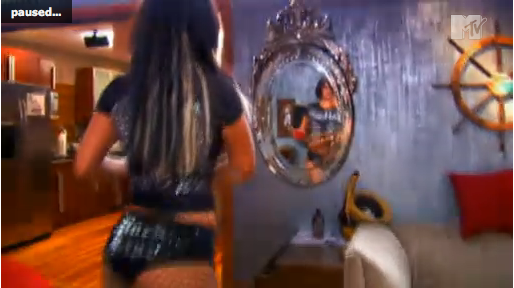
Now I can hear your objections already: “MTV is responsible for this portrayal of Italian Americans because they selected only those cast members who fit the guido stereotypes.” This is true. Except that people like The Situation, J-WOWW and Angelina are less indicative of the guido stereotypes than they are of youth stereotypes in general. Indeed, as Huffington Post columnist Simon Maxwell Apter wrote in a recent piece, “Their persistent claims of ethnic pride notwithstanding, the only ‘ethnic group’ that the Jersey Shore septet really represents is Jersey Shore cast members. Though the cast clearly relishes their shared ethnic background, they use their Italian heritage not as an identity, but instead as a license to develop an orangeish skin tone, use a lot of hair gel, and spend hours lifting weights.”

I agree. In fact, if the cast members of Jersey Shore didn’t have thick Long Island, Staten Island and New Jersey accents, MTV could have easily named the show The Real World: New Jersey. If you have watched any season of MTV’s The Real World since at least 2002 (the year of the infamous Las Vegas season), then you know that MTV generally populates its casts with individuals who:
are incredibly narcissistic
have an inflated sense of self-worth
are not particularly bright or well-informed about current events
prefer to spend every night drinking to excess
enjoy wearing tight, revealing clothing (both sexes)
are extremely horny
abuse self tanners
work out obsessively
get into fist fights whenever possible
Need I go on? What we are seeing on Jersey Shore are not MTV’s exploitation of so-called guidos, but rather, MTV’s exploitation of American youth, something MTV has been doing for years. So if there is going to be outrage over this program, it should be coming from twentysomethings across the county, not just UNICO, the national Italian-American service organization, or the Jersey Shore Convention and Visitors Bureau.
2. The Punch
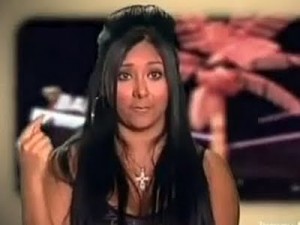
Early teasers for Jersey Shore contained footage of Snooki, the diminutive but loud-mouthed house mate, being punched in the face by a large, male stranger at a bar. Teasers are used to lure viewers into watching a program by featuring the season’s most sensational imagery, so it makes sense that MTV would include this footage. However, when the episode, “Fade to Black,” finally aired on December 18th, MTV decided to pull the footage of the punch, replacing it instead with a black screen. MTV issued a statement about this decision:
“What happened to Snooki was a crime and obviously extremely disturbing. After hearing from our viewers, further consulting with experts on the issue of violence, and seeing how the video footage has been taken out of context not to show the severity of this act or resulting consequences, MTV has decided not to air Snooki being physically punched in the face.”
Given that MTV had aired the 5 second clip multiple times in the weeks leading up to the episode, this decision seems strange. Or rather, it makes perfect sense. Realizing that the key to Jersey Shore‘s ratings is controversy, MTV cleverly channeled the outrage over the “punch heard round the shore” into even more free publicity for the program.
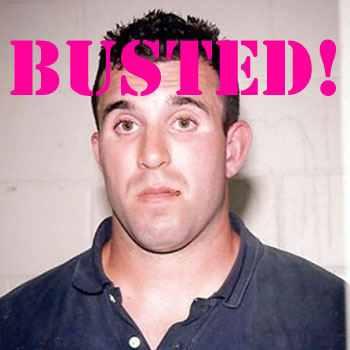
Like the exploiteers of old (Kroger Babb, David Friedman, etc.) MTV understands how to work its target audience. Sensationalizing and then censoring the punch footage is a rhetorical strategy rooted in classical ballyhoo. Eric Schaefer defines ballyhoo as “that noisy, vulgar spiel that drew audiences to circuses and sideshows …a hyperbolic excess of words and images that sparked the imagination” (103). Ballyhoo promises its audiences something — an image, an experience, or reaction (“This movie will nauseate you!”) — that it does not necessarily fulfill. Similarly, MTV promised us a punch, but did not deliver. Therefore, they pulled in viewers and still got to look like the good guy. Sort of.
Keep in mind that MTV has aired many sucker punches in the past. In particular, I’m thinking about a sucker punch that took place during a season of The Real World: Austin. In the premiere episode the Austin cast mates go out to a bar and Danny Jamieson is punched in the face. The sucker punch crushed Danny’s eye socket, resulting in blurred vision and requiring surgery. Despite Danny’s rather serious injuries, MTV had no qualms about airing this footage repeatedly — in ads promoting the series and then in recaps throughout the course of the season.

It seems a bit sexist to me that there was outrage over MTV’s (almost) airing of Snooki’s punch but not over Danny’s punch. Now, I understand that Snooki is a small woman and Danny is a strapping young man. But both were sucker punched, meaning both were completely defenseless when they were hit. And Danny sustained far more serious injuries — those who watched the Austin season may recall that Danny’s face was disfigured throughout the duration of the season. If there is any outrage here, it should be over MTV’s exploitation of violence. It is wrong to sucker punch anyone, whether they are male or female, big or small. Furthermore, Snooki and Danny were assaulted precisely because they were on MTV reality programs (for some reason the presence of the MTV camera crew throws bar patrons into an uncontrollable rage) and MTV then reaped the rewards of that unmotivated violence by exploiting it in ads. This is the true outrage of this situation.
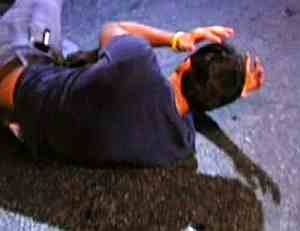
Just in case my comments might be misread, let me make this clear: domestic violence against women is a serious issue. But Snooki’s punch is not an example of domestic violence nor is it an issue of violence against women. Snooki’s punch, like Danny’s, boils down, not to gender, but to the exploitative, circus-like climate created and nurtured by MTV and its film crews. By omitting the footage of Snooki’s punch MTV wants to look like the hero, but they are a primary culprit (along with the two douchebags who did the punching, of course. Big, big douchebags).
Therefore my friends, if you are watching and enjoying Jersey Shore, don’t feel like you are implicitly supporting ethnic stereotyping or violence against women. Instead you are supporting the stereotyping of youth culture and the violence that results when these youth are given too much alcohol, self tanner, body glitter and a barrage of cameras. Oh wait. That’s not good either, is it?
Time Jumping TV, aka, the Most Annoying TV Trope of 2009
Whenever I screen Luis Buñuel’s Un Chien Andalou (1929) for students one aspect of the film that we invariably discuss (in addition to the infamous eye-slicing scene), is the way that the filmmaker plays with time. The film opens with an intertitle “Once upon a time” and is followed with such erratic markers of time as “eight years later,” “around three in the morning,” “sixteen years earlier” and finally, the cryptic “in spring.”


I enjoy Un Chien Andalou‘s defiance of temporality because it makes sense in the context of a Surrealist film; Surrealism aims to disturb the viewer through the irrational pairing of images — ants crawl out of a hole in a man’s palm, an androgynous young woman pokes a severed hand with a stick, etc. The film’s temporal disjunctures further add to the viewer’s unease — we cannot orient ourselves in time and are therefore wholly at the whim of the filmmaker. This kind of playing with time is not limited to Surrealist films. Films as diverse as Pulp Fiction (1994, Quentin Tarantino), Run Lola Run (1998, Tom Tykwer) and Memento (2000, Christopher Nolan) jump around in time, as do television shows like Lost. Recently, programs like One Tree Hill and Desperate Housewives decided to shift their narratives to four and five years in the future, respectively, a bold move which ultimately revived the lackluster storylines of both programs.

It’s not that I don’t enjoy this narrative structure (even when it’s overused). I just hate when writers use this trope to make an otherwise uninteresting story appear more interesting. To show you what I mean, let’s look at two recent examples of narrative time-jumping, one that worked and one that failed.
The One that Worked: Modern Family‘ s “Fizbo”
“Fizbo” opens with various members of the Pritchett clan pacing anxiously around a hospital waiting room. Mitchell (Jesse Tyler Ferguson) refers cryptically to an “accident” while Jay (Ed O’Neill) wonders how it might have been averted. Their faces are grave. At this point in the show the viewer is in the dark about who has been injured, how s/he has been injured and how serious the injury is. The show then jumps back in time to reveal Phil’s (Ty Burrell) decision to host an elaborate birthday part for his son, Luke (Nolan Gould).
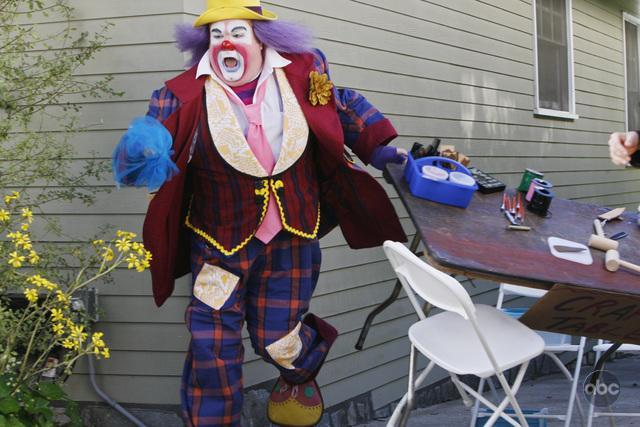
This use of time jumping is effective in “Fizbo” because the viewer is given double duties. First, we are watching the episode’s narrative — about Luke’s over the top birthday party (a moon bounce! a reptile lady! a clown!) — unfold. But we are also searching for the cause of the horrible accident. As a result, every new element introduced to the story becomes a suspect: Jay gives Luke a crossbow as a present, a zipline running through the middle of the party seems destined to cause a concussion for some unlucky child, and one of the reptile lady’s poisonous scorpions is set loose by a jealous Haley (Sarah Hyland). Without the time jumping narrative structure the series of bizarre events occurring at Luke’s birthday party would be just that — bizarre. But knowing that one of these dangers will be the cause of the hospital visit we witnessed at the beginning of the episode serves to tie these disparate elements together. In fact, the more bizarre the element (i.e., the crossbow), the funnier the episode becomes.
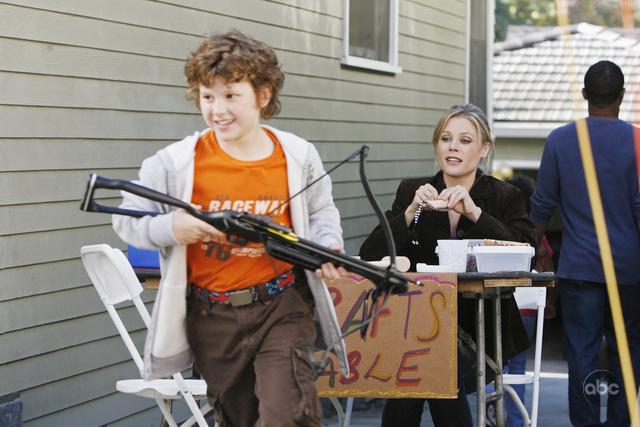
We eventually learn that Luke is the one in hospital and that he broke his arm after slipping on some beads from the craft table his mother set up. This is the great punchline of the episode because the craft table was the most banal aspect of the party but ultimately, the most dangerous. I’ll never look at comb sheaths the same way again.
The One that Didn’t Work: Gossip Girl‘s “The Debarted”
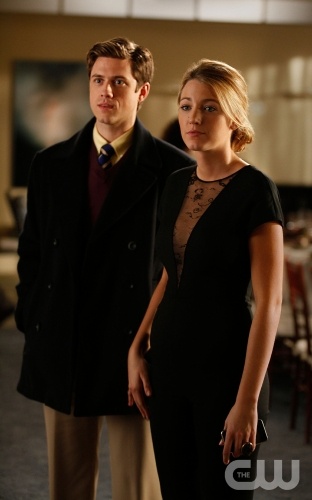
“The Debarted” opens with Serena (Blake Lively) and her milquetoast lover, Tripp Vanderbilt (Aaron Tveit), who I like to call Waspy McWasperson, engaged in a lover’s quarrel. The source of their tension is, I presume, supposed to be mysterious to the viewer. But given that the characters on this program fight with each other constantly, making up and breaking up and swapping lovers and eloping and divorcing in a nonstop carousel of terrible plotting, I was not all that intrigued. Then, out of nowhere, three wolves appear in the middle of the road (seriously!) and poor old Waspy swerves to avoid hitting them (animal lover that he is) and his Range Rover plows into a guard rail. Nooooo! Despite my lack of interest in why Serena and Congressman McWasperson were fighting and who was hurt, the episode jumped back to “eight hours earlier” to explain the whole mess.
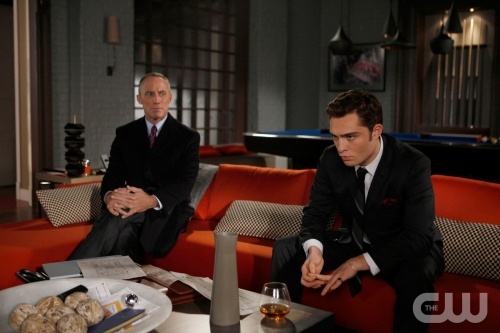
The reason “The Debarted”‘s use of time jumping fails is that it is entirely arbitrary. The big event that the episode is supposed to lead up to — the car crash — only involves two characters and so, when the time jump occurs, all of the other character’s storylines remain unaffected. Knowing why Serena and Waspy were fighting has little bearing on the far more compelling storyline involving Chuck (Ed Westwick) and his inability to mourn his father (the Bart referenced in the episode’s title) on the one year anniversary of his death. Eventually Chuck ends up at the hospital to see Serena, which leads him to finally break down and cry, but the episode needn’t have opened with the car crash in order to bring about Chuck’s change of heart. The episode also focuses on a “secret letter” that Lily (Kelly Rutherford) is keeping from Rufus (Matthew Settle) (YAWN!), but the car accident has very little to do with that story. The fact remains that “The Debarted”‘s narrative and its impact on the show’s characters would have remained unchanged if it had moved forward chronologically. Time jumping in this episode is simply a gimmick, a crutch for the show’s lazy writers. In fact, it is my personal opinion that Gossip Girl is penned by two monkeys throwing their poop at a keyboard. But that’s just my opinion.
So what do you think? Are you sick of time jumping TV? What other prgrams are doing this right now? And who is using this tope successfully and who is failing? I would love to hear your comments.
Notes on THE HILLS Finale

Yet another season of The Hills has drawn to a close and yet the earth still rotates on its axis and the sun still hangs in the sky. Like every Hills episode, the finale was jam-packed with shocking revelations, reversals of fortune and edge of your seat drama.
I’m just kidding ya’ll! Nothing happened! But I’ve written a recap anyway. Please to enjoy:
Brody and Jayde:
Over the course of this season Brody and his on-again/ off-again paramour, Jayde, have endured a series of meaningless fights. I say meaningless because their conflicts are wholly manufactured for the cameras. This is nothing new for The Hills –Spencer and Heidi have turned the fake fight into an art form. The difference with this fake couple, however, is that these fake fights generate palpable discord between Brody and Jayde. Brody, whose emotional range resembles that of a Ken doll, nonetheless appears genuinely annoyed with Jayde whenever he is around her. He seems to loathe her (I too find her asymmetrical eyes vaguely disquieting). So I was not surprised when he decided to end their relationship for good during the finale.

But what surprised me — and it takes a lot for The Hills to surprise me — is that Brody provided the voice of reason in this episode. Witness this conversation between Brody and Jayde at a friend’s engagement party:
Jayde: It’s weird how they’ve been together for like 2 months and they’re engaged and we’ve been together for a year and a half and we’re not even living together.
Brody: Yeah well we’re…smart.
Zing! Now back to the stripper pole for you, dear Jayde.

Lo is an Accessory
I’m not sure why Lo is still on The Hills. Lo is Lauren Conrad’s friend, her sidekick, her accessory. Seeing her in these episodes is equivalent to having one of Lauren’s handbags enjoying a latte with Audrina. It’s unnatural. And really unfair to the handbag, who is probably very bored hanging out with Audrina.

And am I supposed to believe that Lo and Audrina are now BFFs? These two women hated each other last season. And yet here they are in the finale, shopping together at Catherine Malandrino. But Lo is a “monologue catcher” par excellence and the show needs her to balance the lunacy of the other characters. For example, during their shopping trip Audrina tells Lo about her ludicrous plan to meet with Justin “one last time.” Lo is skeptical — because we’ve already seen this episode, right? — and asks, “But what if you get into the same situation, where he’s in control of the situation?” Great question Lo! Why does Audrina keep returning to Justin for further ego bruising? But Audrina won’t listen and Lo sighs and looks in the mirror — she really would look cute in that mini dress. Time for lattes!
Audrina Still Thinks The Hills is Real
Audrina is the one person in America who still believes that the events transpiring in the world of The Hills are real. This did not become fully clear until this season when her earnest reactions to the “drama” unfolding around her stood in stark contrast to the detached, almost robotic actions of her jaded castmates. Audrina is a real life example of The Truman Show. Even Enzo knows The Hills isn’t real and he’s only 6.
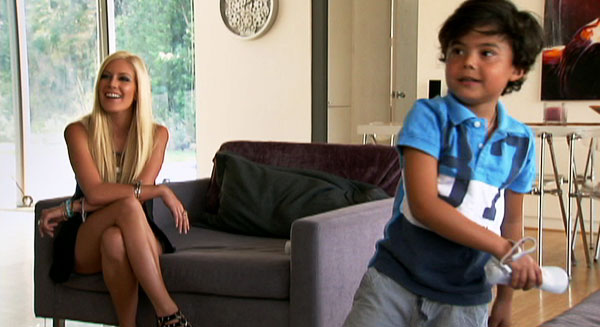
When Audrina headed to the pier (so dramatic!) to talk to Justin “one last time,” she was genuinely hurt by his nonchalance. He tells her “Maybe you just weren’t the one” but what he should have said was “Audrina, our relationship was last season’s storyline. This season I’m supposed to date Kristin. Didn’t you read the script?”
No, Justin, Audrina did not read the script. As her big brown eyes fill with tears it is painfully clear that Audrina believes the world she is living in is real. Poor doe-eyed Audrina.

Speidi is Not Procreating
Spencer and Heidi function on a different plane from their Hills cast mates. They are the undisputed king and queen of faux reality and they rule their domain with an iron fist. I love, for example, how Heidi runs errands in outfits and make up suitable only for a rock video or walking the corner (a high-class corner). It’s just the grocery store, Heidi, chill out. Take off the stilettos.

During the finale it is revealed that (BIG SPOILER HERE) Heidi is not pregnant. Of course, as with all Speidi-generated plotlines, the interest lies not in the “what” but the “how.” And this ridiculous plotline yielded some great lines from Spencer:
On Heidi’s attempts to get pregnant behind his back: “I feel like it’s a sperm kidnapping — straight hijacking sperm.”
Explaining to the urologist why he wants a vasectomy: “I heard it’s kind of like a faucet where I can turn it off and then turn it back on again if I ever need to. So I’m coming here to turn it off.”
As the urologist shows him pictures of how a vasectomy is performed: “Oh so you do go punch into the nuts?”
Brilliant.
I Still Miss Lauren
Hills finales usually end by providing the viewer with some modicum of “closure” for each of the main cast members’ story arcs and the final scene must always, always go to the heroine. So this season’s finale ends with Kristin deciding that yes, she will date Justin Bobby, despite the fact that he has trouble stringing more than two words together. As the camera tracks backwards from Kristin’s picturesque beach house balcony we see Justin drape his (ugh, dirty!) motorcycle jacket over Kristin’s dainty shoulders.

This image should have filled me with joie de vivre but all I could think was: where’s Lauren? How does her story arc end? Then I remembered that Lauren was gone. She’s been gone all season. And I began to weep. I feel like the protagonist of Memento who keeps forgetting that his wife is dead and then has to relive the pain of her death over and over. Okay, that may be a bit dramatic but you get the picture.

I miss you Lauren Conrad. And I shall avenge you.
V: Then and Now

As soon as I heard that ABC was remaking V, the classic 1980s miniseries/television series about extraterrestrials coming to Earth, my mind was flooded with long dormant memories of the original series. Growing up with an older brother who had a taste for the macabre, I was exposed to a lot of popular culture that was not entirely age-appropriate — Stephen King novels, Night of the Living Dead (1968, George Romero), The Dead Milkmen — basically anything with “dead” in the title. And so it should not be too surprising that I watched V, in its various televisual manifestations (miniseries, television series), at the tender age of 7 or 8.

I must have repressed most of my memories of the show because I could only conjure up flashes of images: a beautiful woman eating a rodent, a “Visitor” peeling back his faux human skin to reveal lizard skin below, and a super cheesy 80s era rendering of the inside of a “high tech” mothership. Lucky for me, the internet was more than happy to confirm these hazy visions.

The rodent eating:
This scene is truly laughable now but I’m pretty sure I choked on my Oreos when I watched this as a kid.
The skin-removing:
I think the special effects here are still pretty effective. They were so effective, in fact, that the series made me suspicious of everyone I knew. If anyone could be a V under their natural looking human skin, then what about Mom? Was she a V? What about Dad? I kept a close eye on the hamster cage just in case.
And something that I don’t remember at all but which is hilarious:
Start watching around the 2:10 mark.
Of course, the 2009 remake of V has far superior special effects. For example, when the mothership arrives in New York City a few minutes into the pilot episode we first see its metal body reflected in the windows of a generic office building. It is a beautiful, chilling moment. Anything that arrives that way cannot be good.

And of course the V’s lizard skins are far more … is realistic the word I’m looking for here? I’ll put it this way: although I figured out that Dale (Alan Tudyk) was an undercover V about 5 minutes after meeting his character, I still let out an involuntary shriek when Erica (Elizabeth Mitchell) pulled back his human skin during a violent showdown.

In terms of themes, the 2009 series has shifted away (at least in the first two episodes that have aired) from the overt Nazi allegory of the original (and no, I did not catch the references to Jewish resistance groups and Fascism and Hitler Youth when I was 7. I was in it for the rodent eating). While V is still playing with some of these themes — for example, the Peace Ambassadors are given blazers reminiscent of SS uniforms and the Vs make generous use of propaganda — there seems to be more of a push to see the Visitors as an allegory of modern terrorism. Only these terrorists have discovered that it is far easier to achieve your objectives if you study your targets, use their language and customs and offer them peace, all while plotting how to gobble them up.

One interpretation I am not willing to swallow (excuse the pun) is that the new V is an allegory for the Obama administration and its politics (also here and on many, many other sites and blogs). The scene in which Anna (Morena Baccarin), the beautiful, calm leader of the Vs, offers Earth a form of “universal health care,” is deftly intercut with a scene in which an underground resistance movement is slaughtered by a band of vicious Vs. Certainly such editing techniques make the promise of universal health care appear sinister, as a kind of bait and switch for more nefarious doings. But I read this much discussed moment less as a dig at the President and more as a topical reference that would resonate with audiences. In other words, given the way our health care debates have been going, universal health care only seems possible in the world of science fiction.

And yes, Anna and her fellow Vs are attractive, charismatic, and popular with “the kids,” just like Obama was/is. But isn’t this the case with most successful leaders (both the good and the evil)? If Anna were ugly and devoid of personality then broadcasting her visage over 29 major cities would not be the best way to convince the world to cooperate with the Vs. I am sure that right wing bloggers and pundits will continue to see the program as further evidence that the Obama administration will bring about the destruction of humanity, but this will not keep me from watching the show.
Quick thoughts on the cast:
1. Throughout the pilot episode I kept asking my husband “Who is that guy?” every time Ryan Nichols appeared on screen. “I know that guy!” Then as the second episode started (we watched them back to back) and the name “Morris Chestnut” appeared on the screen. Since his acting debut in Boyz N the Hood (1991, John Singleton) Chestnut has appeared sporadically on the big (The Inkwell [1994, Matty Rich]) and small (Bones) screen, but I hope his leading role in V will ensure more steady work. The man looks fantastic!

2. I am really hoping that Rekha Sharma, who plays FBI agent Sarita Malik, turns out to be an undercover V since she was also one of the “final five” Cylons on Battlestar Galactica (another wonderful, contemporary remake of a somewhat cheesy sci fi program).

3. Elizabeth Mitchell. You are truly kick ass. That is all.

So are you digging V? is it better than the original so far? And does ABC hate Obama?
BET’s BALDWIN HILLS: Injecting Race and Class into the Projective Drama
For those of you who are regular readers of this blog (hi Mom!), you may have noticed that my posting has dropped somewhat over the last few weeks. This is due to the mid-semester crunch as well as some other writing deadlines I had to meet.

One of these deadlines was for the wonderful site Flow TV, “a critical forum on television and media culture published by the Department of Radio, Television, and Film at the University of Texas at Austin. Flow’s mission is to provide a space where the public can discuss the changing landscape of contemporary media.”

If you’d like to read my article on BET’s reality show, Baldwin Hills, it went live today and can be accessed through the link below:
BET’s Baldwin Hills: Injecting Race and Class into the Projective Drama
MAD MEN FINALE Recap
I was not able to watch the Mad Men finale on Sunday night because I was simply too tired to stay awake for it. The problem with writing a Mad Men finale recap late is that you might as well not write it at all. By now all of the die hard Mad Men fans have already gorged themselves on recaps and reviews of “Shut the Door. Have a Seat.” And after reading some particularly insightful pieces ( for example James Poniewozik’s review on Time.com), I wonder how much I have to add.
But the thing about Mad Men is that it almost begs you to write about it. So gorged or not my friends, I hope you have some room for dessert:
1. The Divorce
If any TV couple should get a divorce, it’s Don and Betty Draper. In addition to lying to his wife for the last ten years about his family, his past and his real name, Don has systemically cheated on his wife. “Cheat” doesn’t even really encompass Don’s behavior over the last 3 seasons — he has pursued extramarital affairs with a persistency and zeal unmatched by even Three’s Company‘s Larry Dallas.
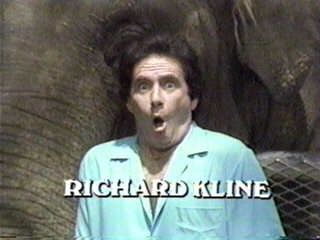
And while Betty’s transgressions were less severe, she did have sex with a stranger in a bar bathroom and nurtured an emotional relationship with Henry Francis (who I do not trust AT ALL). As Don chides, “All along you’ve been building a life raft.” Oh Betty.
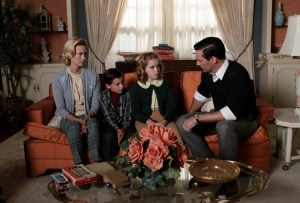
Don and Betty should break up and yet, watching them go through the various motions of the TV couple divorce — meeting with a lawyer, having “the talk” with their children — I couldn’t help but feel very sad. Indeed, when Don crawled into bed with Sally, who slept in Grandpa Gene’s old pull out cot to be closer to her exiled Daddy (even though, as she states, “Gene’s room is creepy”), I was overwhelmed with emotion. There was hardly room for the two of them in that creaky little bed, but in he crawled, still wearing his suit. Don’s children seem to be his only link to his emotions — to the real person (is he called “Dick Whitman”?) under the Don Draper veneer — and so I see this divorce primarily as Don’s loss, rather than Betty’s. Though my guess is that Season 4 will reveal the toll that divorce is taking on Betty.
2. Joan!
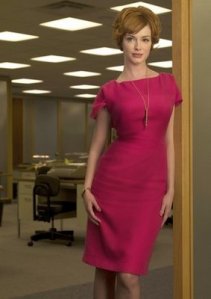
I love Joan. Who doesn’t love Joan? And the moment that Don, Roger Sterling, Bert Cooper and Lane Pryce began to plot how they might abscond from Sterling Cooper with their accounts and files in tact I turned to my husband and said “Joan! They’re going to get Joan!” And when Joan returned she was once again wearing her iconic pen around her neck — a symbol of her power and independence that had been absent from her ample bosom for most of the season. Welcome back pen and welcome back Joan!
3. Peggy
I imagine that if you tried to hug Peggy Olsen she would be one of those people who stiffen and then pat you uncomfortably on the back. Peggy is not sentimental but, paradoxically, she is a successful copywriter because she understands sentiment all too well. Don even tells Peggy — in an attempt to woo her into joining his new firm — that she alone understands that “something terrible has happened” (which I took to mean “Peggy, you understand that people are fundamentally sad and you know how to exploit that sadness in order to sell them consumer goods”).
In this episode Peggy finally seemed to recognize her own worth as a copywriter and as an asset to Don. She initially tells Don to shove it when he tries to strong-arm her into leaving Sterling Cooper, making it clear that she is not like the other women in Don’s life. If he wants her, he’ll need to spill his guts. And when he shows up at her apartment, hat in hand, Peggy weeps. Sure, they were discussing work, but they were also discussing their complicated relationship. When Peggy asks Don if he will stop speaking to her if she refuses his offer, he counters, “No. I will spend the rest of my life trying to hire you.” “Damn that Don Draper’s smooth!” was my husband’s reply to this. But I think Don was being sincere. Peggy is more than just a great copywriter to Don — they are each other’s double and Don finally admits that out loud in this episode. I hope their relationship is explored more in Season 4.
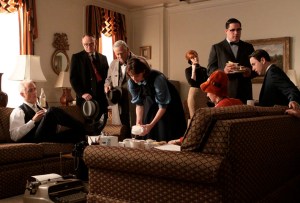
4. The Lighting
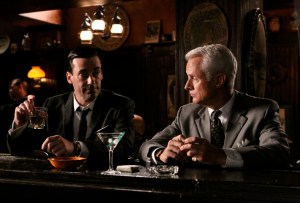
With its superb cast, nuanced writing and slow burn narratives, it is easy to overlook Mad Men‘s understated formal style. This season — and especially in this finale — I have been captivated by the show’s Rembrandt lighting. For example, after Roger and Don convince Pete Campbell to leave Sterling Cooper they head to a bar to commiserate and plot their next move. The set is soaked in shadows, with pockets of brightness here and there. This lighting style is reminiscent of The Sopranos, which also used chiaroscuro lighting to depict a homosocial milieu. In this mix of light and darkness men discuss the things that (they think) they need to keep from their women: their sexual dalliances, their (dirty) business, their feelings.
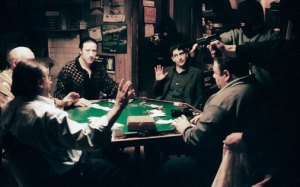
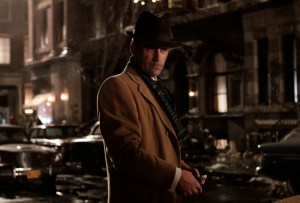
This is also the lighting that is frequently used in the flashback sequences to Don’s childhood. In the finale Don’s father is killed in the darkness of the stables, with father and son alone in the shadows.
5. The Music
Many recaps have already compared this finale to a heist movie (also here and here), with Don, Roger and Bert assembling a team of the Sterling Cooper’s finest in order to steal the dying company’s riches. Roger was firing off zingers like George Clooney and everyone looked like they were having a grand old time. This mood was enhanced by the jaunty music used throughout the episode. Is it my imagination or does this series rarely employ non-diegetic music during an episode (saving it instead for the finale scene/closing credits)? I found myself really noticing the music during these scenes, as if the show was winking at us, letting us know that this heist storyline was all campy fun. This music noticably disappears in the scenes with Betty and in Don’s flashbacks to his childhood, which are highly tragic.
Overall I found the Season 3 finale to be immensely satisfying — the perfect cap to a wonderful, nuanced, slow burn (NOT SLOW!) season. I can’t to see what Season 4 holds in store…
How GLEE Taught my Students to Stop Worrying and Love the Musical
This week in Introduction to Film was musical week — my favorite week. I adore musicals because they are designed to be loved. As Jane Feuer has argued, musicals, particularly the backstage musicals released by MGM’s Freed Unit, function to affirm the necessity of the musical genre in the lives of its audience (458). Forever striving to recreate the sense of liveness lost when the musical left the Broadway stage and became a mass-produced product, classical Hollywood musicals wish to break down the barriers between the performer on screen and the audience sitting in the theater. These films want to merge the dream world of song and dance with the mundane real world where we trip over our feet. Musicals achieve this goal by making song and dance appear natural, effortless and integrated into every day life.
My Intro to Film students are generally put off by musicals, finding their song and dance numbers to be “awkward” or “cheesy” (their words, not mine). And so I usually devote lecture time to explaining how many musicals attempt to integrate song and dance naturally into the diegesis — to ease this transition for the viewer. We look, for example, at one of my all time favorite musical numbers, “Someone At Last” from A Star is Born (1954).
Aside from the crude ethnic stereotyping, I find this number to be completely enchanting every time I watch it. I point out Garland’s skillful use of bricolage, that is the way she “happens” to find certain props around her living room — a smoking cigarette, a tiger skin rug, a table resembling a harp — at just the moment that she needs them. The “mundane world” of the living room becomes, through the joy of performance, a Hollywood set (which, in reality, it is). Bricolage creates a feeling of spontaneity, which is central to the appeal of the musical. As Feuer argues “The musical, technically the most complex type of film produced in Hollywood, paradoxically has always been the genre that attempts to give the greatest illusion of spontaneity and effortlessness” (463). The more natural a performance appears, the more we enjoy it. As we watch this routine we momentarily forget that Vicki Lester/Judy Garland is the most famous female musical star and (both within and outside A Star is Born) and is instead a devoted wife who loves to sing and dance for her husband (James Mason) and for us.
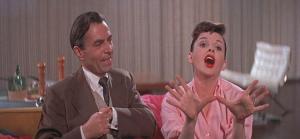
When I show this scene I usually have to put on quite a show myself, explaining to my students exactly why this performance is so satisfying, so joyous. But this week when I showed this clip I heard my students giggling (appropriately) at Judy’s jokes and expressing amusement at her clever use of props. They were enjoying it. The same thing happened when I showed them another one of my favorites, the iconic title number from Singin’ in the Rain (1952). In this scene, Don Lockwood (Gene Kelly) has just shared a kiss with Kathy Selden (Debbie Reynolds), and is consequently filled with joie de vivre. It is pouring rain outside but he dismisses the car that waits to drive him home. Don wants to walk and luxuriate in this moment of romantic bliss. Then, he just can’t help himself. His steps down the sidewalk turn almost involuntarily into dance and his dreamy, romantic thoughts become song. Here dancing and singing truly emerge out of a “joyous and responsive attitude toward life” (459).
As this scene played on the big screen I turned to look at my 100 students and was delighted to see the enchanted looks on their faces. They were enthralled, as I am every time I watch this number. They were enjoying themselves. At last!
But why? Why now? The answer is Glee. When I began my lecture on the musical earlier this week I told my students that by the end of the week I was hoping to have some musical converts in the class. “If you are watching the show Glee right now” I said, “the convention of breaking into song and dance shouldn’t be that foreign to you.” A large portion of the class nodded their heads in reponse to this. As it turned out, more than half of the students in my class are watching the show. And I think this has made all the difference.
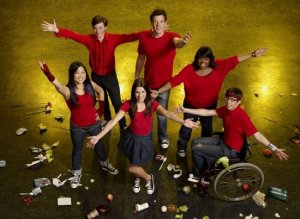
Though I have not always been happy with the politics of Glee, I have always been satisfied with their adoption of the conventions of the backstage musical. Characters sing when they are in love (“I Could Have Danced All Night”) or lust (“Sweet Caroline”) and they sing when their hearts are breaking (“Bust The Windows”). And the most successful (i.e., the most passionate) group performances in the series arise, as they do in the classical Hollywood musical, when the show’s characters are working together and cooperating (“Don’t Stop Believin’,”Keep Holding On”). Resolution in the narrative equals resolution on the stage. The classical Hollywood musical incarnate.
So while Glee may not be breaking any new ground in its use and depiction of homosexual characters or ethnic minorities, it has, to my delight, given my students license to love the musical and to revel in its joy. And that’s something to be gleeful about.
Works Cited
Feuer, Jane. “The Self Reflexive Musical and the Myth of Entertainment.” Film Genre Reader III. Ed. Barry Keith Grant. Austin: University of Texas Press, 2003. 457-471.
 judgmental observer