Year: 2009
Ironic Muppets and Horny Houseplants: SESAME STREET’s Dual Address
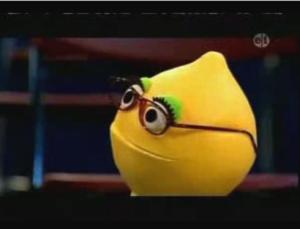
This week I was two-timing my blog by posting on another, far more critically incisive site, In Media Res. If you are not familiar with this site, here is its basic mission:
In Media Res is dedicated to experimenting with collaborative, multi-modal forms of online scholarship.
Each day, a different scholar will curate a 30-second to 3-minute video clip/visual image slideshow accompanied by a 300-350-word impressionistic response.
We use the title “curator” because, like a curator in a museum, you are repurposing a media object that already exists and providing context through your commentary, which frames the object in a particular way.
The clip/comment combination are intended to both introduce the curator’s work to the larger community of scholars (as well as non-academics who frequent the site) and, hopefully, encourage feedback/discussion from that community.
Theme weeks are designed to generate a networked conversation between curators. All the posts for that week will thematically overlap and the participating curators each agree to comment on one another’s work.
Our goal is to promote an online dialogue amongst scholars and the public about contemporary approaches to studying media.
In Media Res provides a forum for more immediate critical engagement with media at a pace closer to how we typically experience mediated texts.
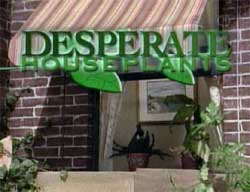
This week’s theme is “Kids TV” and several wonderful scholars are curating clips including: Michael Z. Newman (on The Wizards of Waverly Place), Heather Hendershot (on Ernie and Bert slash), Elana Levine (on Aaron Stone), and Jason Mittell (on Yo Gabba Gabba). My clip and curator’s note, entitled “Ironic Muppets and Horny Houseplants: Sesame Street‘s Dual Address” can be found here.
I hope you’ll check it out and possibly join the conversation!
WHERE THE WILD THINGS ARE review

My husband does not like to go out to the movies. But after viewing the trailer for Where the Wild Things Are a few weeks ago he changed his mind. “That,” he told me, “I would see in the theater. We can bring the 3-year-old.” Here my heart sank: I was ecstatic that my husband was willing to venture out of the house for a movie. But after looking into the film’s production history and reading early reviews, I knew that this film was not for 3-year-olds.
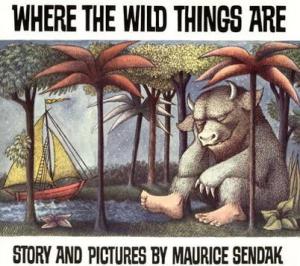
Seeing the film this past weekend only confirmed my hunch. It’s not that Spike Jonze’s vision of Maurice Sendak’s classic 1963 book is too violent for children (though there are scenes in which lives are threatened and limbs are removed). Rather, the problem is that the movie is simply not for children. Case in point: when I went to see the film a girl about the age of 7 or 8 was seated in front of me and she continually asked her parents questions like “Why was that funny? What happened? Why did you guys take me to a 9:30 pm movie?” Okay, that last question was mine.
This child was frustrated and my guess is that the film will also frustrate audience members who were hoping to share the movie with their children, much as they shared the beloved book with them. But, I for one am completely satisfied with Jonze’s re-visioning of Sendak’s work. I’m glad it’s not for kids.
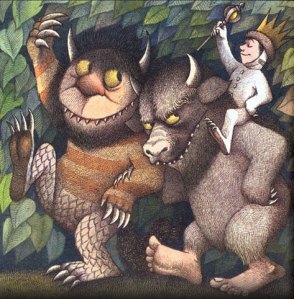
Sendak's Max starts the wild rumpus. While Jonze took many liberties with his adaptation, the original story remains in tact. A little boy is punished for being a “wild thing!” and escapes to a world in which being a wild thing is celebrated. After indulging his id for a while the boy decides to return to the place where “someone loved him best of all.”
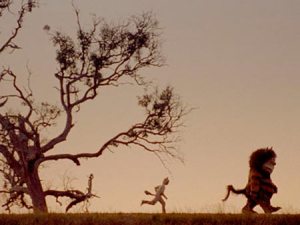
Jonze's Max rumpusing with Carol. Jonze’s film completely immerses us in the consciousness of a 9-year-old boy (Max Records): we listen as he composes imaginative stories for his mother while idly poking at the pantyhose on her toes and we experience how a child’s emotions can change in an instant from pure joy to pure pain during a raucous snowball fight. And this is just in the first 15 minutes of the movie.

Max surveys his kingdom. Once Max reaches the land of the wild things he is made king of all wild things and his first post-election promise is to “keep out all the sadness.” How does he does he achieve this impossible task? By initiating a “wild rumpus” through the woods, drafting plans for an elaborate fort — a place “where only the things you want to happen, would happen” — and by promising the beasts that every night they will sleep in a “real pile” (that is, in a giant snoring heap of wild things). Of course, Max soon learns that it is impossible to keep all of the wild things happy all of the time. Carol (James Gandolfini) is perpetually jealous, Judith (Catherine O’Hara) gives him way too much lip, and KW (Lauren Ambrose) insists on making friends (or are they captives?) outside of her small social circle. In other words, Max learns that he much prefers being a child. Let the adults worry about keeping everyone happy. Amen, Max.
For me, the emotional high point of the film was when Max boarded his boat to go home (a trip that lasts “night and day and in and out of weeks and almost over a year”). The wild things gather on the shore to say good-bye, looking forlorn and abandoned, as children do when a loved one departs. KW approaches Max, putting her face against his, and tells him, “Please don’t go. I’ll eat you up, I love you so.” That was always my favorite line of the book because it could easily come out of the mouth of a child or a parent. I often tell my daughter, when she is being particularly lovable, that I could “eat her up.” For me this is a gesture of love, but for her this is a frightening concept: to be consumed by the love of another. “Don’t eat me up!” she cries and then I have to assure her that I am only joking. But I’m not, really. I could eat her up. Along the same lines, when my daughter was younger she would occasionally bite me when giving me a big hug. Even children understand that love is the overwhelming desire to consume the beloved.
A columnist for Entertainment Weekly, Christine Spines, took her 5-year-old and 15-year-old sons to see the film and wrote about her experiences. Apparently, the 5-year-old “loved” it. But I still see this as a movie for adults, not for kids. Kids don’t need to see Where the Wild Things Are because they are living Max’s life right now. Children know well what it is to run and jump with no purpose other than the joy of running of jumping. Children are capable of imagining entire worlds for themselves in which they are the king. And children understand that adults have a responsibility to take care of them and to love them, even when they are acting most like a wild thing. Adults, on the other hand, need to be reminded of these departed joys. This movie filled me with both longing and happiness. This movie is not for my daughter. This movie is for me. Thanks Spike.
BORED TO DEATH: Why It’s My Favorite New Show
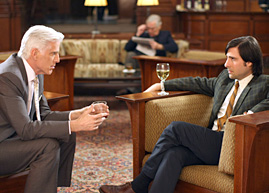
I first started watching Bored to Death because I was desperate to fill the “quirky film noir” void in my TV diet since Veronica Mars went off the air in 2007. And the pilot episode seemed to be headed in that vein: we meet a frustrated novelist named Jonathan Ames (Jason Schwartzman) just as his girlfriend, Suzanne (Olivia Thirlby), is moving out. She is tired of his drinking, his pot smoking and his overall immaturity. Jonathan confirms Suzanne’s decision when they meet for coffee in a later episode and he is only able to articulate why he misses her in terms of concrete material needs: “I’m living like an animal. I have no toilet paper, no food, no toothpaste.”
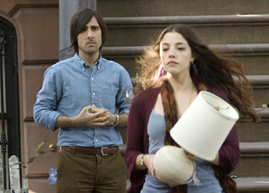
Jonathan’s solution to his heartache and his writer’s block (he cannot write his second novel) is to moonlight as a private detective (he gets the idea after reading some Raymond Chandler). What follows is a series of anti-noir cliches. As Jonathan stakes out his first case we see him standing in the rain in the moonlight, his childish bowlcut dripping onto his khaki trench coat. When he goes to a bar to pump the bartender for information he orders a whisky and promptly chokes on it. “I’m on a white wine regimine,” he explains. And he ends up spending more money on bribing people for information than he makes on his first case. No, Jonanthan is not Sam Spade.
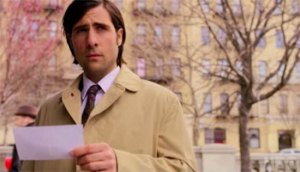
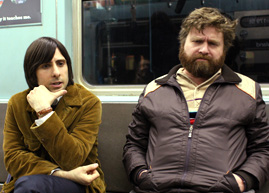
However, after the pilot the series shifted genres. It became less about noir and more about Jonathan and his best friends Ray (Zach Galifianakis), a whiny, infantile comic book artist, and George (Ted Danson), the equally whiny and infantile editor-in-chief of an unnamed New York magazine. In HBO shows about male friendship, like Entourage, there is a clear alpha male (Vincent Chase) and a clear buffoon (Johnny Drama) but no so here. The three male leads in Bored to Death are each buffoonish in their own way. And although Jonathan’s neurotic Jewish character invites comparisons to Curb Your Enthusiasm’s Larry David, or even further back, to Woody Allen in Manhattan (1979) or Annie Hall (1977), he is somehow more…likeable. Yes he is selfish and self absorbed but it is also clear that he is kind and even moral. After Ray is bullied into getting a colonic and must endure a long subway ride home, Jonathan seems genuinely concerned, offering to massage his friend’s shoulders. Sure, he’s stoned at the time, but he cares…about his friend’s colon.
As for the women in the series, well, the women aren’t all that important. Or maybe it’s that they’re too important? Jonathan pines for his ex-girlfriend Suzanne, Ray is nagged by current girlfriend Leah (Heather Burns), and George moves from one young conquest to the next (his current fetish is armpit hair). For these men women provide pain, torment and delight, but ultimately these men seek out the company of other men. This is certainly a recipe for misogyny and for stereotyped female characters, but this doesn’t happen in Bored to Death. Rather, women are a force to be reckoned with: they are inscrutable, independent and appear to function perfectly well without men (except when they need to borrow some sperm). There’s a running joke in the series in which Jonathan and Ray find themselves tripping over trendy baby strollers whenever they want to kvetch together in their favorite coffee shop. By the time they reach their thirties, many men have started families, so for Jonathan and Ray these strollers are a threat, a mystery, a symbol of the responsibility they cannot take on. Indeed, Ray complains that Leah’s children have no respect for him. “They call me fat. And hairy,” he complains. And he is. In this show the men are the problem, not the women.
So far the reviews for this new show have been tepid. The word “precious” and “self indulgent” have been bandied about. But I don’t see Bored to Death as a Curb-derivative or as a “low-stakes version of Woody Allen’s Manhattan Murder Mystery“. Larry David and Woody Allen are so eccentric, so enveloped in their own worlds, that I find them difficult to relate to (and isn’t that part of their appeal?). Here’s the thing: I do find Jonathan relatable. As one of those “responsible adults” with the baby stroller in the coffee shop I understand and empathize with Jonathan. He’d like to be like me: write his novel, help his ex-girlfriend shop for toilet paper and stop smoking so much pot. But, sometimes I’d like to be like him: to play at being a private detective and have a glass of white wine while standing in the rain in my khaki trench coat.
So am I the only one who loves this show? Share your thoughts below.
An Open Letter to MTV from Lauren Conrad

Hi MTV.
It’s me, Lauren Conrad. MTV, we really need to talk.
MTV, we’ve had some good times together. Remember Laguna Beach? Remember how I pined and cried over silly old Stephen Colletti? That was before he started dating that midget from the acne commercials and that nerd show that nobody watches anymore. Then he got dumped and that was awesome. But I digress…
MTV, I was so good at crying about Stephen that you gave me my own show. You even let me change my name from “L.C.” to “Lauren.” Then you scored me a sweet internship at Teen Vogue, even though I was totally incompetent, and paid the rent on an apartment that was too luxe for a young girl just starting out in Los Angeles. Yes, you gave me so many things MTV, and I paid you back. I paid you back with my tears. I cried in taxicabs and I cried on rented yachts. I cried in Les Deux and I cried in Hyde. I cried in public and I cried in private.
Crying over Jason:

Crying over Heidi:

Heidi again:

Crying over Audrina:

F**ing Audrina again:

Crying on my birthday:

Not sure about this one. I think I was just really drunk:

But a girl can’t cry forever, MTV. It was time for me to move on. I had books to write and low end fashion to design.
So when I decided to leave The Hills last spring I thought you guys would do what was right. I thought you would end the show. But not only did you keep the show going, you replaced me (replaced me) with my arch nemesis, my mortal enemy, Kristin Cavallari.
Nothing hurt me more than watching the opening credits to the season 6 premiere of The Hills last week. Instead of seeing me, Lauren Conrad, driving in my convertible with the the California wind blowing through my hair, there was Kristin Cavallari. In my opening credits sequence! That was a real “fuck you” MTV. Don’t you know anything about the girl code? You’re supposed to be my friend, MTV.



Watching the first two episodes, it’s like I never even existed. There’s this big Lauren-shaped, tear-free hole in the show and MTV, and no matter how many skanks you hire, you can never fill that emptiness.
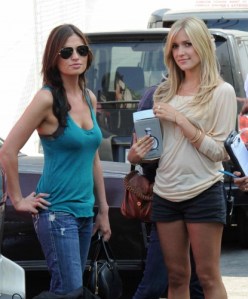
And to choose Kristin! You think Kristin will give you tears? Kristin can’t cry. And even if she could, she certainly doesn’t wear enough mascara to make her tears nice and black like mine are. Who else is going to give you inky black tears, MTV?
Heed my words, MTV: First Kristin Cavallari came for my opening credits, then she came for Audrina’s motorcycle helmet. Well, MTV, one day Kristin Cavallari is going to come for you. And I won’t shed a single black tear.

Lauren.
P.S. Look for my new line, L.C. by Lauren Conrad, on sale now at Kohls!!!
THE BERMUDA DEPTHS: One Cinephile’s Movie Memories Finally Reach the Surface
Randall Martoccia has graciously agreed to write the first guest post ever for Judgmental Observer. Having a guest writer makes me feel important, like I’m too busy to write for my own blog. So while my servant boys feed me grapes and massage my feet please enjoy this guest post:
Thanks to Amanda for letting me guest write. I’m sure the rest of you will appreciate the break from the usual insight on this web site. Intelligent ideas can be so daunting.

This tale begins in the late 1970s. I was 7 years old, scared of girls, and infatuated with sea creatures. My parents, either through a desire to encourage my passion or due to negligence, let me see any marine-related movie, even though these tended to be thrillers. They took me to Jaws (1975, Steven Spielberg) (when I was 6-freakin’-years old), and then to Orca (1977, Michael Anderson) and Tentacles (1977, Ovidio G. Assonitis).


When I was 8 years old, my parents let my brother and me stay up late to watch another one of these creature features that followed in Jaws’s wake. This one was a network TV movie. A scene in which the turtle rises up and swamps a boat is pretty much all I remembered—and all that are left of that scene are fragments: A boat in rough seas. An ominous sky. A seven-story-tall, pissed off turtle.

Over the ensuing three decades, the patchy memory of the turtle kept coming back to me, but I had come to wonder if the scene was from a movie or a recurring dream. My memory never really nagged me so much for me to look into it. Any impulses to identify the movie were swept away by the usual business of life—or my lame version of it.
About two years ago, for one reason or another, I decided to find out for sure about this movie. Blessed be Google—it only took about ten minutes to find with the key words “giant sea turtle TV movie.”

It turns out the movie exists. It’s called The Bermuda Depths, directed by Tsugunobu Kotani and starring Connie Selleca and Carl Weathers. What is astonishing about the movie is the odd community that has formed around it. Here are some typical posts on the movie’s IMDB discussion board:
From yihaa2: Wow. I’m not crazy, it is a real movie, after 25 haunted years of dreams and fragmented memories, I really wasn’t imagining it.
From lilbearlovr: I had the same problem since I was a little kid. I was beginning to wonder if it was just some silly little kid dream.
From barbiegrrl: I have been telling people for years about the fragmented memories I had of seeing this movie as a kid, and no one ever knew what in the heck I was talking about!
From lamsaes: This is extraordinary. I thought I was the only one to remember this film. I saw it on TV when I was just a little kid. For a very long time, I thought I had imagined this film.
From traceymermaid: Holy smokes. Is this coincidence that so many of us are not only remembering this movie but are also taking action, such as writing on this message board? Maybe it is a symbol of something.
From Demarkov-1: My own experience with this movie is so similar to all of you…this is incredibly creepy and wonderfully comforting.
From newtondkc-1: Wow…so I’m not the only one in the world that remembers this flick…. I remember seeing this and I too was scared but strangely drawn to it. I remember the girl with the glowing eyes standing on a boat – I think she came out of the water? And the kids on the beach, carving their initials into the poor turtle’s shell – and then seeing the distorted initials on the back of the fully, fully grown giant turtle as well as a guy caught in the net that the turle was dragging into the depths.
Strangely enough, I have no memory of the oft-referenced girl with glowing eyes, but she would explain my fear of girls.

Michael Summers compares the Bermuda Depths phenomenon to the shared vision of Devil’s Tower in Close Encounters of the Third Kind (1977, Steven Spielberg), and I do wonder how many of you–like the skeptics in Close Encounters–are thinking that the authors of those posts and this blog entry are, well, nuts.

But I doubt all of you think this. While I was doing my sea-turtle research and reading The Bermuda Depths’ posts, my wife Christie (I got over my fear of women—or most of them) piped up and said that she had a similar experience with a different movie, making me think that this kind of experience was fairly common. I’m willing to bet that many of you—being movie junkies, scholars, or makers—have your own version of a giant sea turtle haunting you.
By the way, Christie’s fragmentary memory was of a short called “All Summer in a Day,” based on a Ray Bradbury story, which left her with little more than a image of the sweep of the sun’s ray under a closed door. But that image stayed with her for more than two decades.

Do you have your own haunting movie or television experience? An image fragment that you can’t shake? If you share them below, then perhaps I can help you to identify your movie or to discover a community of like-minded inviduals. Or, if you prefer, you can just call me “nuts.” With lilbearlvr, yihaa2, and barbiegrrl getting my back, I feel secure.
About the Author: When Randall Martoccia isn’t grading stacks of freshman papers he writes screenplays and makes short films. His “Pub of the Living Dead” and “They Shoot Zombies, Don’t They?” can be found on YouTube—though (alas) few people have found them. You can checkout his faculty profile here and you can e-mail him at: MARTOCCIAR@ecu.edu.
Shopping in the City: Recap of THE CITY Premiere

Since the earliest days of moving pictures the cinema screen has functioned, whether intentionally or not, as a department store window. In his essay “Carole Lombard in Macy’s Window,” Charles Eckert writes:
The short dramas and comedies of the first decade of this century, especially those that pictured the contemporary lifestyles of the middle and upper classes, presented innumerable opportunities for product and brand name tie-ins. But more than this, they functioned as living display windows for all that they contained; windows that were occupied by marvelous mannequins and swathed in a fetish-inducing ambiance of music and emotion. (103)
This tradition continues on with television. Hordes of young women (this author included) got the “Rachel” haircut in the mid-1990s in order to emulate the famous tresses of Jennifer Aniston’s character on Friends. And, as Elizabeth Affuso has discussed, MTV programs like The Hills offer a “comprehensive lifestyle brand for viewers.” However, viewers need not speculate about where the girls are buying their clothes or enjoying their cocktails. Affuso explains that “the show enables participation by labeling all of its locations onscreen, so viewers can easily tell where the women are eating, shopping, or partying, providing all the information necessary to replicate this experience if desired.” MTV has a vested interest in identifying these spaces of consumption since it has corporate partnerships with entities like Teen Vogue, Bolthouse Productions, and Epic Records, all of which are featured on the show in some form. Clever indeed.

The City partakes in this tradition, though I would argue that the show functions less as a commercial for specific clothing items, musical groups and eateries than it does as a “look book” of contemporary fashions, as a style to model. As many have noted, Whitney Port, the “star” of The City is a dull heroine (this is not a criticism, by the way — in the world of reality TV the “boring” characters are usually the most normal, mentally-stable characters). As a result, the plotlines on the show are fairly dull as well. I never felt invested in Whitney’s romantic entanglements — they feel even more forced than those on The Hills (which is really saying something). For example, in the premiere episode of Season 2, Roxy Olin, a new addition to the cast who really really wants us to think of her as “the bitch” asks to crash at Whitney’s apartment until she gets her bearings in NYC. See, Roxy doesn’t know anyone in the city. Yet, miraculously, Roxy is able to throw a massive party in Whitney’s apartment a few days later. Huh? And when Whitney returns home to see the mass of revelers in her apartment she can barely suppress her smirk as she “reprimands” Roxy. Didn’t Roxy remember that Whitney was recently issued a citation for having her music up too loud? That she capped the guest list at 10 people? Oh, Roxy remembered all right — so did the show’s writers. It’s like they’re not even trying anymore.

That’s why the real allure of The City is its aesthetics. It is fashion pornography. Scenes in The City frequently open with establishing shots of decadent decors and expensive consumer items, generating desire on the part of the viewer. The difference, however, between The Hills and The City, is that the latter blatantly fetishizes fashion as opposed to commodities in general. Fashion calls attention to itself — when Whitney and Olivia are choosing the right “look” for Jessica Alba’s Elle cover shoot or when one character calls attention to another’s fashion choices. In this week’s episode Kelly Cutrone points out that Whitney looks great in her outfit (and she does).

One of my favorite fashion fetish moments came in the last shot of the Season 1 finale, dramatically titled “I Lost Myself in Us,” just after Whitney decides to end her fake relationship with her fake boyfriend Jay Lyon. As she enters the doors of Diane von Fürstenberg’s store, a visual rendering of her decision to choose a career over love, we are given a close up of her purple, high heeled booties. It is significant that we do not see Whitney’s face here — what is most important are these shoes, rather than Whitney’s emotional state. This moment seems to be saying, who needs a man when you can wear these fabulous purple booties? Hell, I might leave my husband for those booties…

Of course, there is some fashion on the show that confuses me. First, there’s Kelly Cutrone, founder of People’s Revolution, which is not an actual revolution of the people, but a PR firm. Because a lot of Kelly’s job entails producing fashion shows and fashion shoots one can assume that she spends her days surrounded by beautiful pieces of couture, stylish models, and some of the most talented hair and make up people in New York. And yet, Kelly looks like shit. Come on, people, you know it’s true. I get that Kelly must wear black every day to match her coal black heart, but must she wear shapeless black crew neck shirts? And would it kill her to brush her hair? Or put on some blush? To go out into the sunlight? Has anyone told Kelly that she’s on TV? A lot?
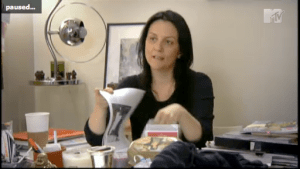
And then there’s Olivia Palermo, “noted socialite” and daughter of real estate developer Douglas Palermo. Olivia is filthy rich and unsuprisingly, a horrible bitch. And according to her wikipedia entry, Olivia is “noted for her sense of style.” Wha??? Methinks Ms. Palermo is penning her own wikipedia entries.
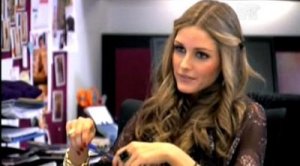
I can almost forgive Kelly for looking like shit because clearly, Kelly doesn’t give a damn. But Olivia? Olivia cares very deeply about her appearance. This is evident in her 10 plus layers of make up and her carefully curled hair. That is exactly how I would do my hair and make up … when I was 13.
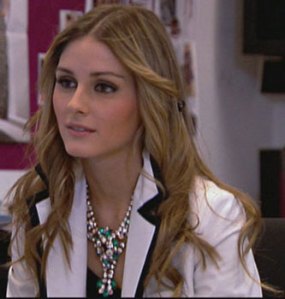
And then there’s her clothes. I have seen photos of Olivia online in which she actually dresses like a stylish woman in her early 20s. But on The City Olivia dresses like one of those “real housewives” from Bravo. Blazers, costume jewelry and SO MUCH BLUSH. Blech. Don’t get me wrong, Olivia would look stunning in a paper sack — she is a beautiful young girl. But I am mystified by the fact that she works in the world of cutting edge fashion but dresses like the old yentas at the country club. Someone get this woman her gimlet!

So, what do you think? Is Olivia’s “sense of style” just way too hip for provincial old me? Will she and Roxy end up mud wrestling in the season finale? Is Kelly Cutrone actually a vampire (the non-sparkling kind)? Discuss…
Works Cited
Affuso, Elizabeth. “ ‘Don’t just watch it, live it’ — technology, corporate partnerships and The Hills.” Jump Cut 51. http://www.ejumpcut.org.
Eckert, Charles. “Carole Lombard in Macy’s Window.” Fabrications: Costume and the Female Body. Eds. Jane Gaines and Charlotte Herzog. New York: Routledge, 1990. 100-121.
THE HILLS Premiere: Viva la Spectacle!
“Media stars are spectacular representations of living human beings, distilling the essence of the spectacle’s banality into images of possible roles.”
-Guy DeBord, Society of the Spectacle
“I’m more famous than president Barack Obama. I’ll say that to President Obama’s face. My portrait is higher than his on the wall at Wolfgang Puck’s Cut restaurant. That’s such a statement. Spencer Pratt is above the President of the United States in fame. No matter what I say or do from here on out, I’ve imprinted myself on the culture. Ask somebody why I’m famous, they’ll say I’m annoying or have a big mouth, but there’s no tangible thing.”
-Spencer Pratt, interview in Spin Magazine Online

I am well out of MTV’s target demographic. I am not a consumer of the bands featured on the show (or its accompanying soundtrack), nor do I plan to party at Les Deux any time soon. I don’t want a career in fashion or public relations or whatever it is that Audrina Patridge does. And truly, I care very little about The Hills’ young, overprivileged, spray-tanned cast. I do however, read a lot of gossip magazines and I even read academic analyses of celebrity culture in my free time. In other words, I enjoy The Hills for the same reason that I enjoy films like Glen or Glenda? or The Room — I love how the text of the show constantly pushes me beyond the frame, to the extratextual. I can never see an episode of The Hills as a self-contained world. I am constantly thinking about the casts’ lives outside of the show — who they’re dating, how much they’re making and whether or not they still have that pesky eating disorder.

The young cast of The Hills is a regular feature in tabloid magazines like US Weekly, In Touch and OK!. They are also featured on celebrity gossip websites like PerezHilton.com and The Superficial. Fans who enjoy the “stars” of The Hills can also buy their clothing, listen to their music and read their novels.
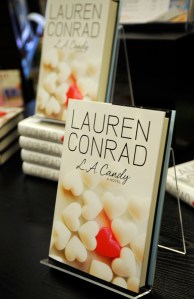
This kind of “multiplatform” engagement with the text is an ideal way to target Generation Y (aka, MTV’s prime demographic), who enjoys consuming their entertainment through multiple venues. This type of engagement also leads to a peculiar viewing experience. As I have written elsewhere, The Hills’ “media savvy audience is likely aware of the characters’ offscreen lives and yet they continue to tune in (in record numbers) to see what transpires onscreen each week.” Viewers tune in to see these characters, rather than to see “what happens next.” For example, I did not need to watch last night’s Hills’ premiere, subtly entitled “It’s On Bitch,” to know that Audrina and Kristin would butt heads — I read all about their growing animosity in last week’s US Weekly. I also love knowing that the only reason Kristin Cavallari is back on reality TV is because her attempts at a film career tanked. No wonder she’s such a bitch. The Hills’ multiplatform structure almost demands that its viewers consider the extratextual. It is central to The Hills experience.

Of course, the most entertaining personalities on the show are Heidi Montag and Spencer Pratt (aka, Speidi), a couple for whom the term “fameosexual” must have been invented. Unlike their co-stars on The Hills , Speidi is fascinating precisely because it is almost impossible to locate where their textual personas end and their extratextual lives begin. While castmates like Lauren Conrad and Lo Bosworth have been caught by the paparazzi’s lens sans make up or biting into a greasy hamburger, Speidi seems to have the preternatural ability to avoid being taken by surprise. Every single paparazzi image of the couple is staged, as if they were able to construct a special fantasy world around themselves — a life-size Barbie dreamhouse that includes shopping at Kitson and going to brunch.


Spencer and Heidi exist in a constant state of performance before an ever-present camera. I imagine Heidi getting into bed at night — in full make up, hair freshly blown out — and turning on a video camera that is mounted to her ceiling. Indeed, their entire life appears in quotation marks: Spencer and Heidi go “golfing,” Spencer and Heidi “shop for toys,” Spencer and Heidi “breathe.” This couple, and the world of The Hills in general, seems to be the emodiment of Guy DeBord’s thesis in Society of the Spectacle (1967) (and I am sure that somewhere a graduate student has already written this paper). DeBord writes “Understood on its own terms, the spectacle proclaims the predominance of appearances and asserts that all human life, which is to say all social life, is mere appearance.” Perhaps its is for the best that DeBord did not live to see the rise of The Hills.
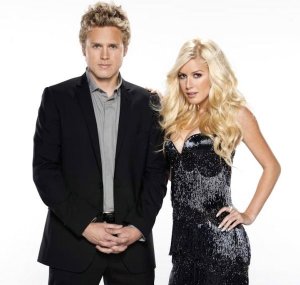
I do not say these things to spite Spencer and Heidi. In fact, if Speidi read this blog post, my guess is that they would agree with everything I’ve just written. In a recent interview, Pratt explained “Heidi and I got married on the show. You know as much about us as anyone. We tell people everything. No one is more honest than Spencer and Heidi.” The thing is, I believe Spencer. I believe that I know as much about his life as Heidi does. I believe that if we took their clothes off we would discover smooth, plastic, genital-free bodies with a “Made in Los Angeles” stamp. And for this I salute them. Long live the Spectacle!
A few other thoughts about The Hills premiere:
1. I love that Lo, once referenced in her onscreen title as “Lauren’s friend,” is now labeled as “Audrina’s friend.” Isn’t Lo important enough to just be “LO”? And more importantly, don’t Lo and Audrina hate each other?
2. Did anyone get a little creeped out when the recap segment at the beginning of the episode featured Kristin’s voice over narration, rather than Lauren’s? It felt dirty somehow, like I was cheating on Lauren.
3. Finally, although I have never been a fan of Kristin, I was definitely enjoying her in the premiere. Moments after her first cat fight with Audrina and Stephanie my husband turned to me and said “This girl’s way more fun than Lauren!”
So, what do you think? Can the show go on without Lauren? Or will Lauren show up at some point this season, mascara streaming down her cheeks, telling the audience that we betrayed her? And if we all keep watching this show, will the world collapse in on itself?
UPDATE on “Is GLEE Racist/Heterosexist/Ableist?”
Have the writers for Glee been reading this blog? No, of course they haven’t. But I was still very pleased to see that Tina (Jenna Ushkowitz) got her big solo — West Side Story‘s “Tonight” — in last week’s episode, “Preggers.” There was a lot of talk about how Rachel (Lea Michele) has a better voice and really should have the solo, but Tina sang it nonetheless. A small victory for the show’s non-white characters.

And, of course, a lot of the episode was devoted to Kurt (Chris Colfer) and his strained relationship with his heteronormative father. I’m glad Kurt was a featured player and for the most part, I thought his story arc was intelligently rendered. Though, was it really necessary for Kurt to shimmy effeminately before making his game-winning kick? I’m still not sold on the show’s need to turn Kurt into Mr. Roper’s vision of the homosexual in every episode. However, the final scene between Kurt and his father, Burt (Mike O’Malley), when we learn that Kurt’s mother has been dead for many years and that Kurt’s father has always known that he was gay was very moving. I imagined these two men figuring out how to negotiate their complicated relationship in the absence of the mediating mother/wife figure and I did get a little weepy.
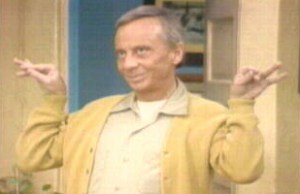
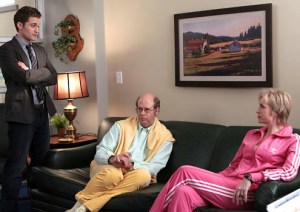
One final note about “Preggers”: every time Sandy (Stephen Tobolowsky) appears on screen in a pair of pastel pants and a turtle-stitched belt, I laugh out loud. The show should get a costuming Emmy based on this character alone.
Excess, Badtruth and the Extratextual in GLEN OR GLENDA
“Let us not mince words. The marvellous is always beautiful, anything marvellous is beautiful, in fact only the marvellous is beautiful.”
–Surrealist Manifesto (1924)
“Badness appreciation is the most acquired taste, the most refined”
-fan of paracinema (qtd. in Sconce 109)
In “Trashing the Academy: Taste, excess and an emerging politics of cinematic style” (1995), one of the first attempts to theorize cult cinema within the academy, Jeffrey Sconce defines “paracinema” as “less a distinct group of films than a particular reading protocol, a counter-aesthetic turned subcultural sensibility devoted to all manner of cultural detritus. In short, the explicit manifesto of paracinematic culture is to valorize all forms of cinematic ‘trash’, whether such films have been either explicitly rejected or simply ignored by legitimate film culture” (101). In an earlier post I discussed how I would be using precisely these kinds of texts in my Trash Cinema course.
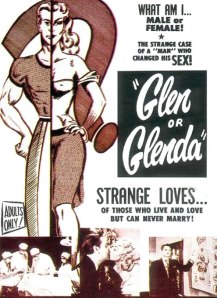
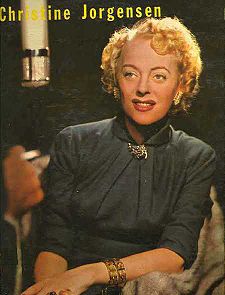
This week my students watched and discussed one prime example of paracinema, Edward D. Wood Jr’s Glen or Glenda? (1953). Glen or Glenda (which has also played under the more sensational title I Changed My Sex) originated as a documentary about the life of one of the first highly publicized transsexuals, Christine Jorgensen, but the film quickly morphed into an odd, often dreamlike self portrait of the director, who was fond of wearing women’s clothing (particularly angora sweaters).
When watching Glen or Glenda? it is vital to know such extratextual details. For example, this knowledge explains Wood’s passionate defense of crossdressing (at a time when men who crossdressed in public were frequently arrested and/or beaten) and his frequent, emphatic claims that the film’s crossdressing protagonist, Glen (played by the director) is NOT a homosexual. At these moments the film becomes Wood’s plea to be understood and embraced by a society bent on rigid gender codification. Indeed, as Sconce points out, paracinematic texts often push the viewer beyond the boundaries of the cinematic frame, demanding that we account for the profilmic.
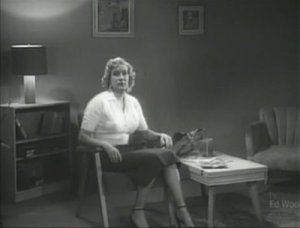
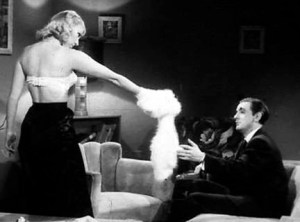
The moments that pull the viewer out of the fantasy of the text, pointing them to extratextual, are often identified by fans of paracinema as instances of “badtruth”: “As with the [Surrealist concept of the] marvellous, the badtruth as a nodal point of paracinematic style, provides a defamiliarized view of the world by merging the transcendentally weird and the catastrophically awful” (Sconce 112). For example, Bela Lugosi’s role in Glen or Glenda? — a mix between a God figure, a mad scientist, and Glen’s subconscious — is strange and distracting and therefore a primary example of “badtruth.”
The above scene only becomes tolerable (and even pleasurable) when we know that Lugosi was, at this point in his career, a fallen star, desperate for money to support his debilitating morphine addiction. Wood was a huge Lugosi fan and could not believe his luck when Lugosi agreed to star in his film. Despite Wood’s enthusiasm (and one can never doubt Wood’s enthusiasm), he clearly had difficulty fully integrating Lugosi into his crossdressing/sex change film. One of my students even asked “Did Lugosi even know that he was making a film?” These moments of badtruth, when Lugosi plods through nonsensical lines like “Beware of the big green dragon that sits on your doorstep. He eats little boys,” point us to the extratextual, and the extratextual, in turn, contextualizes, even rationalizes, the film’s badtruth. This is the circuitous logic of paracinema and one of its primary pleasures.
The obviously doctored newspaper: a great moment of badtruth in Glen or Glenda?
Unfortunately, the majority of my students did not see it this way. They described the movie as “too long” (the version we watched was just 68 minutes long), “exhausting” and “annoying.” Our discussion of what many cinephiles consider to be the “worst film ever made” naturally led us back to The Room, with my students claiming that the latter was far more enjoyable. As one student put it “Both films were poorly made but at least The Room didn’t preach to the viewer.” Apparently, badtruth on its own is pleasurable, but badtruth mixed with a political agenda is not.
Despite my students’ less than enthusiastic response to Glen or Glenda?, I will continue to screen it in the classroom (it holds a regular spot on my Introduction to Film Studies syllabus). As a fan of paracinema I delight in the way the film constantly pushes me past the frame, to think about its production history, its stars and its now iconic director. But maybe Tim Burton and I are alone on this one? At least I’m in good company…
Scene from Ed Wood (1994, Tim Burton)
Why I’m Still Watching SURVIVOR (And Why You Should Too)
A few months ago I was having a conversation with my brother and made a reference to Survivor, one of the first television programs to merge the conventions of reality television with those of the games how. “You’re STILL watching Survivor?” he asked, clearly incredulous. Though most of my other reality TV affairs have come and gone (America’s Next Top Model, Hell’s Kitchen, The Bachelor), I still find myself tuning into Survivor each season.
The success of so many reality shows today are fueled by our enjoyment of the schadenfreude that comes from knowing that we would most certainly never defecate on the floor in front of a group of people while wearing a formal gown (no matter how badly we had to go) or puke into our hands at the dinner table, the way contestants on the dating shows Flavor of Love and Rock of Love , respectively, have done. That’s because in these and in other shows (Nanny 911, The Real World, Bad Girls Club, to name just a few) the viewer is positioned above the cast member. Producers are banking on our elitism and disdain.


Likewise, shows such as So You Think You Can Dance , Project Runway and Top Chef, position the viewers below the cast members. With these shows we lift our eyes to marvel and envy the innate and cultivated talents of the contestants, knowing that we could never achieve that same level of skill. As one Top Chef contestant, Dale, put it a few seasons ago, “You sit on the couch watching the show and be like [sic] ‘Oh I could do that shit.’ Um, well you know what? Most of you? You can’t. ‘Cause it’s really fucking hard.” Dale may not win a spot on the newest season of America’s Next Top Grammarian but he does make a good point. The average viewer cannot whip up an artful amuse bouche in 5 minutes using only items pillaged from a convenience store. But the great thing about Survivor is that it showcases ordinary people — people just like you and me — pushing themselves to do extraordinary things.
Here are a few other reasons why I tune in season after season:
1. The Man
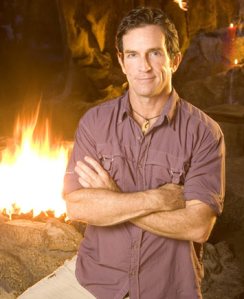
Jeff Probst is, in my opinion, the best game show host of all time. His detailed play by play commentaries during reward and immunity challenges are always informative and often funny. And during tribal council he has the uncanny ability to ask exactly the questions we were hoping he’d ask. He can put contestants on the spot — by challenging their circuitous logic or by bringing up an issue he knows they do not want to address — and somehow not come off as exploitative or mean-spirited. Probst IS Survivor.
2. The Premise
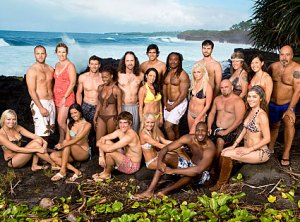
After 19 seasons, Survivor is still great because it is built on a brilliant premise: take a group of average Americans (with the occasional super-athlete or former member of the military occasionally tossed in) and put them on a desert island for 39 days. Require these people, many of whom have never even been camping, to build their own shelter and forage for their own food (sometimes the show’s producers give them rice and beans to start the game and sometimes they don’t even give them flint to make fire). When the contestants weak from hunger, thirst and lack of sleep, force them to compete in grueling physical challenges. And the amazing thing? Even with all of this to worry about, when their legs are covered in rashes and spider bites and their clothes are brown and brittle, these people still find ways to strategize, strategize, strategize.
3. The Hunger
Watching a video of a malnourished family compete for their dinner would be horrifying and even sickening. But watching people who have chosen to place themselves in extreme living conditions compete for their dinner is completely engrossing. I love watching a prim Southern belle eat grubs from under a rock for “protein” or a large, muscled man make do with a few bites of rice. Nothing will match the joy I felt back in season two when Elisabeth Hasselbeck (then known as Elizabeth Filarski) pulled out a clump of her own hair, a side effect of malnutrition. “She really is starving!” I said to myself with glee. This is sick, I know.

4. The Challenges
The reward and immunity challenges alternate between physical and mental competitions, but they are always difficult and intricate. Contestants have to dig holes and shimmy through them, dive under water to unlock treasure chests, assemble puzzle pieces to build ladders. Even the simplest challenges — such as having contestants perch on top of a tiny ledge to see who can stay there the longest — are endlessly fascinating.

True there have been some weak seasons (Survivor: Palau) and weak premises (breaking down the tribes by race?) but on the whole Survivor remains a consistently satisfying reality TV powerhouse. So while the premiere of Survivor: Samoa was down 22% from last year, I for one will continue to watch.
- ← Previous
- 1
- 2
- 3
- 4
- Next →
 judgmental observer